

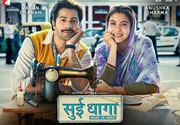
Sui Dhaaga
Synopsis:
Honestly, let's back up for a second because Sui Dhaaga isn't some high-fashion runway flick, it's actually one of those grounded bollywood movies about everyday people trying to survive.
Varun plays Mauji and Anushka Sharma plays Mamta, and they're just two married folks living in a cramped house with Mauji's deeply annoying, coughing father played by Raghuvir Yadav who treats Mauji like an absolute punching bag.
Mauji works at a local shop where he literally has to act like a dog and bark for his boss's amusement just to earn a tiny paycheck, and it's so painful to watch that you just want to throw something at the screen.
Mamta sees all this humiliation happening and she gets sick of it, telling him to quit his soul-crushing job because sab badhiya hai isn't cutting it anymore.
And then boom, they decide to start their own local tailoring business.
They don't have money.
They don't have space.
They literally just have a manual sewing machine and a dream, which is pretty much the ultimate plot fuel for any classic hindi films worth watching.
Let us just pause to talk about Mauji's weird yellow undershirt that he wears in like four different scenes, because nobody talks about how aggressively yellow that cotton fabric is under the harsh studio lights.
Anyway, they start stitching clothes at home, and things are looking up for a hot second until Mauji's dodgy cousin tricks them, steals their designs, and leaves them completely broke and sleeping on the floor of a damp railway station.
Stuff happens.
Enter the interval block right when they are at their lowest possible point, crying near a dusty train track while a totally random, upbeat romantic song plays out of nowhere because you can't have bollywood movies without musical numbers destroying the pacing.
After the break, they refuse to give up and start making eco-friendly garments with old artisans who got kicked out of the big factories, and they even manage to secure a spot in a major international fashion exhibition.
God, the final competition scene is super intense because their clothes get sabotaged at the last minute by the evil corporate competitors, but Mauji and Mamta quickly stitch together a stunning traditional outfit using raw unrefined fabric right on the spot.
The judges are blown away by the authentic craftsmanship, and when the winner is announced, Mauji and Mamta take the crown on stage together, laughing and crying while the rest of their family watches from the crowd with tears streaming down their faces.
Mauji hugs Mamta tightly on the exhibition stage as the camera pans up toward the cheering audience and the credits roll.
Mauji is wearing a sweater that has three different colors of wool in the sleeves because whoever spun it ran out halfway through the left cuff, and if I'm honest, that small wardrobe detail tells you more about how Sharat Katariya wants you to look at this movie than any press release ever could. We are back in the machinery of middle India where people count their small change twice before buying a cup of roadside tea, sweating under fluorescent bulbs in garment factories that smell of hot iron and damp cotton. Hindi films usually prefer to drape their working class in either glossy poverty or heroic squalor, but Sui Dhaaga takes a sideways step and finds something much more irritatingly real, which is the dull, grinding boredom of just trying to stay employed when your boss thinks shouting is a valid substitute for a promotion.
Varun Dhawan plays Mauji with his shoulders permanently hitched up toward his ears, carrying around a dog-like eagerness that makes you want to shake him until his teeth rattle. It is a performance stripped of the usual swagger that comes with a hundred million opening weekend box office receipts, trading all that easy movie star charm for a narrow-eyed, beaten-down shuffle. Anushka Sharma plays Mamta, his wife, who spends the first half hour of the running time looking like she swallowed a stone she cannot quite cough up, watching her husband dance like a literal dog for the local shopkeeper just so they can afford two chapatis and some dal. When Mauji gets ordered to crawl around the floor barking at a family gathering because his employer finds it funny, Dhawan plays the humiliation without any grand cinematic tragedy, just the greasy, flat acceptance of a man who knows his rent is due tomorrow. It is not a flashy choice and it gets uncomfortable to watch because the movie refuses to let you look away from the sheer, grinding indignity of it all, preferring to hold the medium shot for four extra seconds than any audience really needs.
Katariya directs with a kind of stubborn plainness that occasionally makes you wonder if anyone behind the camera watched any other movies before showing up on set. The editing cuts on awkward beats, leaving characters hanging mid-sentence while the camera pans lazily to a dripping tap or an old ceiling fan that sounds like it is about to shake itself right out of the plaster. Raghuvir Yadav pops up as the grandfather, shuffling around in a stained vest and complaining about his knees, and he is so effortlessly authentic that he makes everyone else on screen look like they are reading their lines off a teleprompter taped to a watermelon vendor's cart. The soundtrack keeps returning to this one jaunty, accordion-heavy folk theme whenever things look slightly hopeful, and after the fourth time it piped up during a sequence involving some industrial sewing needles, I wanted to throw a brick at the sound mixer.
There is a specific kind of middle-class anxiety that Bollywood movies usually avoid like a bad tooth, preferring to set their romances in Swiss chalets or sprawling Delhi farmhouses where nobody ever worries about the electricity bill. Sui Dhaaga treats the acquisition of a Usha sewing machine the way action movies treat the launch codes for a nuclear submarine, framing the rusted metal and the greasy pedal with a gravity that feels completely earned because the stakes are real enough to choke on. You watch these two characters build a small, fragile enterprise out of scraps and stubbornness, and it reminds me a bit of what Ken Loach does when he gets particularly grumpy about British labor laws, though with about twenty percent more dancing around a courtyard.
The script gets a bit wobbly when it tries to turn a local tailoring hustle into a David-versus-Goliath fashion competition against high-end design houses, leaning hard into the sort of populist speechifying that every Hindi movie apparently has tattooed in its contract. Nobody in real life stands up in the middle of a trade expo and delivers a thirty-second monologue about the dignity of manual labor without getting hauled off by security, but the film insists on going there anyway, blowing up a modest, quiet domestic drama into a loud, flag-waving commercial for self-reliance. It is a shame, because the smaller moments where Mamta and Mauji just sit on the floor measuring cloth with a frayed tape measure while the afternoon sun fades out are worth ten of those grand inspirational montages.
The cinematography by Anil Mehta stays stubbornly flat and honest, refusing to romanticize the grey concrete walls and the tangled heaps of polyester off-cuts that cover every surface of the characters' lives. Even when the narrative shifts toward its inevitable feel-good destination, the colors stay muddy and the lighting looks like it was borrowed from a government office in Noida, which keeps the whole enterprise from floating off into fairy-tale territory. Anushka Sharma has this one recurring tic where she adjusts the pallu of her sari before delivering a devastatingly practical suggestion, and it grounds the romantic arc in something far more durable than the usual slow-motion rain songs we usually get.
The film doesn't reinvent anything about how stories get told in this part of the world, and it doesn't need to, because its power comes entirely from the patience it grants to people who usually only exist in the background of a hero's origin story. When the credits finally roll over a montage of real artisans working in various damp workshops across the country, it feels less like a calculated emotional cue and more like a quiet nod to the people who actually built the shirts on our backs.