

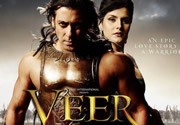
Veer
Synopsis:
There is a specific kind of leather harness worn by extras in historical epics that smells unmistakably of hot warehouse glue, and you can practically smell it radiating off the background cavalry during the first major charge in Veer. Salman Khan spent years dragging this passion project around like a heavy antique trunk he refused to leave in the attic, writing the story himself, pouring his own idiosyncratic ideas of 19th-century colonial rebellion into a script that feels less like a structured narrative and more like an elaborate diary entry written by someone who has watched too many old Westerns and history textbooks without reading either.
Director Anil Sharma has never been known for subtlety, opting instead for a sensory overload that makes subtlety look like a design flaw, throwing every single resource at the screen until the sheer volume of horses and dust does the heavy lifting for the drama. The screenplay lurches forward in great, clumsy bounds, ignoring temporal logic in favor of emotional set pieces that demand our total submission. If I'm honest, the pacing is just broken. It drags through endless romantic vignettes in the middle stretch before sprinting through the political treachery that supposedly motivates the entire plot. Scenes begin midway through conversations as if the editor was fighting a losing battle against the running time, chopping off dialogue exchanges before they can even establish why these people are shouting at each other across a dusty courtyard.
Salman strides through the chaos with his jaw permanently clenched, radiating an exhaustion that feels half-character choice and half-contractual obligation, treating every line delivery as if he is trying to remember where he parked his car. His Veer is meant to be a fierce Pindari warrior fighting British tyranny, but he plays him with the weary detachment of a man who has done this exact posture in ten other movies. Opposite him, Zarine Khan enters the frame looking like she stepped straight out of a glossy magazine advertisement for vintage fabrics, utterly terrified of the camera and entirely incapable of modulating her voice past a breathless whisper. Her performance is a blank slate onto which the audience is supposed to project grand romance, though she mostly just stands there blinking against the wind machine. Aryan Vaid pops up as the scheming rival, delivering his lines with a theatrical sneer that belongs in a much cheaper stage play, while Ashok Samarth and Bharat Dabholkar chew the scenery whenever they are allowed near a dialogue sheet.
There's a supporting actor near the back of the royal court scenes who is so clearly dubbed by someone with a completely different vocal timbre that every time he opens his mouth to warn the king about the British, you can hear a three-second delay between his jaw movement and the audio track, and it bugged me for the rest of the runtime. Bunny Anand gets a few moments to skulk around the edges of the frame, adding to the general sense that everyone involved is trying their best to fill out the background of a massive canvas with whatever props were available on the lot that Tuesday. Meanwhile, the cinematography by Nigel Willoughby tries desperately to make the studio-built Rajasthan deserts look like David Lean territory, bathing everything in an aggressive golden filter that turns human skin into marzipan and makes the night scenes look like they were lit by a car headlight parked just off-camera. Sajid-Wajid's soundtrack arrives with all the subtlety of a brass band falling down a marble staircase, hitting every emotional cue three seconds before it happens on screen so you never have to wonder whether you should feel sad or heroic.
Hindi films have long had a complicated relationship with historical revisionism, treating the past as a giant costume party where modern grievances can be settled with slow-motion sword fights and melodramatic speeches about national pride. Veer tries to wedge a personal father-son betrayal into the larger machinery of anti-colonial resistance, but the two ideas constantly fight for oxygen until the anti-British sentiment feels like an afterthought bolted onto a standard family feud. It occupies a strange space in the broader history of Bollywood movies, neither a modern blockbuster nor a traditional period piece, sitting awkwardly between genres like an expensive custom-built car with a lawnmower engine. Salman's physical presence carries the entire weight of the enterprise, and when he finally surrenders to the demands of the tragedy in the third act, you can see the precise moment where the film stops pretending it was ever about history and simply gives itself over to pure star worship. It is a loud, messy, often baffling artifact of a star at the absolute peak of his commercial dominance trying to write his own mythos into the very fabric of Indian cinema.