

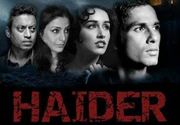
Haider
Synopsis:
Shahid Kapoor is standing in a dusty graveyard screaming bismil at the top of his lungs while feathers are flying everywhere and people are shooting guns and dancing in red outfits and honestly it's wild that this happens right after a guy's entire life just collapsed.
So then to understand why everyone is crying and dancing in the snow we gotta go back to the start of this whole mess because Haider is Vishal Bhardwaj taking Shakespeare and throwing it straight into 1990s Kashmir during the peak of the insurgency.
Dr. Hilal Meer played by Narendra Jha operates on a militant and gets his house blown up by the Indian army for harboring terrorists and then he just vanishes off the face of the earth, leaving behind his sad wife Ghazala played by Tabu and his son Haider who is studying poetry in Aligarh.
Right after that Haider comes home to Kashmir looking for his dad and finds his mom acting way too cozy with his sleazy uncle Khurram played by Kay Kay Menon, who is always wearing these little wire-rimmed glasses and smiling like he knows a secret about where the body is buried.
The funny thing is before any of the heavy political drama gets too depressing we have to sit through Bismil because bollywood movies love a good song number even when the protagonist is actively losing his mind over his missing father.
Anyway Shahid is wearing this amazing grungy oversized grey sweater with a hood that he pulls down over his eyes while walking through rain-slicked streets and dodging soldiers and looking utterly exhausted throughout the entire runtime.
Then Roohdaar shows up out of nowhere played by Irrfan Khan with a long coat and a limp and a cigarette dangling from his lip, and he pulls Haider aside in a ruined brick building to drop the absolute worst news possible.
Roohdaar explains that he was locked up in a torture cell with Dr. Hilal Meer and that Khurram actually betrayed his own brother to the army and shot him, which shatters whatever sanity Haider had left.
This brings us right up to the interval block which is such a classic staple of hindi movies where everything stops on a massive cliffhanger just as the hero learns his uncle is a total snake.
Arshia played by Shraddha Kapoor tries to keep Haider grounded because she's his childhood sweet-talker and she's a journalist's daughter played by Lalit Parimoo who gets caught in the crossfire and dies a really stupid death in a narrow alleyway.
So then Arshia's brother Salman gets mad and picks a fight with Haider and they have this brutal showdown in a cemetery where Haider ends up killing Salman and digging another grave for the pile.
Arshia loses her mind completely after finding out her dad and brother are both dead, and she's just walking around handing out plastic flowers and singing nursery rhymes until she slips off a bridge and drowns in the freezing river.
Khurram and his goons try to trap Haider in a snowy valley for the grand finale because hindi films always need a snowy showdown to cap off a tragedy.
Ghazala realizes too late what a monster Khurram is and she walks out onto the battlefield wearing a bridal red veil packed with explosives and detonates herself right in front of Khurram to blow up his entire operation.
Haider walks up to a bleeding Khurram who is begging for mercy in the snow and remembers his father's final warning about revenge breeding only more revenge.
He drops his gun, turns his back on his uncle, and walks away into the falling snow.
Shahid Kapoor looks genuinely cold in the Kashmir sequences, that specific grey-blue winter chill where the nose stays red and the woolen pheran can only do so much against an uncharitable wind. It is an undramatic detail to fixate on during the opening stretch of Vishal Bhardwaj's adaptation, but the movie invites this sort of small-scale noticing because the bigger gears grind so loudly. Shakespeare translated to the Valley is a heavy lift, especially when the political machinery of 1995 insurgency gets tangled up with a dead father and an uncle with a slick mustache. If I am honest, the translation feels a bit strained during the gravedigger scene where the dark humor lands with a heavy, leaden thud rather than the gallows lightness it needs.
Bhardwaj directs with a kind of restless energy that occasionally trips over its own shoelaces, never quite knowing when to let a quiet moment breathe without shoving a screaming violin track into the mix. The screenplay, co-written with Basharat Peer, handles the political backdrop with a cold-eyed sharpness that makes most mainstream Hindi movies look like nursery rhymes, yet it still indulges in these bursts of rhyming dialogue that sound better on paper than they do coming out of actors' mouths in the middle of a snowy courtyard. There is a relentless momentum to the framing where Pankaj Kumar’s camera tracks characters through claustrophobic corridors and damp hallways, though I could have done without the slightly cheesy slow-motion effect every time a grenade goes off. It is a small thing, but it bugged me, that cheap action-movie crutch showing up in a film that otherwise works so hard to avoid genre clichés.
Tabu carries the entire enterprise on her shoulders without breaking a sweat, finding depths in Ghazala that the text only hints at. She plays guilt not as a grand theatrical tear-fest but as a quiet, distracted posture, the way a woman might fix her hair while her world is literally burning down around her. Kapoor matches her beat for beat once he sheds the jittery, nervous energy of the first act and settles into that cold, calculated madness, though there are moments where his descent feels a bit too textbook, like he studied a manual on how to play grief-stricken. Kay Kay Menon plays the villain with a oily charm that occasionally crosses the line into mustache-twirling territory, chewing scenery with an appetite that makes you wish someone had reeled him in by half a notch. Narendra Jha brings a quiet dignity to the ghost-father role, and Irrfan Khan wanders in as the Roohdaar figure with a gravelly, theatrical menace that elevates every single frame he shares with Kapoor, anchoring the political allegory in flesh and blood.
The soundtrack is stitched into the fabric of the narrative rather than sitting on top of it, Vishal Bhardwaj using Gulzar's lyrics to smuggle political commentary past the censors and straight into the emotional core of the tragedy. Bismil is the obvious showstopper with its red flares and frantic choreography, but the quieter acoustic numbers linger much longer, humming under dialogue scenes like a persistent tinnitus. Yet the sound design occasionally overdoes the wind howling through the pine trees, turning the natural atmosphere into a heavy-handed metaphor that beats you over the head every time the characters step outside.
There is a specific danger when adapting classic texts into the landscape of modern Bollywood movies, the risk of turning living, breathing people into walking symbols for a syllabus. Haider mostly dodges this trap by making the political violence feel intimate and domestic, where a checkpost interrogation is just as terrifying as an execution because it happens to your neighbor. The personal betrayal mirrors the larger betrayal of a population caught between two armies, and while critics have pointed out the historical omissions, the emotional geography feels true to the trauma of the place.
Shraddha Kapoor is cast as the tragic love interest and she tries her best, bless her, but the role remains a sketch compared to the flesh-and-blood monsters around her, lacking the jagged edges that make everyone else so compelling. She wanders through the second half looking suitably pale and distressed, reciting lines about longing that belong in a softer romance rather than this blood-soaked political nightmare, and the editing doesn't help her case by lingering on her reaction shots a beat too long after the emotional heavy lifting has already been done by the score.
Compare this to Maqbool, which felt tighter and more contained within its Mumbai underworld, and you can see how Bhardwaj’s ambitions have ballooned to the point where the seams are showing, leaking raw exposition into scenes that should be humming with subtext. There are too many moving parts by the time the third act rolls around, too many corpses piling up in the snow, too many speeches about freedom and betrayal that belong in an editorial rather than a drama.
The closing scenes do not resolve into a neat moral package, thankfully, leaving the protagonist alone in the falling snow with his ghosts and his unfinished business, staring down a future that offers no comfort and no answers. It is an exhausting watch, heavy on dialogue and even heavier on atmosphere, demanding an attention span that most commercial Hindi films abandoned years ago.