

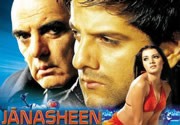
Janasheen
Synopsis:
Picture this if you can, because it still makes zero sense to me, but there is a scene right in the middle of Janasheen where Fardeen Khan is just riding a dirt bike around some massive Spanish estate wearing the most insanely bright patterned shirt you have ever seen in your life, and he is dodging explosions and looking intensely into the camera like he is late for a brunch he didn't want to go to anyway.
To back up a bit and explain why he is even on that bike, we have to look at how this whole crazy ride started out in the sunny world of modern bollywood where Fardeen plays this guy named Lucky who lives it up in Australia as a professional bike stunt rider who apparently has zero real responsibilities other than looking extremely glossy and brooding over his estranged past, which leads us right into the whole family trauma aspect of the movie.
His dad is this wildly rich, terrifyingly slick guy played by Feroz Khan who lives in this enormous sprawling mansion in Afghanistan that looks like a Bond villain’s weekend retreat, and he is up to no good with land grabs and shady business deals, and he wants Lucky to come home and take over the empire, but Lucky’s mom died under super suspicious circumstances involving this exact same crime lord dad.
So then Lucky goes to a massive resort party and meets Jessica, played by Celina Jaitley, who is walking around in these ridiculous early 2000s outfits that defy all laws of physics and gravity, and she is an aspiring fashion designer or something, and they instantly fall in love while dancing on a beach to some techno track that sounds like it was recorded on a toaster.
Celina is just gorgeous in every single frame, and honestly, the movie spends a solid twenty minutes just watching her pose by swimming pools in sunglasses that take up half her face while Fardeen stares at her like she just invented the wheel.
Anyway, Feroz Khan's character tries to get rid of Lucky because he won't fall in line with the family business, so he blows up his favorite motorcycle or tries to frame him for murder, and things escalate so fast that you can't even keep track of who is betraying who anymore.
Right after that, Lucky finds out his dad actually murdered his uncle or his guardian or someone important, and the plot just completely off-roads into this chaotic action movie territory where people are shooting guns from horseback in the desert.
They escaped the compound.
So then there's this weird court case or a confrontation scene where everyone is yelling at each other in massive rooms with marble pillars, and Feroz Khan is chewing the scenery so hard you can practically see the wood chips flying out of his mouth, and he yells out some dialogue about power and blood that gets echoed by a choir on the soundtrack.
Classic bollywood movies love a good family betrayal, and hindi films from this era relied heavily on the whole dramatic father-son showdown where both guys are wearing leather jackets inside a burning building.
The funny thing is that the supporting cast is just running around in the background trying to look busy while Fardeen and Feroz have this massive shouting match about honor and real estate.
Celina shows up out of nowhere with a gun to save the day, and she looks completely unfazed by the explosions happening two inches from her hair extensions, and she just shoots the main henchman right in the shoulder without blinking.
They didn't even care.
The whole climax boils down to Fardeen and his dad fighting on a helipad while a helicopter is trying to take off for some reason, and they're punching each other over bags of cash or stolen deeds, and then the dad gets trapped underneath some burning wreckage and gives this long tragic speech about how he always loved him in his own messed up way.
Lucky walks away from the burning explosion in slow motion while holding Celina's hand, and they get into a sleek red sports car and drive off down a coastal highway into the sunset.
There is a specific kind of shoulder roll Fardeen Khan deploys whenever he is asked to look intensely concerned about horse breeding that instantly drains three degrees of temperature from any room he happens to occupy. It is a slow, oily sort of pivot, accompanied by a tiny downward tilt of the chin that suggests he is either listening to a very complicated instruction regarding polo ponies or attempting to remember where he left his lighter. Watching him wander through the sun-baked dust of Afghanistan before the story relocates to the neon-drenched gambling dens of Australia, you get the distinct sense that nobody involved in the production ever quite figured out what to do with his hands when the cameras were actually rolling. If I'm honest, the whole enterprise rests on this peculiar brand of vacant charisma, a quality that makes him less a protagonist and more an expensive piece of furniture that occasionally speaks French.
Feroz Khan directs this thing with the frantic, scattershot energy of a man who watched too many American action pictures on VHS during a single weekend and decided he could replicate the editing rhythm by just cutting away to a helicopter whenever someone stopped talking. The screenplay makes very few concessions to logic, preferring instead to hop continents whenever the budget or the weather demands a change of scenery. We bounce between opulent villas and underground race tracks with zero regard for spatial continuity, creating a dizzying impression of motion that never quite translates into genuine momentum. Characters enter scenes through doors that clearly lead back to the craft services table, and entire subplots involving corporate espionage are dropped the moment the director spots a particularly striking sunset he wants the camera operator to obsess over for four unbroken minutes.
Celina Jaitley spends a considerable portion of her runtime squinting against the glare of various tropical lights while delivering lines that sound as though they were phonetically translated from a different language entirely. Her performance exists in a separate atmospheric layer from everyone else on screen, operating on a frequency of pure, unadulterated glamour that occasionally intersects with dialogue about land deeds and family vengeance. When she is required to look devastated by betrayal, she merely tilts her head toward the key light and lets a single, perfectly spherical tear trace a path down her cheek, an effect that looks suspiciously like glycerin applied with an eye dropper between takes. It is a flat, ornamental presence, yet it oddly fits the artificial, hyper-stylized world Feroz Khan constructs around her like a cheap plexiglass dome.
The visual style borrows heavily from the glossy aesthetic of late-nineties thrillers, leaning hard on desaturated blues and aggressive lens flares that occasionally obscure the actors' faces entirely. The cinematography loves nothing more than a slow-motion tracking shot of a leather boot stepping out of a sports car, lingering just a beat too long on the ankle before tilting up to reveal someone pointing a revolver at the horizon. This specific visual tic repeats itself so frequently that you can set your watch by the impending gun-draw, ruining whatever meager suspense the narrative might have accidentally generated. The soundtrack doesn't help matters, looping the same three synthesizer chords over and over during every confrontation until you feel like you are being interrogated by an avant-garde dentist.
Feroz Khan himself saunters through the second half as the primary antagonist, wearing silk shirts unbuttoned down to his sternum and delivering threats with the weary amusement of a man who knows he is the most interesting thing in the frame. His performance is full of strange, rhythmic pauses, as if he is waiting for someone off-camera to cue his next punchline. There is a bizarre scene where he confronts Fardeen over a billiard table, and the tension is completely derailed because Feroz insists on chalking his cue with such aggressive circular motions that the tip nearly snaps off, an unscripted detail that the editor inexplicably chose to leave in the final cut. That kind of small, mechanical oddity haunts the entire production, dragging down the more grandiose aspirations of the plot.
Hindi films have long possessed a unique tolerance for narrative nonsense provided the wardrobe budget exceeds the GDP of a small principality, and this production milks that tradition for every ounce of gloss it can muster. We are treated to musical numbers that stop the film dead in its tracks, featuring backup dancers wearing metallic headgear that probably caused permanent neck strain under studio lights. These sequences have no bearing on the already tenuous plot, existing solely to provide a palette cleanser between scenes of low-stakes interrogation. It's a small thing, but the constant costume changes between dialogue beats get genuinely distracting when characters are supposed to be fleeing for their lives across an international airport.
The thematic ambitions of the story never stretch much further than a vague, generalized obsession with honor, bloodlines, and the corrupting influence of foreign currency. Whenever the script tries to grapple with generational guilt or family trauma, it immediately cuts to a jet ski sequence or a close-up of a roulette wheel spinning toward red. You can see the ghost of better bollywood movies hovering at the edges of the frame, films where the familial strife actually carried emotional weight rather than serving as a flimsy excuse for an overseas holiday. The comparisons to Deewaar are entirely unearned and frankly embarrassing to consider in the same breath, given how utterly weightless every emotional beat feels here.
By the time the narrative stumbles toward its chaotic beachfront resolution, involving a fistfight that goes on for an eternity without anyone breaking a sweat or mussing their hair, you are left wondering what any of it was actually about. The villain is dispatched with a minimum of fuss, the romantic leads exchange a look of profound indifference that is supposed to pass for enduring love, and the credits roll over a reprise of the title track that sounds like it was recorded in a tin shed. It is not a disaster of epic proportions, nor is it a misunderstood camp classic waiting for rediscovery by a clever internet subculture. Not great, not bad, just there, floating in the ether of mid-budget cinema like a discarded cigar butt in an empty swimming pool.