

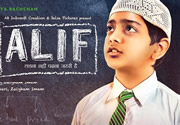
Alif
Synopsis:
Ali is screaming at his teacher while holding a violently crumpled piece of paper and crying real tears that make his nose all red in a tight classroom where nobody else knows what to do with their hands. Look, I know this sounds like a weird place to jump into the middle of things, but Alif is just that kind of movie where kids are carrying the weight of the entire universe on their tiny shoulders and adults are constantly making the worst possible choices about education and religion. Let us back up for a second because before we get to all that shouting and paper-throwing, we have to talk about how this indie-spirited drama fits into the grand scheme of modern bollywood. You see, hindi films usually love a big shiny wedding or a dance number in the Swiss Alps, but this project starring Neelima Azim, Pawan Tiwari, and Bhavna Pani takes us straight into the narrow, dusty lanes of old Bhopal to look at real people trying to figure out what education even means when you are struggling to survive.
Ali is just a regular kid who wants to go to a proper school and learn English and dream about airplanes, but his family is dealing with crushing poverty and old-school traditions that make every single day feel like an uphill battle. His father works insanely hard, and man, can we talk about that one background extra sitting outside the tea stall in scene four who is wearing the most hideous mustard-yellow sweater with green stripes that definitely doesn't fit him? It distracts you completely from the heavy dialogue about societal expectations. Ali's mom is played by Neelima Azim, and she is just heartbreakingly good, worrying over every single piece of stale bread while trying to keep the household from falling completely apart. Ali wants to study, but the local clerics and the rigid traditional system keep slamming doors in his face, saying that modern schooling will ruin his soul or whatever. And then boom, out of nowhere, we get a random musical interlude where people start singing about hope right after a devastating argument about school fees, which is such a classic bollywood movies move to break your heart and then make you tap your foot awkwardly.
Ali keeps pushing forward despite everyone telling him to just drop out and get a job breaking stones or fixing bicycles. He meets other kids in the neighborhood who are also just trying to catch a break, and the friendship dynamics feel genuinely lived-in, like these kids actually hang out behind abandoned brick walls and share cheap snacks when the cameras aren't rolling. Bhavna Pani enters the frame and brings this lovely, grounded energy to the narrative, shifting the emotional stakes higher because now Ali has someone believing in his potential when his own father is losing patience. But things get so intense right around the interval point that you honestly forget to breathe for a minute. The interval block hits you like a truck when a major confrontation happens right outside the local madrasa involving shouting matches and torn notebooks flying everywhere in slow motion.
After the break, the movie doesn't slow down at all, rushing headfirst into the heavy drama of whether Ali will actually get his scholarship or if he is doomed to repeat his father's exhausting daily grind. Pawan Tiwari's character is standing there with this intense frown, delivering lines about honor and duty that make you want to scream at the screen because you just want the kid to catch a break. Honestly, hindi movies love to punish their characters before giving them any kind of redemption, and Alif is no exception to this rule. Stuff happens so fast in the third act that characters are suddenly changing their minds about modern education after one big emotional speech, which feels a little rushed compared to the slow-burn pacing of the first hour.
Ali walks slowly down the dusty alley toward the school gates with his brand new notebook clutched tightly against his chest while the camera pans up to the bright blue sky.
Zahra's thumbs are always dry. It’s a tiny detail, the kind of actorly micro-choice that usually gets lost beneath the heavier machinery of a message-driven indie, but Neelima Azim lets you see the chalky cuticles in the second scene and then never draws attention to it again. You just know that old woman uses cheap detergent or washes her hands too often in cold water while waiting for a son who isn't coming back. Cinema is full of grand gestures about generational fracture, yet most families break down over things like flaky skin and mismatched silverware. Director Zaigham Imam knows this, or at least he operates as if he does for the first hour before the script demands he start underlining the subtext with a grease pencil. We get a story about education and religious orthodoxy in the older alleyways of Varanasi, places where every wall smells of damp lime and frying oil. If I'm honest, the opening twenty minutes feel less like a constructed drama and more like footage stolen from a documentary shot twenty years ago when the light hit the brick differently. The plot limps forward through narrow lanes, following a young boy named Alif who just wants to learn English instead of memorizing verses he cannot parse. It is an old conflict, tired in the hands of lesser filmmakers, but Imam shoots it with a patience that lets the dust hang in the air between characters. You watch the boy sketch letters in the dirt with a broken twig, his tongue pressed against his cheek, and the sheer weight of what people expect from him settles onto the screen without a musical cue telling you to feel sad about it. The cinematography leans into natural light, sometimes to a fault, leaving whole conversations obscured in sudden patches of shadow where you can barely track who is speaking. That kind of unvarnished realism can be frustrating when you are trying to read subtitles on a dodgy print, but it keeps the film from sliding into the glossy aesthetic typical of standard Hindi movies where even poverty looks like it was curated by an interior designer. Pawan Tiwari enters the frame as the stern father with a slouch that tells you everything about thirty years of carrying debt and wounded pride. He doesn't bellow his lines the way veteran actors do when they want to make sure the back row hears them; he mutters them into his tea, his eyes fixed on the rim of the glass. There is a scene where he fixes a broken hinge on a kitchen cabinet using a matchstick and some wood glue, and he takes so long doing it that you forget the camera is even there. That level of behavioral detail saves the middle stretch from sagging under the weight of its own earnestness. Bhavna Pani floats through the periphery as the aunt caught between modern aspirations and familial duty, bringing a bruised warmth to scenes that might otherwise calcify into pure polemic. She reminds me of Surekha Sikri in "Tamas," that same exhausted authority beneath a cotton sari, though she lacks the older actor's terrifying precision. It's a small thing, but it bugged me how the sound design keeps dropping the ambient street noise entirely whenever two people are having an emotional breakthrough, plunging the alleyways into an unnatural, hollow silence that screams post-production ADR. We don't need the crickets to shut up just because a father is crying. Bollywood movies have conditioned us to expect every emotional pivot to arrive wrapped in a swelling string section, so when Alif resists this convention it feels almost bracing, until the third act arrives and decides to explain every single metaphor out loud. The themes of schooling versus tradition are handled with enough nuance that you can root for both sides of the argument at different moments, which is rare for a social drama that ostensibly wants to teach its audience a lesson about modernization. Zahra's silence in the household becomes a physical barrier that the other characters keep bouncing off of, her face remaining largely expressionless while the men shout around her about honor and tuition fees. Azim plays this not as saintly martyrdom but as a deeply ingrained survival strategy, the kind women develop after decades of losing every argument before it even starts. The camera loves her hands, catching them twitching against her lap or smoothing the pleats of her dupatta with a compulsive rhythm that speaks volumes about her internal weather. The script stumbles when it tries to widen its lens to encompass the entire neighborhood's politics, losing the intimate friction between father and son in favor of broad strokes about communal harmony that feel imported from a different, less interesting project. Still, there is a grubby authenticity to the way characters negotiate money—small loans from local shopkeepers, crumpled notes counted under tables, the quiet humiliation of asking for an extension on school fees. You can smell the kerosene and the cheap tobacco. It avoids the sanitized sheen common to many contemporary Indian releases, preferring instead to show the grease on the walls and the frayed collars of school uniforms that have been handed down three times. When the boy finally speaks his first full sentence in English, it doesn't sound like a triumph of the human spirit; it sounds awkward, mispronounced, and entirely underwhelming, which is precisely how real learning happens in rooms with peeling paint and too many students. The sound of chalk scraping against a slate board recurs as a motif, grating on the nerves after the fourth time, an obvious sonic bookmark that the editor should have trimmed by half.
The pacing slackens considerably right around the hour mark, lingering on lingering shots of bicycle spokes turning against a gray background as if the director fell in love with his own B-roll. It is a common trap for filmmakers working outside the commercial machinery of Mumbai, mistaking slow motion for depth, letting scenes breathe until they suffocate. Yet whenever the film threatens to disappear up its own artistic ambitions, Pawan Tiwari does something unremarkable with his shoulders or Neelima Azim sighs in a way that sounds entirely unscripted, pulling you right back into the kitchen. The dialogue avoids the poetic flourishes that usually sink this subgenre, sounding instead like actual arguments overheard from a second-story balcony while you are trying to sleep. That verisimilitude makes the heavy-handed moralizing at the very end all the more jarring, a sudden gear-shift into sermonizing that feels bolted on by someone who didn't trust the audience to get the point from the chalk dust alone. You leave the theater thinking about the dry thumbs and the matchstick in the hinge, the minor physical facts of a life lived in cramped quarters where every decision has an immediate, bruised consequence.