

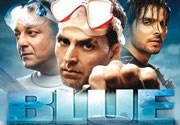
Blue
Synopsis:
Katrina Kaif cannot swim. Or at least she looks deeply, profoundly uncomfortable every single time the camera dips below the surface of the Pacific during the first twenty minutes of Blue, clutching a prop steering wheel like it's a moving bus, which is a small thing to fixate on when there are multimillion-dollar underwater action sequences happening around her, but it bugged me because the film spends so much money convincing us these characters are basically part fish. Anthony D'Souza directed this thing with an invisible wallet and a visible instruction manual titled Fast and Furious Underwater, except nobody thought to check if the buoyancy looked right in the post-production suite before shipping reels to cinemas across the country. Hindi cinema has chased international slickness for decades without ever quite understanding that slickness requires invisible seams, whereas Blue wears its glue on the outside where the salt water can wash it off. You have Sanjay Dutt playing a rugged boat-salvage captain who owns a bar called The Tuna Melt or something equally absurd, and Akshay Kumar wearing enough leather in the Bahamas to make a biker convention look under-dressed, all of them chasing a sunken treasure that has apparently been sitting at the bottom of the ocean since the East India Company forgot where they parked their ships. The screenplay reads like it was translated from an entirely different language by someone who had never met a human being, stuffed with dialogue that hits your ear like wet cardboard dropped from a second-story window. Characters explain their motivations to each other while standing on the deck of a yacht in broad daylight as if the audience collectively forgot what happened five minutes ago during the intermission. Zayed Khan shows up to look confused and wet, mostly succeeding at the wet part.
Sanjay Dutt walks through this movie like he has somewhere else to be that actually pays on time, anchoring the chaos with a gruff fatigue that feels earned simply by virtue of his having survived the production. He doesn't do much acting here; he just squints into the sunlight, adjusts his collar, and growls lines about brotherhood and betrayal with the casual authority of a man reading a grocery list. Akshay Kumar, on the other hand, is working overtime, sprinting across rooftops and diving off cliffs with a manic intensity that makes you wonder if someone told him his paycheck depended on his heart rate staying above one hundred and forty beats per minute. He has this one scene where he’s supposed to be menacing while dangling upside down from a crane, but he just looks like he's trying to remember if he left the stove on back at the hotel. Lara Dutta gets saddled with the thankless task of standing on the shoreline looking worried while the boys go play in the deep end, which feels like a waste of an actor who usually brings some actual bite to her commercial roles. Then there's Kylie Minogue showing up for a single musical number because someone in the budget department had a spare million pounds burning a hole in their pocket and thought, why not an Australian pop star in a blue swimsuit. It's the kind of casting decision that belongs in a pitch meeting fueled entirely by cold pizza and bad decisions, yet somehow it happened, and now it exists forever on celluloid for future historians to puzzle over while trying to understand the economic boom of the late two-thousands. Hindi movies have always loved a good cameo, but shoving an international chart-topper into a beachside dance sequence where she doesn't even make eye contact with Sanjay Dutt is a special kind of disconnected ambition.
Pete Robertson's cinematography is basically a two-hour tourism ad for the Bahamas interrupted occasionally by men punching each other in the face near some rusty anchors. Every frame is graded in this aggressive, teal-and-orange soup that makes the ocean look less like a natural body of water and more like a swimming pool at a luxury resort in Dubai that has been over-chlorinated by an anxious manager. When the characters go diving, the camera tracks them with an expensive steadicam rig that swoops around coral reefs like a drone operated by a caffeinated teenager, which is visually arresting for about ten minutes before you realize you have no idea who is punching whom because all the stuntmen are wearing identical wetsuits and scuba gear. A.R. Rahman supplied the soundtrack, and if I'm honest, it's the only reason anyone stayed in their seats past the halfway mark, bringing a thumping electronic pulse to scenes that would otherwise be entirely dead on arrival. The title track features Kylie and Sonu Nigam trading vocals over a beat that borrows heavily from Bollywood movies of that era while still sounding remarkably fresh compared to the dialogue surrounding it. Rahman doesn't save the film from itself, but he gives the actors something rhythmic to move their hips to when the plot stalls out and everyone needs to pretend they are having the time of their lives on a yacht that smells faintly of diesel and fiberglass.
The thematic undercurrent here is supposed to be greed destroying family bonds, but it's handled with the subtlety of a sledgehammer falling through a skylight. Dutt and Kumar's characters are stepbrothers whose relationship soured over a sunken ship and a dead father, which is the exact plot of about forty different action pictures released during the eighties, just updated with more expensive wetsuits and a higher-resolution camera. There is no moral gray area to explore because the script telegraphs who the villain is from the second he walks on screen wearing sunglasses indoors during a night scene. It reminds me a bit of Dus, another glossy multi-starrer that traded narrative coherence for fast cuts and loud bass lines, though at least that film had the good sense to keep its action on dry land where gravity makes sense. Here, the underwater fights slow everything down to a sluggish crawl, turning what should be high-tension life-or-death struggles into slow-motion ballets where nobody looks like they're exerting any actual physical effort. The treasure hunt angle acts as a thin excuse to string together music videos and action set pieces, yet the filmmakers keep trying to inject heavy emotional beats about loyalty and trust right after showing Zayed Khan riding a jet ski through a narrow cave. It’s an impossible tonal pivot that leaves everyone looking slightly embarrassed.
That endless underwater climax drags on long after the narrative has flatlined, featuring so many slow-motion explosions in the middle of the ocean that you start to wonder how physical chemistry works in this specific cinematic universe. A fuel tank blows up underwater, creating a massive fireball that somehow has access to atmospheric oxygen, defying every known law of physics while the sound design cranks the bass up until the theater seats start to vibrate. It's loud, it's dumb, and it refuses to end. The characters emerge from the water soaked, exhausted, and miraculously free of any decompression sickness, ready to smile for the final freeze-frame as the credits roll over a reprise of the title track. There's a supporting actor playing a local henchman who is so obviously dubbed by someone standing in a small studio booth in Mumbai that his lips don't even pretend to match the syllables, a minor technical slip that captures the general rushed indifference of the entire enterprise. Nobody involved seemed to care about the logic of the plot once they secured the permits to shoot off the coast of Nassau. They just wanted the boat to move forward, the cameras to roll, and the paycheck to clear before the tide came in.