

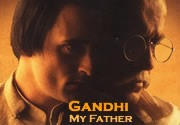
Gandhi My Father
Synopsis:
Akshaye Khanna wears glasses that slide just a millimeter down the bridge of his nose in every third scene, and if I am honest, that tiny wardrobe annoyance became my anchor during the first hour of Gandhi My Father because the grandness of the subject matter kept threatening to float away into the ether of standard historical piety. Firoz Abbas Khan directed this adaptation of his own play, bringing a stage-bred claustrophobia to a narrative that usually demands sweeping vistas of salt flats and massive crowds chanting in the rain. Bollywood movies often treat the freedom struggle as a bronze monument to be polished from a distance, yet this picture drags the lens into the messy, dimly lit back rooms where fathers and sons destroy each other with quiet syntax.
Darshan Jariwala plays the Mahatma not as a saint caught in amber but as an aging, stubborn man who possessed infinite patience for the Indian subcontinent and precisely zero patience for his own flesh and blood. When he speaks, his voice has that raspy, weary drop at the end of sentences that makes you realize how exhausting it must have been to carry a billion people toward independence while your eldest boy was quietly drinking himself to death in Johannesburg. The screenplay refuses to grant the great man an easy moral shield, showing how his rigid adherence to abstract principles acted as a meat grinder for his family.
The central tragedy belongs entirely to Harilal Gandhi, and Khanna plays him with a hollow-eyed desperation that makes you look away from the screen during his worst bender scenes. He isn't just a rebellious kid acting out against a famous dad; he is a ghost haunting the margins of history books, trapped in the impossible shadow of a father who belonged to the public long before he belonged to his children. Shefali Shah matches this internal rot with a heartbreaking portrait of Kasturba, caught in the eternal crossfire between wifely devotion and maternal fury, her shoulders permanently hunched under the weight of a domestic life sacrificed on the altar of political destiny. Bhoomika Chawla and Daniel Janks fill out the periphery with a gritty, unglamorous authenticity that keeps the biopic from floating off into hagiography.
Visually, the film adopts a washed-out palette that occasionally dips into the territory of standard television drama, relying too heavily on warm interior light shafts and dusty streets that feel a bit too constructed. The background score has this habit of swelling with a heavy, mournful cello whenever Harilal looks at a bottle of liquor, and it is a small thing, but it bugged me every single time because the actors were already doing the heavy lifting without the musical cue nudging us in the ribs. Hindi films of this historical weight usually feel the need to instruct the audience on how to feel every four minutes, and while Khan mostly resists that urge, the sound design occasionally betrays its theatrical origins with dialogue that echoes just a fraction too cleanly in rooms that should be swallowing sound.
What saves the production from becoming just another prestigious costume drama is its willingness to stare directly at the emotional collateral damage of moral absolutism. Mohandas Karamchand Gandhi could negotiate with the British Empire and organize massive civil disobedience campaigns, yet he could not write a warm letter to his son without turning it into a lecture on diet and celibacy. Watching Khanna try to parse those letters on screen, his face twitching with a mixture of desperate longing and pure hatred, brings to mind Mickey Rourke in Barfly, though filtered through the strict moral code of early twentieth-century Gujarat. It is a grueling dynamic that plays out in cramped railway cars and modest sitting rooms, completely stripping away the mythical aura of the father of the nation.
We have seen plenty of cinematic treatments of the Mahatma over the decades, stretching from Richard Attenborough's grand epic down to various modern streaming misfires, but none of them spend nearly this much time in the damp corners of domestic failure. The film makes you uncomfortable by suggesting that saving a country might actually require you to abandon the people sleeping under your own roof, and it refuses to offer a neat emotional reconciliation before the credits drop. Harilal dies alone in a hospital ward, unrecognizable to the nurses who tend to him, while his father delivers speeches about non-violence to adoring millions thousands of miles away, and the picture lets that brutal juxtaposition hang in the air without offering any comforting narrative resolution about forgiveness or legacy.