

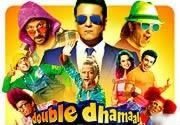
Double Dhamaal
Synopsis:
The four good-for-nothing jokers from Dhamaal - Roy (Ritesh Deshmukh), Adi (Arshad Warsi), Manav (Jaaved Jaaferi) and Boman (Aashish Chaudhry) are back again! They are still as stupid and useless as before. Hard work is a strict no and the only work they have ever done in their lives is to lie down on their backside and dream about a good life where they have everything without doing anything!
And then suddenly they see their old arch enemy - the corrupt Insp.Kabir Nayak (Sanjay Dutt). But he''s no longer a cop and instead of chasing crooks, he''s chasing money - driving a Merc and has a posh office and a lavish villa. The four mad caps are green with envy and decide that come what may, by hook or by crook they will share Kabir''s good fortune. And so they blackmail Kabir into making them his business partners. They are in seventh heaven, yippee, all their dreams are coming true. What they don''t know is that soon their dreams are going to turn into nightmares because Kabir has his own hidden agenda, only shared by his sultry wife Kamini (Mallika Sherawat) and lovely sister Kiya (Kangna Ranaut). And so starts a game of one-up-man ship, with both sides having tricks up their sleeves and where sundry characters like Batabhai (Satish Kaushik) and King of Casino Johnny Bonzola, turn up to make their foursome''s life miserable. And ofcourse, there''s a helluva lot of money at stake.
There are also lots of twists and turns and a bellyful of laughs. But who will have the last laugh? Canny Kabir or our four loveable jokers?
That extra beat on Riteish Deshmukh’s reaction shot in the hotel lobby remains burned into my retinas long after the credits stopped rolling. It is a small thing, sure, but it bugged me the entire afternoon. Indra Kumar returns to the well with Double Dhamaal, bringing back his squad of dimwitted grifters and hoping the audience has short memories about how thin the original film wore itself out to be by the halfway mark. If I'm honest, nobody was really clamoring for a continuation of these specific character arcs, yet here we are, sitting in the dark, watching Sanjay Dutt try to anchor a narrative that drifts off into absolute nonsense every eight minutes. Bollywood comedies often struggle with the transition from physical gag to actual narrative propulsion, and this script treats plot logic like an optional extra you can skip to save on fuel.
The writing relies heavily on characters shouting exposition while running down narrow corridors or diving behind parked cars. Screenplays of this specific vintage treat subtlety with genuine suspicion, preferring instead to hit every comedic note with a sledgehammer wrapped in cheap felt. Arshad Warsi does what he can with dialogue that feels like it was punched up on a napkin during a lunch break at a suburban cafe, leaning into his frantic persona with the kind of muscle memory you only get from doing twenty similar hindi movies a decade. Jaaved Jaaferi gets fewer lines than he deserves, which might actually be a mercy given the quality of the punchlines he is handed by the writers. The pacing moves in wild, jagged leaps, abandoning entire subplots for twenty minutes at a time only to drag them back into the light when the editor suddenly remembers they need to fill ninety minutes before the contractual song sequence.
Sanjay Dutt walks through his scenes with the weary detachment of a man who has signed a contract and is simply waiting for the check to clear at the bank. He plays the straight man to a bunch of manic performers who treat every frame like a high-school drama competition final, and his complete lack of enthusiasm actually lends the movie a weird, unintended deadpan energy. Mallika Sherawat and Kangna Ranaut show up in roles that require them to stand in dramatic lighting and look vaguely threatening or glamorous, depending on which way the wind is blowing on the soundstage. Satish Kaushik pops in for a stretch as a wealthy antagonist, chewing the scenery with enough vigor to make you wonder if he hadn't eaten anything all day. There is an unmistakable fatigue hanging over the entire enterprise, as if everyone involved realized by day three of the schedule that the magic from the first outing was entirely gone.
Visually, the film looks like it was lit by someone who discovered a box of neon gel filters in a basement and decided to use every single one before lunch. The camera work is constantly in motion for no discernible reason, zooming in on bewildered faces during conversations that should be static and stable. The soundtrack leans on a recycled loop of beats that feels suspiciously similar to what Anu Malik was churning out for mid-tier projects around the time Welcome hit theaters, and it plays at such an aggressive volume during dialogue scenes that you miss half the jokes anyway. Whenever a new location is introduced, the drone shots swoop down with a pointless aggression, making a standard Mumbai street look like the staging ground for a military intervention. It is all very loud and very bright and strangely exhausting to watch for two hours.
Underneath the slapstick and the cheap double entendres, the story attempts to say something about the rot of greed in contemporary urban spaces, though it abandons this thread the moment a pratfall or a car crash is required to wake the audience up. Hindi films have a long tradition of using ensemble comedies to mask social commentary about class disparity, but here the commentary is so toothless it barely registers as satire. The four losers are not charming rogues you want to see succeed; they are obnoxious opportunists who deserve every miserable thing that happens to them on screen, which makes the obligatory happy ending feel completely unearned. The thematic ambition starts and stops with the realization that money makes people act foolishly, a revelation that hardly requires a multi-starrer feature to uncover.
There is an amateurish quality to the sound design where background Foley effects drop out entirely during crucial reaction moments, leaving the actors stranded in unnatural silence. You can hear the boom mic dipping into the top of the frame during a wide shot in the second act, and nobody bothered to fix the color grading between two adjacent scenes in the climax, resulting in a jarring shift from cool blue to sickly yellow. These mechanical lapses accumulate until the movie feels less like a finished product and more like an unedited assembly cut that accidentally escaped into multiplexes across the country. It is hard to stay angry at a machine that is this comprehensively inept, but it is equally hard to muster up any genuine warmth for an exercise so thoroughly drained of joy.