

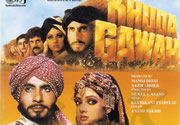
Khuda Gawah
Synopsis:
Sridevi is literally blindfolded and standing trial in front of a raging mob of Afghan tribal leaders while Amitabh Bachchan is yelling about honor and horses and it's just pure chaos.
Look, Khuda Gawah is one of those massive epic hindi films from the nineties that just doesn't care about your attention span and honestly, it starts way back when Badshah Khan, played by Amitabh, travels all the way from Afghanistan to India just to win the hand of Benazir, played by Sridevi.
Benazir's dad says Badshah can't marry her unless he brings him the head of his worst enemy, and because this is old-school bollywood, he actually does it, bringing back the head wrapped in a cloth like it's no big deal, and they finally get married.
They have a daughter named Mehenaz, but things go sideways immediately because Badshah has to go back to India to settle a blood feud, and while he's gone, his rival Haji escapes and frames Badshah for a murder he didn't commit, getting him thrown into an Indian prison for twenty years.
Benazir waits and waits in Afghanistan, completely isolated, and then the rival tribesmen burn her house down with her inside it, and she dies, which is brutal, but before we can even process that tragedy, we get a random song where everyone is dancing on horseback in the mountains because classic hindi movies just love whiplash.
And then boom, we hit the interval point where the movie literally pauses to make you catch your breath from all the horses, sword fights, and crying in the desert.
Jump to twenty years later and Nagarjuna Akkineni shows up as Inspector Raja, who is actually Badshah Khan's grown-up adoptive son or protege or something complicated, and he falls in love with Mehenaz, who looks exactly like her dead mother Sridevi because of classic dual-role movie logic.
Mehenaz hates Badshah Khan because she thinks he abandoned her mother, and she forces Raja to hunt him down and kill him to prove his love.
Amitabh finally gets out of prison, old, bearded, and half-blind, and he wanders around looking for his family while wearing this incredible brown leather jacket that has like fifty pockets, and honestly, I couldn't stop staring at the weird tassel details on his sleeves during this whole dramatic sequence.
Raja finds Badshah and brings him to Mehenaz, but she still wants revenge and puts him on trial in front of the whole village.
That brings us right back to that blindfolded trial scene where Sridevi's ghost or memory is basically haunting everyone, and then Benazir's ghost actually shows up or maybe it's just a hallucination, but she tells Mehenaz to forgive Badshah because he kept his promise all those years.
Right at the end, the real villains show up to ruin the family reunion and start shooting up the place, and Badshah takes a bullet protecting everyone.
Amitabh dies slowly in Sridevi's arms while dust blows everywhere, and Raja and Mehenaz just stand there crying as the screen cuts to black.
That sound design choice right after the intermission in Khuda Gawah still makes me wince. You hear this heavy, metallic clank every single time a character draws a sword in the second half, which is often, and after the fourth or fifth repetition it starts sounding less like a weapon clearing its scabbard and more like someone dropping a metal lunchbox down a concrete flight of stairs.
Mukul Anand directed this thing with a sort of operatic restlessness that usually gets associated with Italian historical epics rather than standard Bollywood productions from the early nineties. He had this habit of shooting actors from low angles against churning skies, letting the wind do half the heavy lifting for the drama, which works wonderfully until the weather changes mid-scene and the continuity department has to scramble to match the lighting. The screenplay, which he co-wrote with Santosh Saroj, sprawls across decades and international borders without ever really deciding whether it wants to be a gritty tribal blood feud or a sweeping romantic melodrama about people who cannot communicate their feelings honestly. You get these enormous, lung-bursting confrontations between Badshah Khan and Benazir, separated by rivers and political grudges, followed immediately by silly comedic interludes involving Danny Denzongpa's henchmen that feel like they wandered in from an entirely different movie shot on a budget of twelve rupees. It is messy, if I'm honest, and yet there is an undeniable momentum to the way Anand hurtles from one massive set piece to the next, refusing to let the viewer catch their breath or think too hard about the plot holes.
Amitabh Bachchan wears a salt-and-pepper beard here that looks glued on by someone who had a train to catch, but he sells the absolute sincerity of Badshah Khan anyway. There is a specific way he narrows his eyes when he tells Sridevi's Benazir that he will bring her the head of her father's killer, a quiet intensity that reminds you why he stayed at the top of Hindi cinema for so long even when the scripts started repeating themselves. He is playing a man trapped entirely by his own ridiculous code of honor, a trope that could easily slide into parody if played with even a fraction less conviction. Sridevi pulls double duty as both Benazir and her daughter Mehendi, and she handles the transition with the kind of physical precision that makes most other actors look like they are sleepwalking through their scenes. Watch her face in the courtroom sequence where she has to pretend she doesn't recognize the man who abandoned her mother; she doesn't blink, she just hardens her jaw until the skin goes white around her mouth. It is a terrifyingly good bit of acting that outclasses the material by a mile, especially when compared to Nagarjuna's somewhat stiff turn as the dutiful inspector caught in the middle of this multi-generational family mess. Nagarjuna looks gorgeous on horseback, certainly, but he plays most of his dramatic scenes with his mouth slightly open, as if he's perpetually waiting for someone to remind him of his lines.
Laxmikant-Pyarelal gave the film a score that relies heavily on sweeping string arrangements and sudden, thunderous percussion hits that announce every emotional beat five seconds before it happens on screen. The songs, particularly Tu Na Ja Mere Badshah, manage to anchor the romance even when the narrative logic starts wobbling under its own weight. Cinematographer Rajan Kinny used these long, dusty lenses for the Afghan sequences that give the desert a harsh, bleached-out look, contrasting sharply with the saturated greens and reds of the later Indian segments. Yet for all the visual grandeur, you keep noticing tiny editorial stumbles, like a reaction shot of Kiran Kumar that lingers a beat too long after everyone else has left the frame, or a crowd scene in Kabul where a background extra is clearly staring directly into the camera lens with a look of mild boredom.
Honor and retribution form the backbone of the entire enterprise, driving characters to make decisions that make zero sense to anyone living in the modern world. Badshah Khan rides across borders and serves twenty years in an Indian prison simply because he promised a woman he would return with a token of vengeance, a premise that requires an extraordinary amount of audience buy-in. It treats tribal codes not as historical artifacts to be examined, but as absolute laws of physics that govern human behavior just as surely as gravity. The second half trades this geopolitical friction for a more domestic tragedy involving parent-child separation, which feels smaller, less earned, and significantly more melodramatic than the sweeping tribal politics that opened the picture.
Watching this thing now, away from the box office hype of ninety-two, it looks less like a definitive Hindi movie statement and more like a massive, unwieldy artifact of an era when producers still believed that throwing enough extras and horses at a screen could solve any structural deficiency in the script. It reminds you of Sholay in its obsession with male bonding and revenge, though it lacks the tight, economical storytelling that made Ramesh Sippy's classic work so effortlessly. The sound effects still grate, the supporting cast still features actors whose dubbing is out of sync by a full second, and the runtime drags in the middle like a wet wool blanket. Badshah Khan's final ride back to Afghanistan remains genuinely affecting anyway, mostly because Bachchan manages to make you believe in the sheer absurdity of his devotion.