

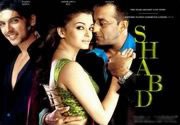
Shabd
Synopsis:
Halfway through the film, Sanjay Dutt is staring blankly at a very weird looking wooden desk and typing out sentences that honestly sound like they were pulled straight from a bad diary, and he's sweating profusely while wearing this oversized brown sweater that looks like it hasn't been washed in months. But to understand why he's having such a total meltdown in his study, you have to look at how this whole messy situation started with him playing a brooding author named Shaukat who wins a national award and decides to take a teaching job at a quiet college somewhere in Goa just to get away from the noise. So then he meets Antara, played by Aishwarya Rai, who's his gorgeous and supportive wife teaching at the same college, and she's just walking around campus looking like an absolute vision in these stunning cotton sarees that probably cost a fortune and she's completely devoted to him even though he's constantly lost inside his own head. Right after that, a cheerful young photographer named Yash, played by Zayed Khan, bursts onto the scene with his cargo pants and a camera swinging around his neck, and he's just full of boundless energy and annoying charm that immediately starts rubbing off on everyone around him.
The funny thing is that Shaukat decides his next novel shouldn't just be made up of boring old fiction and instead he wants to write about real human emotions as they happen in real time, so he literally invents a plotline where his wife starts having an affair with the photographer just to see how the story would play out on the page. He starts typing out these dark, brooding paragraphs about Antara and Yash getting closer together, and he's whispering the words under his breath like he's casting some kind of weird psychological spell over their actual lives. Anyway, Antara and Yash actually do start hanging out all the time because Yash is always taking her pictures for his portfolio and they're walking on the beach and laughing at dumb jokes, and Shaukat just sits back and watches it all unfold with this bizarre, creepy smile on his face like he's conducting some kind of twisted science experiment. He's feeding his own paranoia and writing it all down in hindi films style, where everything has to be super dramatic and loaded with heavy stares and poetic dialogue about the nature of love and betrayal.
The funny thing about this movie is how much time they waste on this one specific scene where Sanjay Dutt's character goes to a local stationery shop just to buy a particular brand of fountain pen ink, and he spends like five solid minutes arguing with the shopkeeper about whether they have the royal blue shade or just the standard black, and he's holding up the queue of people and sighing heavily while touching the glass display case over and over again, and then he just walks out without buying anything at all. Then they speed through the entire middle portion where the psychological mind games escalate to a point where Shaukat actually starts believing his own fiction and accuses Antara of cheating on him for real, completely forgetting that he was the one who pushed them together in the first place.
Things get really out of hand because Shaukat's mental state is crumbling into absolute dust, and he's wandering around the house at three in the morning muttering to himself about plot twists and tragic endings while Aishwarya Rai just looks exhausted and confused by his total personality shift. She didn't sign up for this level of weirdness when she married the guy, and now she's stuck trying to figure out why her husband is treating her like she's just a character in Microsoft Word. Zayed Khan's character finally realizes he's just being used as a pawn in some novelist's sick little game and tries to step away from the whole mess, but it's way too late because the damage is already done and the fictional boundaries have completely blurred into reality. It's honestly wild how much this movie leans into the darker side of creative obsession, proving that writing books can be way more dangerous than people think, especially if you're watching it as part of a late-night marathon of classic bollywood movies.
Shaukat loses his grip completely and starts destroying his own manuscript by ripping pages out of the binder and throwing them into a trash can while screaming out loud, and then he picks up his car keys and drives recklessly down a coastal highway with the rain pouring down on the windshield. He shows up at a cliffside where Antara and Yash happen to be standing, and he's raving about how he wrote their entire destinies and how they couldn't escape the narrative he built for them. Aishwarya Rai looks at him with this mix of absolute pity and terror, telling him that life isn't a book and he can't just dictate how people are supposed to feel about each other. Shaukat stands near the edge of the cliff staring out into the dark, crashing waves of the ocean, drops his pen into the dirt, and walks away in absolute silence.
The turtleneck that Sanjay Dutt wears through the first twenty minutes of this picture has a weight to it that seems actively hostile to the actor's comfort, bunching awkwardly around his neck every time he turns to look at a typewriter. It is a small thing, but it bugged me, mostly because the man looks less like a celebrated novelist living in a scenic Goan bungalow and more like someone who got dressed in the dark during an unexpected cold snap in a tropical climate. There is an entire subgenre of Hindi movies where the creative class is represented strictly through indoor knitwear and lingering close-ups of fountain pens, and Leena Yadav’s directorial debut plants its flag firmly in that peculiar aesthetic without ever quite figuring out how to make the intellectual labor look like anything other than an excuse for brooding.
We are asked to believe that Shaukat, Dutt’s reclusive author character, is so profoundly affected by the written word that his life starts bending to fit his fictional drafts, which is a neat psychological premise if you ignore the part where he basically decides to ruin his marriage because he lacks fresh ideas for Chapter Four. He reads an unfinished manuscript to his wife, played by Aishwarya Rai with an exhausting, porcelain perfection, and notices she looks vaguely bored, so he invents a charming young college professor, brought to life by Zayed Khan with a breezy energy that feels misplaced in this suffocatingly dour house, and essentially tells his wife to go fall in love with the boy so he can harvest the resulting emotional fallout for his prose. It is the sort of high-concept literary absurdity that sounds moderately clever on a napkin at a café in Bandra and completely unspools the moment actual human beings have to say the lines out loud, especially when those lines involve lines about how reality is merely a draft waiting to be edited by the imagination.
Yadav directs with a heavy hand that wants desperately to be European, dragging out reaction shots until the actors are forced to blink awkwardly to keep their eyes from drying out under the studio lights. The camera circles the living room furniture like a bored predator, catching dust motes suspended in sunbeams that look entirely artificial, while Vishal-Shekhar’s score creeps in at the edges with soft piano chords that tell you precisely how to feel about a character staring blankly out a window. There's a supporting actor playing a publisher who is so obviously dubbed by someone else in a studio booth that every time he speaks, his mouth movements seem to belong to a completely different conversation happening in another zip code, and it pulls you right out of the supposed psychological tension of the scene.
Aishwarya Rai spends a lot of time walking along the beach in white linen saris that never seem to get damp, regardless of how close the crashing waves come to her ankles, looking less like a flesh-and-blood woman wrestling with temptation and more like an oil painting that has somehow wandered onto a film set. She has a scene where she sits at a dressing table, her face illuminated by a single warm bulb, and the lighting is so meticulously sculpted to make her cheekbones catch the glow that you stop thinking about her character's internal turmoil and start wondering where the key light is positioned. It recalls the way Sanjay Leela Bhansali used her in Devdas, where every frame was polished to such a blinding sheen that any genuine messiness of human emotion got smoothed away by the sheer decorative willpower of the production design, leaving behind a pristine artifact that is far easier to admire from a distance than it is to actually care about.
Zayed Khan enters the picture wearing leather jackets and a grin that suggests he wandered over from an entirely different Yash Raj production happening on the next soundstage, and his casual, sun-kissed charm serves as the only real disruption to the film's monochromatic misery. When he talks to Rai about poetry and freedom, his delivery is loose and conversational, completely ignoring the stilted cadence that Dutt and the script are trying to force onto every single interaction. It creates a strange tonal friction where you have two people acting in a moody melodrama and a third person who looks like he is auditioning for a campus romance, and that friction is honestly the most interesting thing happening in the frame, even if the screenplay clearly views his character as nothing more than a convenient plot device with a nice smile.
The themes of authorship, control, and the blurry boundary between life and art are handled with the subtlety of a sledgehammer wrapped in velvet, spelling out every psychological metaphor through voiceover narration that explains what we just watched happen on screen two seconds prior. Shaukat types away at his vintage machine, the click-clack rhythmic and demanding, and we are subjected to his internal monologues about how he is playing God with his characters, as if the audience couldn't figure out the Frankenstein parallel without the author literally spelling it out in bold letters. It treats the viewer like a moderately inattentive student in a freshman literature seminar who needs the professor to pause and write the main point on the whiteboard twice.
By the time the narrative spirals into its messy, unconvincing climax where the boundaries between the book and reality dissolve completely, the movie has essentially abandoned any pretense of logic in favor of letting Sanjay Dutt scream at a blank page while the wind machine works overtime in the corner of the room. It is a bizarre artifact of mid-2000s commercial cinema trying to play high-brow art house while relying on the exact same melodramatic crutches it pretends to transcend, resulting in a viewing experience that feels less like a journey into madness and more like sitting through a very long, very expensive creative writing exercise that forgot to include any actual characters worth rooting for.