

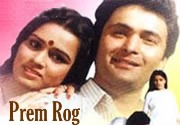
Prem Rog
Synopsis:
Raj Kapoor loved a white dress almost as much as he loved a sweeping string section, and honestly, sometimes the repetition of that visual motif gets a little exhausting when you are three hours deep into his filmography. Prem Rog opens with a mud-splattered Rishi Kapoor tumbling off a horse, which is fine, but then we have to sit through about ten minutes of broad rural comedy involving village simpletons before the actual picture gets going. If I am being entirely honest, that opening stretch feels like it was directed by someone who had one eye on the box office ledger and the other on lunch. Yet once the narrative locks into its central tragedy, the film shifts gears into something fierce and uncompromising, demanding that the audience watch a patriarchal social structure tear itself apart from the inside out.
The screenplay, credited to Jainendra Jain alongside Kapoor himself, takes the classic boy-meets-girl template and breaks its legs before the intermission. Devdhar is a humble orphan raised on the estate of a wealthy feudal family, and his childhood attachment to the aristocratic Manorama turns into a burning, obsessive fixation that defies every rule of caste and class. When Manorama is widowed at a tragically young age, her husband having died under murky, hurried circumstances, the household expects her to crawl into a corner and fade away into a spectral existence of white saris and endless prayer. Kapoor refuses to let her fade, charging back into her life after years away, only to find that the girl he worshipped has been effectively erased by ritualized cruelty and superstition. The direction during these domestic sequences relies heavily on long, stifling corridor shots and oppressive indoor lighting that makes the ancestral mansion feel like a mausoleum with a mortgage.
Padmini Kolhapure was only seventeen when she made this, which makes her complete control over the second half of the movie nothing short of astonishing. She does not play Manorama as a passive victim waiting for a savior, even though the script occasionally tries to wedge her into that traditional mold. Her eyes do the heavy lifting in scenes where the elders are screaming ancient edicts at her, conveying a dull, persistent horror that stays long after the scene cuts away. Opposite her, Rishi Kapoor trades the sweater-wearing romantic goofiness of his earlier hits for a jagged, desperate intensity that feels genuinely unhinged at times. He is not a polished hero. He screams, he throws things, he makes an absolute fool of himself in front of high-society wedding guests because he cannot comprehend why the woman he loves must wear white for the rest of her days just to satisfy the egos of dead men.
Laxmikant-Pyarelal’s score leans heavily into the melodramatic register, utilizing the song "Yeh Galiyan Yeh Chaubara" with such frequency that you will be humming it in your sleep whether you want to or not. It is a small thing, but the constant recycling of that specific melody during flashbacks starts to feel like a crutch when the visual storytelling is already doing the job quite well. Still, the musical numbers function as emotional pressure valves in a narrative that would otherwise be entirely airless. The cinematography by Radhu Karmakar captures the stark class divide through framing alone, keeping the wealthy patriarchs elevated on high verandahs while Devdhar and the working-class villagers are always shot from below, looking up through dust and sunlight.
Raj Kapoor had already tackled big social issues in films like Satyam Shivam Sundaram, but here the fury feels more grounded in the everyday realities of rural Uttar Pradesh rather than abstract mysticism. The supporting cast brings a lived-in texture to the proceedings, particularly Shammi Kapoor as the gruff, sympathetic uncle who tries to mediate between modern law and ancient tradition without getting his own hands too dirty. Nanda and Tanuja add layers of quiet complicity and silent suffering as the women who have internalized their own oppression so deeply that they actively police the younger generation. It is worth noting how similar the emotional trajectory is to Bimal Roy's Sujata, though Prem Rog replaces that film's quiet social observation with a series of emotional sledgehammers.
Hindi cinema has rarely been subtle when dealing with widow remarriage, and this movie is no exception, shouting its message from the rooftops during the courtroom and village council sequences near the end. The climactic confrontation on the temple steps relies on a level of theatrical speechifying that tests the patience, pushing the boundaries of what an audience can accept from characters who have spent two hours acting like real, bruised human beings. Yet the sheer conviction of the performances saves the enterprise from collapsing into pure propaganda. When Manorama finally stands up in front of the assembled village elders and refuses to accept her assigned doom, the emotional payoff works precisely because Kolhapure and Kapoor have earned every single tear along the way, making it a difficult picture to shake off once the lights come up.