

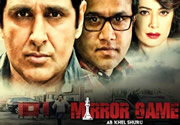
Mirror Game
Synopsis:
Okay so let's back up a second because Mirror Game throws you right into the deep end of psychological thrillers without handing you a floatie first.
Jay Kapoor is just trying to teach psychology, which is already a chaotic career choice in most hindi movies, but he gets completely tangled up in this massive web of lies, murder, and academic backstabbing.
Parvin Dabas plays Jay with this permanent expression of mild annoyance mixed with total terror, and he's joined by Dhruv Bali who brings a whole lot of brooding energy to the screen.
Pooja Batra shows up too and she's just commanding every single room she walks into while wearing these insanely sharp blazers that probably cost more than my entire apartment.
So Jay is a professor and he's got this super intense obsession with the human mind, perception, and reality, which sounds cool until you realize it actually means he's about to ruin his own life and everyone else's around him.
And then boom, a murder happens and suddenly the police are asking really hard questions that Jay definitely doesn't have good answers for.
Let's talk about the background details for a quick second because I couldn't stop staring at this one extra in the lecture hall scenes who wears the most hideous mustard-colored knitted vest that looks like it survived a house fire from 1994.
Nobody else in the movie acknowledges the vest, the characters are talking about life-or-death stakes and psychological manipulation, but my eyes were just glued to that terrible yarn.
Anyway, the plot moves forward and people start turning up dead or missing, and Jay is right in the middle of it all sweating through his button-down shirts.
We hit the interval point right when things are getting genuinely unhinged and you're sitting there eating your popcorn wondering how the director is going to untangle this giant mess in the second half.
Bollywood movies love to throw a curveball at the intermission, and Mirror Game is no exception because right as the tension peaks, the screen cuts to black and forces you to stare at your own reflection in the dark phone screen for fifteen minutes.
Coming back from the break, the film decides we need a pacing shift and things get even more convoluted with secret alliances, blackmail, and cops investigating crimes with the enthusiasm of people waiting in line at the DMV.
Dhruv Bali's character is plotting things in the shadows and you never really know whose side he's on because he keeps switching his loyalties faster than I change my mind about ordering takeout.
Stuff happens and characters start double-crossing each other in empty warehouses and dimly lit parking lots because apparently nobody in this universe has ever heard of indoor lighting or safety precautions.
Pooja Batra drops some cold dialogue that basically spells out how screwed everyone is, and she doesn't even blink while delivering lines that should probably come with a warning label.
If you like standard commercial bollywood fare with huge dance numbers and happy endings, this isn't it because this indie-style thriller belongs firmly in the darker corners of modern hindi cinema where everyone loses and nobody gets a consolation prize.
Jay realizes he's been played as a pawn in a much bigger game orchestrated by people way smarter than him, and his grand psychological theories completely collapse around him into a pile of ash.
The twists come fast and furious at the end, wrapping up years of deceit in about three rushed minutes where characters confess to crimes they didn't commit just to keep the plot moving.
Jay sits alone in a cold, sterile interrogation room staring blankly at a cracked mirror on the wall.
Jayashankar's camera lingers on a badly painted doorframe in the opening sequence for maybe three seconds too long, long enough for you to wonder if the projectionist is having a seizure or if the DCP just stuttered. It’s a small thing, but it bugged me, setting a tone of minor friction that the rest of the picture never quite shakes off. Mirror Game doesn't want to be easy. It wants you to sit there squinting at the edges of the frame while characters argue about intellectual property rights and university politics in rooms that smell faintly of damp carpets and instant coffee. If I'm honest, the whole academic thriller angle feels like someone watched a bootleg of The Paper Chase after drinking four Red Bulls and decided they could crack the Indian market with it. Yet there's a stubbornness to the construction here that keeps you from checking your phone, even when the dialogue starts looping back on itself like a cheap cassette tape caught in the deck.
Parvin Dabas plays a psychology professor whose life has gone sideways in that specific, dreary way that involves beige cardigans and drinking lukewarm tea out of chipped mugs. He carries an exhaustion that looks earned, not pasted on by a makeup artist who spent forty minutes airbrushing stubble onto a jawline. When he speaks, his voice drops into this gravelly register that forces the back rows of the theater to lean forward, although half the time he is muttering lines that sound like they were translated from a German textbook by someone who learned English via satellite television in 1994. Beside him, Dhruv Bali brings a coiled, twitchy energy to the proceedings that occasionally threatens to blow the hinges off the scenes he shares with the older actor. Bali is not doing subtle work, not by a long shot, pacing around desks and jabbing his index finger at pieces of looseleaf paper as though every memo contains state secrets. It reminds me a bit of Kay Kay Menon in Gulaal, that same unsettling intensity where you cannot quite tell if the guy is about to weep or shatter a window with his bare fists.
The screenplay, credited to Shailendra Jha who also takes the director’s chair, operates on a logic of escalating paranoia that feels borrowed from late-night radio dramas. Characters walk into empty lecture halls and discuss blackmail schemes in normal conversational volumes while janitors push brooms ten feet away. That sort of carelessness happens in mediocre hindi films all the time, pulling you right out of the illusion just when the tension is supposed to be tightening around your throat. But Jha compensates for the plotting holes by staging conversations in claustrophobic spaces where the shadows do heavy lifting. The lighting isn't fancy, yet it creates a genuine sense of dusk settling over institutional corridors that have seen better decades. There is a recurring piano motif on the soundtrack that hits every single time a character has a realization, which gets grating around the fourth repetition, hammering the mood home with a brick instead of a feather. Cinematographer Uday Singh uses shallow focus like a crutch to isolate faces from their messy backgrounds, creating an artificial tunnel vision that matches the protagonist's shrinking world.
Pooja Batra shows up midway through with an air of practiced weariness that grounds some of the more preposterous turns in the second act. She plays the dean’s estranged partner or colleague or something equally administrative, her exact title gets buried beneath layers of bureaucratic mumbo-jumbo that nobody bothered to clarify in the script notes. She shares a cigarette with Dabas on a concrete balcony while traffic grinds to a halt below them, and for two minutes the picture actually breathes. You get a glimpse of the movie this could have been if the budget had allowed for four more drafts and a bit more trust in the audience's attention span. Instead, the narrative keeps snapping back to the central gimmick, this theatrical workshop game where participants have to mirror each other's physical movements until lines blur and identities fracture. It is a neat metaphor for academic plagiarism and psychological manipulation, sure, but it gets literalized until the actors are basically pantomiming schizophrenia under fluorescent tubes.
Hindi movies have a long, awkward history of trying to import Western intellectual thriller tropes without adjusting the local plumbing, resulting in pipes that rattle and leak at the joints. This project doesn't entirely escape that curse, dragging its feet through expository dialogue dumps that explain plot points we figured out twenty minutes prior during the scene with the photocopier. Yet Dabas manages to anchor the madness with a performance that stays inside its own skin, refusing to play for cheap sympathy even when the script practically begs him to weep into his porridge. He just looks tired. That tiredness is probably the most honest thing in the entire production, outlasting the twists, the implausible blackmail threats, and the shaky hand-held camera movements that signify dramatic urgency. By the time the credits begin to crawl over a blank charcoal screen, you realize you haven't watched a slick machine of suspense, but rather a stubborn, clumsy artifact that tried its damnedest to reach for something darker than standard Bollywood fare usually permits.