

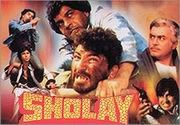
Sholay
Synopsis:
Halfway through the film, Thakur is sitting there in the dust with his empty sleeves flapping in the wind while Gabbar Singh is literally kicking him and taunting him about how kitne aadmi thhe, and it is just so intense and brutal, but to understand why we are even at this point you have to go back to the very beginning of the whole mess where this retired police officer needs some serious revenge and hires two small-time crooks to do his dirty work.
The two crooks are Veeru and Jai, played by Dharmendra and Amitabh Bachchan, and they are introduced in this fantastic, insanely long train robbery sequence where they are chained together in a police wagon and have to fight off horse-riding bandits using a giant coin to flip heads or tails on whether they should shoot or duck, and they are just the coolest guys ever, wearing these dusty denim jackets and messing around with a harmonica.
So then they get hired by Sanjeev Kumar's character, this stern retired cop named Thakur Baldev Singh, who invites them to his rugged village of Ramgarh because the local police are too scared to touch a terrifying, snarling bandit leader named Gabbar Singh, and Amjad Khan plays Gabbar with this greasy hair and rotten teeth and a leather belt that he whips against pillars while laughing like a maniac, and he's easily one of the most iconic villains in the entire history of bollywood movies.
Anyway, Veeru and Jai show up in the village and immediately get distracted by romance, and Hema Malini plays this wildly talkative village girl named Basanti who won't stop chattering while she drives her horse carriage, and Dharmendra has this hilarious scene where he gets drunk on top of a giant water tank and threatens to jump off unless her aunt lets him marry her, which is just classic comedy.
And there is also this other quieter romance going on with Jai and Thakur's widowed daughter-in-law Radha, played by Jaya Bhaduri, where they barely say a single word to each other, but you can tell they're into one another just by the way she plays with her little lantern at night and he watches her from the porch, and they even brought along Sachin as this sweet teenage orphan boy named Ahmed who plays the flute and tries to help out around the farm.
Right after that, Gabbar attacks a local train full of police officers and completely massacres them to send a message, and then he rides into Ramgarh to punish the villagers by slaughtering poor little Ahmed in the middle of the dusty square, and this is where you find out why Thakur doesn't have any hands because a flashback shows Gabbar brutally chopping them off with a sword years ago.
So the dynamic duo has to fight a massive battle against Gabbar's entire gang at the rocky quarry hideout where bullets are flying everywhere and people are getting shot left and right, and Jai ends up sacrificing his life in this really dramatic explosion on a bridge to save Veeru from a swarm of bad guys.
Veeru gets super angry and goes after Gabbar alone, beating him to a bloody pulp in the mud, and just as he's about to strangle the villain to death, Thakur limps up with heavy spiked shoes on his feet and stomps on Gabbar's hands to avenge his family before the police finally show up and drag the bleeding criminal away.
Veeru gets on the train and leaves Ramgarh alone while Basanti watches him go from the tracks.
The horses kick up an absurd amount of dust before anyone even speaks, and honestly, if I am honest, that amber-tinted haze never really clears for the next three hours. Ramesh Sippy wasn't reinventing anything when he pointed his camera at the red ravines of Ramanagara, but he understood how to stretch a wide-screen frame until it felt like the sky was actively pressing down on the characters. It is a big, noisy movie that somehow finds room for tiny, quiet moments of desperation, even if some of the day-for-night shooting looks a bit muddy on older prints. You have Jai and Veeru bouncing a coin between them to decide who takes the risky end of a village rescue, a little visual motif that gets repeated perhaps one time too many before the intermission hits. Salim-Javed wrote a script that gives everyone from the comic relief to the village elder at least one sharp-edged sentence that stays in your teeth long after the lights come up. That screenplay operates like a Swiss watch dropped into a blender, mixing traditional revenge tropes with the kind of banter you usually find in a buddy comedy from a completely different decade.
Sanjeev Kumar plays Thakur Baldev Singh with the sort of heavy-lidded exhaustion that makes you forget he is wearing a crisp white shawl in forty-degree heat. He doesn't raise his voice much, letting the missing arms inside his sleeves do most of the dramatic lifting, which is a neat trick that keeps the melodrama from boiling over into pure camp. Opposite him, Amjad Khan arrives as Gabbar Singh with a laugh that sounds like dried leaves scraping across concrete and completely reorders the power dynamics of commercial Hindi films. People talked about his voice for years afterward, that high-pitched rasping delivery that made a simple dialogue about fifty rupees worth of reward money sound like a death sentence delivered by the postman. He chews tobacco and paces around rocks with a manic energy that leaves Dharmendra and Amitabh Bachchan looking almost casual by comparison, though Bachchan has that slow, deliberate way of loading a rifle that tells you everything you need to know about his past.
Dharmendra plays Veeru with his shirt half-open and a bottle of country liquor tucked into his waistband, bouncing off Bachchan’s melancholic cool like a pinball with a drinking problem. Hema Malini talks too much as Basanti, a character who could have easily been written off as annoying noise if the actress didn't have such precise comic timing when she is threatening her horse with a beating. Then you have Jaya Bhaduri sitting quietly in the corner of every scene in a white saree, managing to register profound grief without ever chewing the scenery or stealing focus from the men yelling around her. Even Sachin gets a brief, tragic run as the blind boy who walks into the village square with a lantern, setting up a sequence where the camera tracks his little footsteps with an agonizing amount of patience. It is an enormous cast where nobody gets lost, except maybe the local police inspector who mostly exists to run in after the gunfire has already stopped and look slightly confused by the mess.
The background score by R.D. Burman uses mouth organs and heavy percussion to anchor scenes that might otherwise float away into pure abstraction. When the train robbery sequence starts in the opening reel, the percussion kicks in with a rhythmic chug that matches the locomotive wheels before dropping out entirely to let the sound of wind take over. Dwarakayanth's cinematography uses shadows with a painterly touch, especially during the nighttime raids where Gabbar’s gang emerges from the ravine like beetles crawling out of the earth. You can feel the heat radiating off the rocks in the afternoon scenes, that yellowish glare that makes everyone squint and sweat through their makeup. It is a muscular visual style that feels closer to Sergio Leone than anything coming out of Bombay studios at the time, though Sippy keeps the emotional core rooted firmly in domestic melodrama and familial duty rather than pure nihilism.
Underneath all the gunfights and horseback stunts, the story is really about property rights and the fragile ecology of a small farming community terrified of losing its harvest to bandits. The state is represented here by a retired police officer who has to recruit two small-time criminals because the formal legal system is too slow and too far away to matter. That dynamic runs through the entire narrative like a dry creek bed, asking uncomfortable questions about who actually owns the land and who gets to protect it when the badge isn't enough. It's a theme that older Hindi movies loved to chew on, pitting the collective strength of the village against the singular, predatory greed of the landlord class, though Sholay wraps that social critique in so many explosions and bullet squibs that you barely notice the political argument happening in the background. The revenge plot serves as an excuse to clear the slate, letting two drifters find a home by destroying the threat that made settling down impossible in the first place.
There is a recurring problem with some of the voice dubbing on the minor villain roles, where the sound doesn't quite match the lip movements in wide shots, but you forgive it because the sheer momentum of the second half refuses to let you stop and complain. When the final showdown arrives in the rocky quarry, with the Thakur using his feet to crush Gabbar’s fingers against the dirt, the film abandons all pretense of realistic combat and becomes a brutal, operatic ballet of raw thumbs and broken bones. It doesn't need a neat summary or a final moral lesson to justify its three hours and twenty minutes on screen. It just ends on a dusty road with one man riding off alone and the other staying behind to look after the ruins, leaving you to sort out the rubble while the credits roll in absolute silence.