

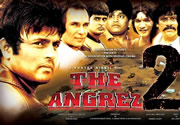
The Angrez 2
Synopsis:
There is literally Zeq McCoy standing in the middle of a dusty Hyderabad street wearing the most ridiculous neon orange sunglasses you have ever seen in your entire life while three guys on mopeds try to circle him and he just casually drops the line, nakko bhai, and slaps the first guy so hard his helmet flies off into a passing fruit cart, and honestly I stared at my screen for a good five minutes wondering how I ended up watching this specific sequel on a random Tuesday night.
So then to understand why Zeq McCoy is beating up moped riders in broad daylight, we gotta go back to the start and remember that this whole thing is part of a grand tradition of regional cinema that tries to capture the quirky flavor of old school hyderabadi comedy just like the first film did, except this time around we have Kuntaa Nikkil joining the chaos as his hyperactive sidekick who spends the first twenty minutes trying to sell fake watches to tourists outside Charminar.
The plot kicks off when these two lovable goofballs accidentally cross paths with a local gangster who is trying to smuggle a vintage radio stuffed with fake currency, and right when they should be running away, Kuntaa Nikkil decides to argue with the henchmen about the price of tea, which leads to this insanely long tracking shot following a stray goat that wanders through an open-air market while background extras are doing the most unenthusiastic choreography you will ever witness in any of the lower-budget hindi movies currently floating around the internet.
Anyway the gangster realizes the boys have the wrong radio and starts chasing them all over the old city, but instead of focusing on the actual crime thriller elements, the director suddenly decides to dump a completely random item song right before the interval block where everyone is dancing in a mechanic shop among old tractor tires for literally no narrative reason whatsoever.
Right after that heavy musical interruption, we hit the interval point with Zeq McCoy dangling upside down from a billboard while Kuntaa Nikkil throws chai at a villain's face, and honestly out of all the bollywood movies I have suffered through this year, this specific intermission cut made me laugh out loud because it didn't resolve a single plot thread.
The second half moves at the speed of light because they suddenly get kidnapped, escape through a sewer pipe, find the real money, and confront the boss in an abandoned warehouse.
Zeq McCoy walks up to the main villain, gives him a stern look, and kicks him straight into a giant pile of empty cardboard boxes.
The police show up out of nowhere with sirens blaring, the bad guys put their hands up without even trying to fight back, and Kuntaa Nikkil grabs a megaphone to yell one final joke at the cops before the screen abruptly cuts to black with the credits rolling over a blooper reel.
The sound mix on the establishing shot of Charminar is about four decibels too loud, which shouldn't bother anyone except it happens three more times before the interval block. Hyderabad looks sun-bleached and slightly desperate in The Angrez 2, trading the hyper-saturated sheen of mainstream Hindi movies for something dustier, grease-stained, and altogether more honest about how the local tea-stall culture actually functions under a brutal July humidity.
Zeq McCoy walks through these frame corners with a strange kind of vertical stiffness that feels half like intentional character work and half like an actor who was told to find his mark and then forgotten about by the second assistant director. Beside him, Kuntaa Nikkil operates on an entirely separate frequency of comic timing, chewing through dialogue with a casual, off-hand rhythm that makes most contemporary Bollywood dialogue writing look like it was translated from a German operating manual by someone who hates joy. They aren't trying to save a genre or reinvent indie cinema, which is mostly a relief.
The direction by whoever was actually holding the monitor that Tuesday—production credits on these regional sequels get awfully muddy after the second week of shooting—relies entirely on medium-close coverage that occasionally cuts off an actor's chin just to keep the energy moving. It reminds you of how Ram Gopal Varma used to shoot a room full of shady guys arguing over percentage points in Company, except nobody has bothered to light the corners properly so half the supporting cast is swimming in a muddy brown blur that hides their reaction shots.
Screenplay-wise, the whole thing sags terribly around the forty-minute mark when two cousins get into an argument about a Vespa that has already been sold in the first scene, a continuity slip that the editor clearly tried to fix by throwing in a reaction shot of a stray dog. If I'm honest, the dog was the best actor in that specific sequence because it managed to look confused without over-projecting to the back row.
There is a recurring background gag involving a man trying to fix a faulty neon sign for an internet café that gets funnier every time they drop back to it, mostly because the actor never changes his expression of quiet, existential defeat. McCoy handles his deadpan delivery with enough dry authority that you almost forget how thin the actual narrative spine is beneath him. Nikkil, meanwhile, bounces off walls with a rubbery physicality that occasionally threatens to knock over the cheap plastic tables they're sitting at, bringing a chaotic energy that prevents the conversational scenes from flatlining into pure exposition.
Cinematographerially, the camera moves with a jerky handheld urgency that implies a lot of running up and down stairwells with a shoulder rig and a dying battery, which works well enough during the street chases even if you can't tell who is chasing whom for about thirty seconds. The soundtrack leans heavily on a cheap accordion loop that plays whenever someone mentions going to Dubai, and after the sixth time it happens, you start wishing the characters would just stay home and finish their Irani chai in peace.
Bollywood movies have spent the last decade trying to sand down every rough local edge until everything looks like a glossy airport lounge in Bandra, so seeing a picture that is actively proud of its own low-resolution texture feels like finding an old cassette tape in the glove box of a second-hand autorickshaw. It captures the specific cadence of Old City banter without feeling like an anthropologist wrote it for an audience in South Mumbai.
The themes don't stretch much further than the cost of living, the impossibility of getting a visa, and how annoying your uncles are at family weddings, which is plenty of thematic weight for ninety minutes of comedy. No one is carrying the weight of generational trauma on their shoulders here, they are just trying to borrow five hundred rupees from a cousin who hasn't answered his phone since Tuesday.
That supporting actor who plays the landlord with the eyepatch is clearly dubbed by someone twenty years younger, and the voice mismatch pops out of the audio track every time he raises his voice about the overdue rent. It's a small thing, but it bugged me every time he walked into a frame because his lips were moving two frames ahead of the sound coming out of the tinny speakers.
When the film just lets McCoy and Nikkil sit on a curb and argue about the correct way to fry Samosas, it hits a strange, loping rhythm that most modern Hindi films are too impatient to allow themselves, rushing instead toward some mandatory emotional beat that nobody in the audience believes for a second. The ending doesn't resolve anything major because characters like these don't get character arcs, they just get older and find new places to sit when the tea stall closes for the afternoon.