

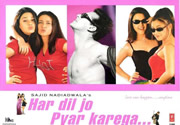
Har Dil Jo Pyaar Karega
Synopsis:
Halfway through the film, Salman Khan is standing in a hospital corridor wearing this extraordinarily shiny teal shirt that somehow has about eight different pockets and zippers on it, and he's totally panicking because he's about to be caught in a massive web of lies. But to understand why he's sweating through this ridiculous designer top, you have to look at how this whole messy situation started back when he was just an ambitious guy trying to make it big as a singer in the bustling city of Mumbai, which is basically a rite of passage for heroes in classic bollywood movies. He's trying to get his big break, singing in clubs and living a pretty standard struggling artist life until he witnesses a horrific car crash and saves a young woman named Pooja, played by Rani Mukherjee, who ends up going into a deep coma after the accident. So then Salman's character, Raj, visits her in the hospital every single day and the grieving family mistakes him for Pooja's secret husband, and because they're old and frail and practically falling apart from sorrow, he just doesn't have the heart to shatter their world by telling them the truth, so he plays along and moves into their sprawling house as their dutiful son-in-law. Right after that, Raj crosses paths with Jahnvi, played by Preity Zinta, who happens to be Pooja's best friend and roommate, and she's dealing with her own messy life and ends up moving into the exact same sprawling household as a paying guest because her uncle, played by Paresh Rawal, thinks it's a safe place for her, and honestly Paresh Rawal is just delightful here playing the quirky guardian who's always yelling at servants and getting mixed up in everyone's business. There is this one scene that goes on for an eternity where Paresh Rawal's character is trying to fix a broken ceiling fan while arguing with Shakti Kapoor about the price of onions, and he's wearing these oversized plaid trousers that keep falling down every time he reaches for a wrench, and I swear this random comedic filler takes up ten whole minutes of runtime before the plot even remembers it exists. Anyway, Raj and Jahnvi start hanging out all the time, singing songs, dodging suspicion, and naturally they fall head over heels in love with each other, even though Raj is technically still pretending to be married to the comatose Pooja upstairs, which creates this intensely awkward love triangle that's peak late nineties romance drama. The songs are playing everywhere, and if you know anything about hindi films from this era, you know the music is the glue holding the entire production together, and Har Dil Jo Pyaar Karega is no exception because every single track became a massive chartbuster that people were blasting from every car stereo across the country. They sing in the snow, they dance in colorful costumes, and Salman Khan brings that specific brand of lovable rogue charm that made him a megastar in the broader world of bollywood movies, flashing his dimples and wearing pastel sweaters like it's nobody's business. Things get super complicated when Jahnvi finally discovers the whole truth about the fake marriage, and she's heartbroken and angry, but then the ultimate plot twist drops because Pooja suddenly wakes up from her coma with no memory of her past or her actual fiancé, and she instantly latches onto Raj because she genuinely believes he's her husband. Just like that, Raj is trapped again. He's taking care of Pooja to protect her fragile mental state, while Jahnvi is standing on the sidelines watching the man she loves play house with her best friend, and the emotional turmoil is just off the charts. Neeraj Vora and Satish Shah show up as a couple of nosey neighbors who add to the comedic chaos by spreading wild rumors about who is sleeping in which room, and honestly their comedic timing is pretty solid even if the script gives them very little to work with besides yelling at each other in the hallway. Kamini Kaushal plays the doting grandmother with so much sweetness that you just want to give her a hug, and Rajiv Verma and Ajit Vachani pop in as various family members who nod approvingly whenever Salman sings a lullaby or fixes a leaky pipe. The funny thing is, nobody in this house ever seems to have a real job, they just wander around massive living rooms discussing marriage prospects and crying over framed photographs. So the drama peaks at a grand family wedding celebration where all the secrets are finally dragged out into the open for everyone to see, leading to a massive emotional showdown where Pooja realizes she actually loved someone else all along, freeing Raj and Jahnvi to finally run toward each other across a crowded train station platform. They hug. Credits roll.
Rajiv Verma's voice in the first twenty minutes of Har Dil Jo Pyaar Karega sounds remarkably like he recorded his lines inside a tin shed during a heavy downpour, and honestly, it takes you right out of the movie every single time he opens his mouth. Look, nobody is coming to a late-nineties Bollywood production expecting pristine ADR work, but when a supporting actor sounds perpetually divorced from the acoustic space of the room he is standing in, it creates a weird little barrier between the viewer and the emotional stakes. Raj Kanwar directs this stuff with a heavy foot on the accelerator, moving from slapstick misunderstandings to hospital melodrama without ever stopping to check if the tires are still on the pavement. You get the sense that everyone on set was working off three different drafts of the screenplay, which probably explains why the tonal whiplash between Paresh Rawal shouting comedic non-sequiturs and Salman Khan looking deeply, soulfully pained hits you with the subtlety of a rolling pin to the forehead.
Salman plays Raj, an out-of-work singer who rescues a woman from a train track and then somehow ends up pretending to be her comatose fiancé to protect her fragile grandmother, which is the kind of convoluted premise that requires enormous suspension of disbelief even if you grew up on a steady diet of these things. He wears leather jackets and smiles with his teeth while carrying the weight of a deception that gets more tangled by the scene, channeling that specific brand of earnest heroics that made him a megastar before his persona curdled into something entirely different. There is a moment where he looks at Rani Mukherjee through a pane of hospital glass while she cries about her lost love, and he manages to communicate a kind of clumsy, flustered guilt that feels surprisingly lived-in for a movie that spends most of its runtime operating at maximum volume. He isn't doing anything revolutionary, but he understands the assignment better than anyone else on the call sheet, holding the center of a narrative that threatens to fly apart from centrifugal force every time Shakti Kapoor shows up to chew the scenery.
Rani and Preity Zinta split the romantic duties down the middle, though Preity gets the shorter end of the stick once the plot mechanics kick into high gear and force her into a corner of quiet self-sacrifice. She brings that fizzing, high-energy charm that defined her breakthrough era, reminding you why she felt like a genuine breath of fresh air in hindi movies back when most female leads were still expected to just look pretty and wait by the window. When she sings or dances, she looks like she is genuinely having a blast, whereas Rani plays the tragic widow-in-waiting with deep, heavy-lidded sighs that belong in a completely different genre of cinema altogether. They have an easy chemistry with Salman that prevents the love triangle from feeling entirely mechanical, even if the script treats their emotional trajectories with the delicate touch of a bulldozer. Neeraj Vora and Satish Shah pop up for comic relief that mostly consists of people yelling at each other in cramped living rooms, a staple of the era's comedies that has aged worse than milk left on a radiator.
The Anu Malik soundtrack dominates the entire enterprise, for better and frankly mostly for worse, because that title track gets recycled as background score, transition music, and emotional cue roughly forty-five times before the credits roll. If I hear those synthesized flute stabs one more time, I might lose my mind, but you cannot deny that the songs punch above their weight in terms of sheer earworm tenacity. Cinematographer Harmeet Singh shoots the musical sequences with saturated primary colors and soft-focus lenses that make every outdoor location look like a scented greeting card, capturing a very specific aesthetic of late-nineties commercial filmmaking where budget constraints were papered over with lots of sparkly fabrics and wind machines. It is bright, it is loud, and it refuses to let you have a single quiet second to contemplate the sheer absurdity of the plot developments unfolding on screen.
Underneath the gloss and the comedy routines, the film actually pokes around at some fascinating questions about identity theft and performative love, though it is far too busy rushing to the next song to really dig into them. Raj has to perform not just as a singer, but as a son, a fiancé, and a moral anchor for two entirely different families who think the world of him, effectively turning himself into a human sponge for their grief and affection. It bears a strange, accidental resemblance to the themes of deception and borrowed identity found in something like Raju Ban Gaya Gentleman, though without that movie's sharp-elbowed ambition about urban survival. Instead, this story settles for a more domestic, melodramatic resolution where all secrets are eventually dragged into the light and everyone has to forgive everyone else because blood and marriage ties demand it. Kamini Kaushal plays the blind grandmother with a fierce, trembling authority that anchors the emotional third act, grounding all the silly lies and musical numbers in a genuine register of maternal vulnerability.
There is a sloppy charm to the whole mess that makes it hard to dismiss outright, even if the editing decisions often feel like they were made by someone working with a pair of scissors and a blindfold. A reaction shot lingers a beat too long on Satish Shah's face after a punchline that didn't land, deadening the comedic rhythm and leaving everyone waiting for the next scene to start. Those little technical scuffs accumulate over three hours, reminding you that commercial Bollywood movies of this vintage were often cranked out on a assembly line fueled by caffeine and deadlines. It does not reinvent the wheel, and it certainly doesn't hold up under any kind of rigorous structural analysis, but it moves with enough blustery confidence to carry you past the rough patches. You leave the theater or close the streaming app remembering the sheer scale of the hair gel on display and the way Preity Zinta throws her head back when she laughs, which might honestly be enough.