

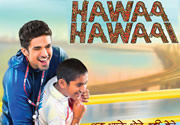
Hawaa Hawaai
Synopsis:
There is literally nothing better than watching a random kid on a bicycle chase after a high-end sports car on the streets of Mumbai while a catchy track blares in the background, which is basically what happens when you decide to sit down and watch Hawaa Hawaai. But to understand why everyone is screaming on the pavement and why a bunch of kids are covered in grease, we gotta go back to the start where young Arjun, played brilliantly by Partho Gupte, arrives in the big bad city with his mom after his dad passes away, and he has to start working at a local tea stall just to survive.
So then, Arjun is basically stuck washing glasses and serving chai to rude customers all day long while dreaming about the skies, and he spots these fancy roller skates hanging in a shop window like they are made of solid gold, and honestly, the way he stares at those skates for way too long is so relatable because we have all wanted something completely out of our budget just because it looked shiny.
The funny thing is, Saqib Saleem shows up as Aniket Bhargava, this former skating champion who now runs a catering business or something, and he is just chilling with his cool shades and his supportive coach girlfriend Pragya Yadav, who plays Anjana, and she is just walking around in these extremely chill kurtis giving everyone good advice while drinking coconut water. Right after that, Arjun bumps into Aniket because kids running around Mumbai streets will always crash into someone important, and instead of getting mad, Aniket notices this poor chai delivery boy has some crazy natural balance and insane footwork on foot.
So then we hit the interval point, which in classic Bollywood movies always happens right when things are getting juicier than a fresh mango, and everybody takes a bathroom break to eat samosas while arguing about whether the second half can possibly live up to the first.
Anyway, after the break, Aniket decides to secretly mentor Arjun because traditional coaches are total snobs who think poor kids belong in tea stalls instead of skating rinks, and they start sneaking around late at night to practice on empty roads and abandoned parking lots. They build this makeshift pair of skates using old parts and pure determination, and there is this training montage where Arjun falls down about fifty times, skins his knees, wipes away his tears, and gets right back up because Bollywood movies love making kids suffer for their art.
The funny thing is, Pragya Yadav is just standing on the sidelines looking very encouraging and eating street food while Aniket yells motivational dialogue like you can achieve anything if you just stop crying, and honestly, it is so cheesy yet so sweet.
So then Arjun gets good enough to enter the local skating competition, but drama strikes because his wicked uncle or some random relative tries to pull him out of Mumbai and drag him back to the village to work in a coal mine or some depressing place like that. Arjun runs away from the train station, steals a bicycle, and pedals like his life depends on it just to reach the stadium on time, which leads us right back to that opening scene where he is chasing the car.
He makes it to the race, straps on his skates, lines up against rich kids wearing imported gear that costs more than a small house, and the starter pistol goes off with a loud bang. Arjun skates like the wind, overtaking kids left and right while his friends and Aniket scream their lungs out from the grandstands, and he crosses the finish line just as the crowd goes wild.
Arjun stands on the podium holding his gold medal high in the air while smiling through his tears.
The extra blue in the skies of Amol Gupte's movies always looks slightly rented, like somebody ordered a gallon of it specifically for the morning shifts and forgot to wash out the bucket afterwards. That synthetic sheen hits you right at the start of Hawaa Hawaai, long before anyone starts talking about dreams or roller skates, and if I'm honest, it took me a good twenty minutes to stop squinting at the digital grading. It is a small thing that bugs me about modern Hindi films, this obsession with making every street corner in Bandra look like an advertisement for filtered water. But Gupte is not really interested in the grime of the city anyway, even when his characters are sleeping on pavements and eating dry bread out of greasy newspapers. He is chasing a very specific kind of fable-making where the poverty is just clean enough to photograph and the children speak in lines that sound like they were workshopped in a very expensive Mumbai writing seminar. Saqib Saleem plays Lucky, a kid who has drifted into town from some unspecified village with enough dust on his shoes to let you know he’s rural without needing an exposition dump about crop failures. Saleem spends the first half-hour doing that heavy-lidded, intense staring thing that actors do when they are trying to convince you they have a rich inner life that doesn't involve catering vans. It is a performance that is not great, not bad, just there, functioning mostly as a human clothesrack for the oversized jerseys and grease-stained aprons he has to wear while scrubbing plates at a local roadside joint. Then the skates show up. They are imported, shiny, professional-grade beasts that belong to a coach named Aniket Bhargav, played by Pragya Yadav with the stiff posture of someone who spent her entire prep period being told to keep her shoulders back by an overzealous modeling agent. Yadav doesn't have much to do other than look concerned, look impressed, and occasionally yell encouraging phrases that get swallowed up by the clatter of ball bearings on concrete. The dynamic between her and Partho Gupte’s character, a scrawny ragpicker named Arjun who spends his nights peering through the chain-link fence of a skating rink, is supposed to be the emotional core of the enterprise. Partho is Amol Gupte's son, and you can see the director coaching him just off-camera every time the kid flashes that gap-toothed grin that feels slightly too practiced for someone living under a staircase.
There is a scene near the middle where Arjun tries on a pair of skates that are four sizes too big, stuffing the toes with old plastic bags so his feet don't slide right out the front. It is a heavy-handed metaphor that practically trips over itself, but Gupte films it with such absolute, unironic sincerity that you almost forgive the clumsiness of the writing. He loves these grand gestures of innocence, framing his young actors against low-angle sunsets and making sure every single tear catches the afternoon glare just right. It reminded me of what Majid Majidi used to do in Children of Heaven before the international funding got too heavy, though Gupte lacks Majidi’s patience for quiet spaces where nothing is happening. Every frame in Hawaa Hawaai has to be doing something, whether it is pushing a socio-economic point about child labor or reminding you that dreams don't cost a dime even if a decent pair of skates costs more than a month’s rent for these kids. The screenplay lurches between gritty social realism and a weirdly sanitized sports-movie fantasy where the bullies are cartoonishly cruel and the mentors are saints who only need to hear a kid laugh once before they start coughing up cash for equipment. Saqib Saleem’s character undergoes a sudden personality shift that nobody bothered to write transitions for, going from a bitter, suspicious older boy to a grinning guardian angel the second the plot requires him to hand over his old wheels. That kind of narrative shortcut happens all the time in mainstream Bollywood movies, where emotional logic is routinely sacrificed on the altar of the next big song-and-dance cue. Speaking of the music, Hitesh Sonik’s score leans on these soaring string arrangements every time someone so much as looks at a pair of skates, turning every ordinary moment into the climax of a national championship. It gets repetitive very fast, that same three-note violin motif creeping up on you whenever the kids start running down an alleyway. By the time the third training montage rolled around with its mandatory slow-motion shots of dust kicking up off the asphalt, I found myself zoning out and looking at the background extras to see if any of them were actually trying to skate or just pretending while holding onto a metal railing.
The cinematography by Amol Gupte and a revolving door of camera operators is jittery when it wants to feel urgent and completely static when it wants to break your heart. That visual schizophrenia runs through the entire production, which can't seem to decide if it wants to be a gritty street-level document of Mumbai’s informal economy or a glossy inspirational poster for kids who want to win trophies. Partho Gupte carries most of this tonal weight on his tiny shoulders, and to his credit, he doesn't mail it in. His energy is infectious in the early scenes where he’s sliding across cardboard sheets on the floor of his cramped chawl, pretending he's on ice. There's a raw desperation to his movements that feels truer than anything in the script, a sense that he's actually trying to impress his father behind the lens instead of just hitting his marks. Yet the film keeps dragging him back down with dialogue that sounds like it was translated from a self-help pamphlet printed in the late nineties. The supporting crew of ragpicker kids—collectively known as the gang, though they mostly just stand around looking dirty and supportive—are given nothing to do except cheer for Arjun when he finally makes it onto the rink. One of them has a little stutter that disappears entirely whenever he has to deliver a long, emotional speech about how the rich kids are never going to let them win. It’s a small detail, but these little oversights accumulate until the whole thing starts to feel like a school play directed by an over-enthusiastic English teacher who read one too many books on urban poverty.
The climax is entirely predictable, structured around a local competition that carries all the life-or-death gravity of a neighbourhood cricket match despite the swelling orchestration trying to convince you it's the Olympics. You know every beat before it arrives, from the moment Arjun’s homemade skates start to fall apart on the track to the slow-motion tumble that precedes his triumphant recovery. There is no real room for surprise in a narrative this heavily engineered for maximum tear-jerking efficiency, which makes the two-hour runtime feel considerably longer than it actually is on the clock. Still, there is a strange, stubborn earnestness to the way Gupte shoots these sequences that prevents the movie from sinking completely into cynicism. He genuinely cares about these kids, even if he doesn't quite know how to write about them without turning them into walking symbols of resilience. When the credits finally roll over a montage of real-life underprivileged children posing with roller skates, you are left with the distinct impression of a film that meant very well indeed, even if it tripped over its own laces about halfway down the track.