

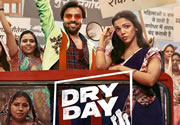
Dry Day
Synopsis:
Honestly, Dry Day is just one of those weirdly specific bollywood movies that you don't expect to be entirely about a guy waging a bloody, chaotic war against alcohol sales in his small town, but here we are.
Jitendra plays Gannu, this useless, directionless good-for-nothing who spends his days hanging out with his sketchy buddies and causing general chaos, and oh god, his hair in the first thirty minutes is just tragic, like why did the wardrobe department do him so dirty with that grease-ball mop?
Gannu is deeply in love with Nirupama, played by Shriya Pilgaonkar, and she is way out of his league, and she finally gives him a brutal ultimatum that she won't marry him unless he actually cleans up his act and becomes someone worth respecting instead of just being the local drunkard who crashes every wedding.
And then boom, Nirupama gets pregnant, and Gannu thinks his life is finally turning around, but stuff happens and things get messy because his local political patron, this slimy politician played by Annu Kapoor, completely betrays him and uses him as a scapegoat just to win local elections.
Annu Kapoor is chewing the scenery so hard in every single frame, like he's just having the time of his life being the absolute worst human being imaginable in the entire universe of hindi films.
Right when you think Gannu is going to redeem himself, we hit the interval block, and honestly, the interval point hits like a truck because Gannu publicly loses his mind after a random, wildly out-of-place song and dance sequence that completely breaks the dramatic tension of the narrative in that classic chaotic way typical of hindi movies.
Look, the second half just goes off the rails because Gannu decides that if he can't win the local election legitimately, he's going to run a massive anti-alcohol campaign to shut down every single liquor shop in the entire district just to spite the corrupt politicians who ruined his reputation.
Shrikant Verma shows up as this hilarious sidekick who is just constantly exhausted by Gannu's sheer stupidity, and honestly, Shrikant's facial expressions while holding a rusted bicycle chain are the true highlight of modern bollywood.
Gannu stands up on a makeshift stage in the middle of a massive riot, bleeding from his nose, and gives this roaring speech about prohibition and dignity that somehow actually sways the entire electorate.
The politicians try to frame him, beat him up, and pay him off, but Gannu refuses to back down even when his own friends start abandoning him because they just want a cheap drink on a hot afternoon.
Nirupama stands by him through the madness, giving him these looks of pure exhaustion that every person in a long-term relationship knows way too well.
The climax involves a massive, sweaty street brawl outside the local municipal office where Gannu literally tackles the corrupt MLA into a pile of cardboard boxes right in front of a live news camera.
Gannu wins the election by a landslide, the liquor shops get padlocked by court order, and he walks down the dusty street holding his newborn baby while grinning like an absolute idiot at the sky.
Jitendra Kumar wears a mustache that seems to precede him into every room, curling downward with the accumulated fatigue of a man who spends his afternoons shouting at municipal clerks who won't look up from their tea. It's a small thing, honestly, but that facial hair does about half the heavy lifting in establishing his character's total lack of municipal clout in a dusty Uttar Pradesh town where political ambition usually wears a brighter, much more expensive shirt. If I'm honest, the first twenty minutes of the movie had me checking my watch because the pacing drags its feet through the mud of standard small-town setup before anyone even mentions the titular alcohol ban that forms the backbone of the narrative. Saurabh Shukla directs with an earnestness that occasionally mistakes noise for momentum, leaning hard on background chatter and overlapping dialogue to create atmosphere when a simpler wide shot might have let the heat of the scene actually register on the actors' skin. The screenplay, credited to multiple writers whose fingerprints show in the lopsided tonal shifts, wants desperately to be a satirical punch to the gut of local politics while also pausing for domestic heart-to-hearts that feel entirely grafted on from a different, much gentler television script.
There is a specific kind of regional drama that Bollywood churns out every few months now where the grit feels manufactured in a writer's room in Bandra, and while Dry Day doesn't entirely escape that scent of artificial sweat, it manages to occasionally puncture its own slickness with genuine ugliness. Jitendra Kumar, shedding the beloved earnestness of his work in Panchayat, plays Gannu as a perpetually aggrieved loudmouth who isn't particularly good at being a criminal and is even worse at being a revolutionary. He stumbles through public meetings and private humiliations with a hunched posture that communicates physical and moral bankruptcy long before he opens his mouth to deliver another hollow threat to the local MLA. Shriya Pilgaonkar, playing his long-suffering partner, gets saddled with dialogue that often reduces her to a scolding moral compass, yet she rescues half her scenes by simply refusing to match Kumar's theatrical volume, dropping her voice until the camera is forced to lean in and catch the quiet exhaustion in her eyes.
The cinematography relies heavily on that over-processed golden-hour glow that makes every dusty alleyway look like it was color-graded by a reluctant algorithm trying to fulfill a Netflix mandate, flattening the actual texture of the dirt and grease. But then you get moments of unexpected stillness, like a long, unbroken take inside a cramped kitchen where the background noise of a ceiling fan dying a slow death creates more tension than any of the shouting matches happening out on the street. Shrikant Verma pops up as a rival fixer with oily charm and a leisure suit that looks like it hasn't seen a dry cleaner since the nineties, bringing a greasy vitality to scenes that would otherwise sink into regional-drama clichés. Annu Kapoor, chewing the scenery with the casual authority of a veteran actor who knows he can sleepwalk through his exposition scenes and still get a check, plays the aging patriarch with a gravelly growl that occasionally threatens to swallow his consonants whole. It reminds me of Pankaj Kapur's work in Maqbool, that same dense, stage-trained menace, though the writing here rarely gives Kapoor enough room to build a real monster instead of a cartoonish obstacle for the hero to bump against.
The soundtrack is a recurring irritation, mostly because the background score refuses to trust the audience to feel the weight of a betrayal without hitting a heavy percussion beat right on the emotional cue. Every time a character makes a bad decision—which happens roughly every twelve minutes—the strings swell with a melodramatic urgency that belongs in a much trashier soap opera, undercutting the dry, cynical humor that the actors are trying to dig out of the mud. That constant musical underlining becomes exhausting by the midpoint, telling you how to react before the cut even happens, and it is a baffling choice for a story that relies so heavily on the quiet indignities of everyday corruption. Hindi films have long struggled with knowing when to turn down the volume, mistaking silence for emptiness, and this movie falls into that exact trap whenever the narrative threatens to get genuinely uncomfortable or ambiguous.
Beneath the bluster of election rallies and bootleg liquor shipments, the film is actually interested in the slow erosion of male ego in places where the old feudal certainties are rotting away from the inside. Gannu isn't fighting for prohibition because he cares about public health or moral upliftment; he's fighting because his wife has a job that pays better than his ambitions, and the local political machine treats him like furniture they can rearrange whenever a bigger donor comes to town. That psychological claustrophobia gives the middle section a sharp, prickly energy that saves it from being just another streaming-service crime caper with a social conscience pasted onto the poster. The women in the story carry the practical burdens while the men posture with sticks and party flags, a dynamic that the script observes with a clear-eyed frustration that feels earned even when the plotting gets clumsy and improbable.
The climax abandons the messy, low-stakes realism of the first two hours in favor of a chaotic showdown at a wedding venue that feels entirely engineered by committee to hit every obligatory action beat without bothering to earn the emotional fallout. Characters make sudden moral about-faces that defy their established stubbornness simply because the running time is expiring and the streaming platform needs a neat resolution that can set up a second season if the metrics look good on Monday morning. Yet, even as the narrative careens off a cliff into predictable hero-redemption territory, Jitendra Kumar keeps his performance grounded in a kind of petty, pathetic smallness that refuses to let us mistake Gannu for a genuine freedom fighter. He remains just a small-time nuisance who got in over his head, and that refusal to turn him into a romantic rebel is the sharpest thing the movie does.