

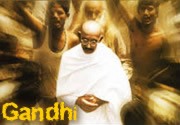
Gandhi
Synopsis:
In 1893, It is thrown off a South African train for being an Indian and traveling in a first class compartment. It realizes that the laws are biased against Indians and decides to start a non-violent protest campaign for the rights of all Indians in South Africa. After numerous arrests and the unwanted attention of the world, the government finally relents by recognizing rights for Indians, though not for the native blacks of South Africa. After this victory, It is invited back to India, where he is now considered something of a national hero. He is urged to take up the fight for India''s independence from the British Empire. It agrees, and mounts a non-violent non-cooperation campaign of unprecedented scale, coordinating millions of Indians nationwide. There are some setbacks, such as violence against the protesters and It''s occasional imprisonment. Nevertheless, the campaign generates great attention, and Britain faces intense public pressure. Too weak from World War II to continue enforcing its will in India, Britain finally grants India''s independence. Indians celebrate this victory, but their troubles are far from over. Religious tensions between Hindus and Muslims erupt into nation-wide violence. It declares a hunger strike, saying he will not eat until the fighting stops. The fighting does stop eventually, but the country is divided. It is decided that the northwest area of India, and eastern part of India (current day Bangladesh), both places where Muslims are in the majority, will become a new country called Pakistan (West and East Pakistan respectively). It is hoped that by encouraging the Muslims to live in a separate country, violence will abate. It is opposed to the idea, and is even willing to allow Muhammad Ali Jinnah to become the first prime minister of India, but the Partition of India is carried out nevertheless. It spends his last days trying to bring about peace between both nations. He thereby angers many dissidents on both sides, one of whom finally gets close enough to assassinate him.
Ben Kingsley stands in the rain outside a courthouse in South Africa and you can practically smell the wet wool of his European suit, which looks about two sizes too big for a man who weighs maybe ninety pounds dripping wet. If I'm honest, the whole opening sequence moves so fast through time that I felt like I was reading the Wikipedia page while running on a treadmill, but then things settle down once John Briley’s script stops trying to cram forty years into four minutes and actually lets the camera breathe for a second.
Richard Attenborough spent twenty years trying to get this movie made, hawking his own house and chasing reluctant studio execs who probably just wanted another Lawrence of Arabia knockoff with more sand and fewer speeches. He directs with a sort of dogged, honorable literalness that never quite reaches the visual poetry David Lean brought to the desert, though Billy Williams and Ronnie Taylor manage to find these stunning, washed-out tones in the Indian light that make you squint against the glare even in an air-conditioned theater. There is an enormousness to the crowd scenes—hundreds of thousands of extras, real people standing in fields in Bihar and Gujarat—that puts modern CGI blockbusters to shame because you can see the sweat on their foreheads and the genuine dust settling into their cotton dhotis. Still, the film has this habit of cutting away from a riot just as it gets genuinely terrifying, opting for a dignified distance that feels a bit like a high-end educational film made for British secondary schools in 1982.
Kingsley’s performance is the kind of tightrope walk you only see maybe twice a decade where an actor doesn't just play a historical figure so much as he seems to hollow himself out and let the ghost take up residence inside his bones. When he speaks, his voice has this reedy, carrying quality that never strains for effect, even when he is addressing a stadium full of people shouting him down over partition. Candice Bergen pops up as Margaret Bourke-White with a camera slung around her neck, looking sharp and modern and entirely American, though her scenes exist mostly to give the western audience someone who asks the obvious questions so Gandhi can deliver the philosophical answers without looking like he's just talking to himself. Edward Fox plays General Dyer at Amritsar with a chilling, clipped bureaucratic coldness that makes the Jallianwala Bagh massacre all the more nauseating because he treats slaughtering unarmed men, women, and children like he is clearing a bureaucratic backlog after lunch. John Gielgud shows up as Lord Irwin too, all aristocratic sighs and exhausted patience, looking like he'd rather be playing croquet at his country estate than dealing with a skinny lawyer who refuses to eat.
The soundtrack by Ravi Shankar and George Fenton leans heavily on traditional sitars and sweeping orchestral cues that sometimes tell you how to feel about five seconds before the emotional punch actually lands, which gets a little exhausting by hour three. It’s a small thing but it bugged me every single time—that exact same soaring flute motif returning whenever Gandhi walks toward a crowd, as if the audience might forget who the hero is if the woodwinds don't check in every ten minutes. Then again, the movie avoids the trap of most prestige historical dramas by not turning every conversation into a shouting match about destiny; instead, people mumble over tea, argue about spinning wheels in damp rooms, and look genuinely tired of the British Empire's endless, grinding paperwork. Kingsley captures that specific brand of stubbornness that isn't loud or theatrical, just an absolute refusal to move out of the doorway, which is much harder to make compelling on screen than a guy swinging a broadsword.
Looking at it alongside Richard Attenborough’s later work like Cry Freedom, you can see the same earnest liberal humanism driving the machine, though Gandhi benefits immensely from not having a white journalist as its primary narrative lens for the entire runtime. It lets Indians be the central agents of their own history, even if the British characters still get far too many dramatic close-ups when they look troubled about beating protesters with wooden lathis. Speaking of local cinema, the massive scale of these crowd numbers predates the booming commercial output of modern Bollywood movies that routinely fill theaters with twenty thousand dancers, yet Attenborough uses his thousands of extras not for spectacle but for weight, making every march feel heavy with actual bodies. The themes of civil disobedience and non-cooperation hold up remarkably well because the movie doesn't pretend the strategy was easy or that it didn't leave a trail of broken friendships and bitter compromises in its wake. When Nehru and Patel argue behind closed doors about whether partition is the only way to stop the country from burning down entirely, you feel the crushing weight of pragmatism destroying a dream in real time.
By the time the funeral procession arrives at the riverbanks, with cameras mounted on cranes looking down on an ocean of white caps stretching into the hazy distance, the film has earned its three-hour runtime through sheer accumulated detail and performance grit. It doesn't ask you to worship the man so much as it asks you to watch him figure out, step by painful step, how to make an empire trip over its own moral contradictions without throwing a single punch. The lighting in the final interior scenes gets remarkably dark, almost Rembrandt-esque, casting deep shadows across Kingsley’s face as he writes letters by candlelight in Birla House just hours before his assassination on the lawn. That closing shot of his ashes floating down the Ganges doesn't feel manipulative so much as it feels like an exhale after a very long, very hot day spent walking down dusty roads in the middle of nowhere.