

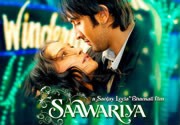
Saawariya
Synopsis:
Salman Khan wears a towel in this movie, which is a choice that demands some immediate adjustment from anyone sitting in a dark theater expecting a romantic drama. Not great, not bad, just there, hanging off his hips while he leans against a bridge singing about lost causes. It establishes a weird tone right out of the gate, stripping away the usual polish of a major Hindi film debut for the two leads and replacing it with something theatrical, blue-tinted, and stubbornly artificial. You can see the soundstages from space. Every brick of the bridge has been painted by an art director who likely hasn't smelled actual damp stone in decades, and Sanjay Leela Bhansali leans into that theatricality so hard it starts to feel like a fever dream directed by a man who only knows the world through snow globes.
The plot lifts its bones from White Nights, though Dostoevsky probably didn't imagine his melancholy Petersburg could be rebuilt as an enormous Bollywood set where it never stops raining turquoise light and the extras carry glowing lanterns like lost elves. Ranbir Kapoor plays Raj with a manic, puppy-dog energy that makes you want to hand him a Red Bull and tell him to sit in the corner for five minutes, bouncing through alleys and chasing stray dogs with a jazz-hands enthusiasm that feels entirely detached from the actual gloom of unrequited love. He wears a bowler hat and a oversized suit that nods heavily toward Charlie Chaplin in City Lights, except Chaplin knew when to stay still for more than two seconds. Opposite him, Sonam Kapoor plays Sakina as a woman carved out of marble who has been told she has to stand very, very still while people shout poetry at her. She looks gorgeous, absolutely, draped in rich greens and deep indigos that catch the rim light just right, but she spends most of her screen time gazing into the middle distance with the expression of someone trying very hard to remember if she left the stove on back home. The chemistry between them is mostly non-existent, though that might be the point since Raj is essentially falling in love with a ghost who is too busy plying her own heartbreak to notice he exists.
Then Salman shows up as Imaan, the mysterious lover who returns after a long absence, and the movie suddenly remembers it has movie stars in it and needs to give them actual things to do besides wander through neon-lit fog. Salman has this knack for standing completely still while everyone else is hyperventilating, which provides a weird anchor for a film that would otherwise float away into the ether of its own production design. Rani Mukherjee pops up as a hooker with a heart of gold who narrates the whole affair from a brothel that looks like an upscale Parisian parlor, complete with plush velvet and soft focus lenses that make her look like she is being filmed through a jar of Vaseline. It is a lot to process. The music by Monty Sharma tries to weld traditional ghazals with heavy orchestrations that swell every time someone looks mildly sad, and while the title track has a certain hypnotic drive, the background score uses the same four-note motif so often that you start hearing it in your molars whenever the screen turns blue.
Visually, the film is an absolute assault of turquoise and magenta. Ravi Chandran's camera glides over artificial canals and painted backdrops with a fluidity that borders on vertigo, treating every single frame like a greeting card that someone spent forty million dollars making. You have to hand it to the production team for refusing to compromise on their vision of a fantasy town, even if that vision looks like an abandoned theme park that has been thoroughly power-washed and rented out for a very expensive music video. There is an unmistakable sincerity to the whole enterprise. Bhansali isn't being ironic about any of this. He genuinely believes that people in love wear velvet waistcoats and burst into choreographed routines involving hundreds of extras holding umbrellas under an indigo sky. That commitment keeps the movie from sliding into total camp, though it gets dangerously close whenever Ranbir starts doing his little puppet dance on top of a piano.
The supporting actors are frequently dubbed by people who sound like they recorded their lines inside a walk-in closet, a small technical glitch that kept pulling me out of the romantic reverie every time a nameless shopkeeper shouted advice in a voice five decibels louder than the surrounding room. It is a small thing, but it bugged me. Hindi movies have long struggled with the tension between realism and pure spectacle, and this one doesn't even bother pretending to care about the former, opting instead for a hermetically sealed universe where nobody ever has to pay taxes or deal with traffic. They just pace along bridges and wait for the rain to start again.
Ranbir’s entry, dropping down from a rooftop while a chorus chants his name, tells you right away that the movie is more interested in myth-making than character arcs. He is playing an idea of a lover rather than a person, a collection of floppy hair and wide-eyed gestures borrowed from old musicals, and he pulls it off with a terrified, frantic energy that makes his later scenes of rejection land with actual bruising force. When he finally breaks down at the end, watching the woman he saved walk away toward the man she actually wanted, the camera lingers on his tear-streaked face for a beat too long, forcing you to sit in the awkwardness of his humiliation without any dialogue to smooth the edges.
There are worse ways to spend two and a half hours than staring at expensive wallpaper and listening to very loud strings, provided you have a high tolerance for directors who treat subtlety like a personal insult. It falls apart in the middle stretch where nothing happens except people staring at each other across courtyards while the lighting changes from dusk to dawn in the span of a single cut, ignoring all laws of physics in favor of emotional geometry. Yet the ambition behind it remains weirdly impressive. It is an artifact of a specific moment in the industry when big studios were still willing to finance wildly eccentric passion projects for debutants, betting the house on painted sets and classical melodrama instead of safe formulas.
The closing sequence drags out its farewells until you feel like you are attending a funeral for a stranger, with slow-motion pans that refuse to quit and musical swells that try to convince you that unrequited longing is the only valid human emotion. Raj stands alone on that same blue bridge, hands in his pockets, watching the snow fall down like bits of shredded paper from the grid above, and you realize the film has spent all its energy on the surface without leaving anything substantial underneath for the characters to actually chew on.