

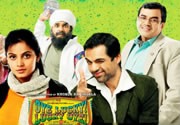
Oye Lucky! Lucky Oye!
Synopsis:
Abhay Deol wears a tracksuit that looks like it cost thirty rupees at a pavement stall in Lajpat Nagar, and he wears it with an absolute, unshakeable swagger that makes you almost forget he is breaking into heavily guarded South Delhi bungalows to steal silver tea sets and expensive VCRs. That exact visual detail, that commitment to the tackiness of upward mobility in a booming, post-liberalization India, is what keeps Dibakar Banerjee’s second feature from turning into just another glib crime caper about a charming rogue. Most hindi films about thieves want you to root for an underdog with a heart of gold, or at least admire the sheer engineering genius of the heist, but this movie does something much stranger. It treats the burglary not as an intellectual puzzle but as an extension of consumer desire, a way to bridge the terrifying chasm between what a lower-middle-class kid from Punjabi Bagh thinks he deserves and what he actually owns. If I'm honest, the film takes its sweet time getting going, spending way too much energy on the childhood framing devices that feel like homework compared to the adult sequences.
Banerjee shoots Delhi not as a historical monument or a romantic expanse of bureaucratic power, but as a sprawling, hideous, neon-drenched fever dream of bad taste and desperate aspiration. The screenplay, co-written with Manu Rishi, avoids standard dramatic beats by letting scenes dissolve into one another with very little narrative fanfare, meaning you often figure out that a crime has already been committed only after Lucky is back on the street eating a roadside snack. The framing of the camera is often slightly askew, flatly lit like a low-budget cable access show from the nineties, which drains the proceedings of any accidental glamour. Anurag Arora as the hapless, perpetually sweating older brother and Rajinder Sethi as the exasperated police inspector add a gritty texture that grounds the proceedings whenever the satirical elements threaten to float off into pure cartoon. Richa Chadda, in a very early role, doesn't get nearly enough to do as the girlfriend trapped in the periphery of these schemes, but she makes every second of her limited screen time crackle with genuine irritation at the men around her.
Then there is Paresh Rawal, playing three distinct father figures with such casual brilliance that you almost miss the sheer technical difficulty of the stunt. He is the alcoholic biological father, the wealthy art collector who gets robbed, and the corrupt politician, all bundled into these varying degrees of bloated self-importance. When he shares a frame with Abhay Deol, the generational friction of the entire country gets played out in silence over overpriced scotch and cheap plastic chairs. Deol himself is a marvel of deadpan understatement, never winking at the audience, never asking us to forgive his character’s blatant opportunism, just gliding through high-society living rooms like he owns the Persian rugs he is rolling up to take away. There is a bizarre running gag involving a dubbed voice on a minor security guard that clearly didn't match the actor's lips during the mixing stage, and once you notice it, the audio sync issue pulls you right out of the illusion for a few seconds.
The soundtrack by Sneha Khanwalkar hits you over the head with its brassy, unapologetic Punjabi folk-pop fusion, blasting out of autorickshaw speakers and tacky wedding tents with an energy that threatens to rattle your teeth. It is loud and repetitive, and honestly, the title track gets recycled as background score way too many times during the second hour, acting as a noisy crutch whenever the narrative momentum threatens to dip. Yet that aural assault matches the sensory overload of a Delhi that was rapidly changing its wardrobe in the late nineties, trading khadi and socialist austerity for imported electronics and designer tracksuits. This isn't a traditional musical where characters suddenly burst into choreographed routines to express inner turmoil, because the music is part of the environment itself, blaring from cassette players and television sets while characters try to have conversations about stolen goods. It reminds me a bit of Ram Gopal Varma’s Company in the way it treats background score as atmospheric poison rather than emotional hand-holding, though the tone here is vastly more cynical and funny.
Class mobility in mainstream hindi movies is usually treated as either a noble struggle against oppressive landlords or a tragic descent into corruption, but this picture bypasses both moral extremes to look at the sheer comedy of bad taste. Lucky doesn't steal to feed his family or to bring down the capitalist system, and he certainly doesn't do it out of existential angst, choosing instead to fence stolen VCRs simply because he likes the feeling of having nicer things than his neighbors. The satire targets the hypocrisy of the newly rich just as much as it targets the criminal, skewering the art collectors and politicians who accumulate wealth through equally dubious means while looking down on a kid from the wrong side of the tracks who has better taste in luxury cars. That perspective keeps the material fresh even when the pacing meanders through repetitive sequences of suburban break-ins and police chases that lead nowhere in particular.
The film refuses to wrap up its protagonist's fate with a neat moral lesson or a tragic downfall, declining to offer the audience the comfort of seeing crime punished or justified in standard cinematic fashion. Lucky simply drives off into another hazy horizon in a stolen vehicle, his future completely unwritten and probably just as chaotic as his past, leaving us staring at a freeze frame that feels entirely provisional. It is a messy, occasionally frustrating viewing experience that sprawls in all directions without ever quite mastering its own ambitions, yet it stays lodged in your head long after slicker, more respectable cinematic products have dissolved into complete amnesia.