

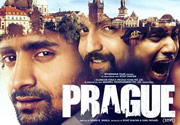
Prague
Synopsis:
A city with a history of heritage, myth and superstition. A passionate architect with strong but delusional ideas about love and life. A Czech gypsy girl searching for her identity and true love. Add to the drama of a mean friend you can’t do without and cannot trust either. The conflict of these complex characters is further heightened with illusions of someone who is there but at the same time not there- what you see is not true? or is the truth, what you not see? All of the above are thrown together in a very unique and unusual situation where you do not know what to believe and what to disbelieve.
It deals with the inner conflicts of Chandan, a passionate architect who comes to It for a project along with his friend Gulshan who he idolizes and wants to emulate but is also strangely scared of. In It Chandan meets a gypsy girl, Elena. This girl becomes the love of his life, his inspiration and also the pain of his soul because of his past from India refuses to leave him alone. Chandan’s experiences have made him mistrust his own shadow and his insecurities have made his life a living hell. His only ally in his darkest times is his friend Arfie but then…
Elena Kazan pronounces the word apartment in a way that makes Chandan Roy look like he just swallowed a spoonful of dry mortar, and that specific vocal abrasion stayed with me for twenty minutes after the screening ended. Prague is the kind of movie that arrives without much noise, a small independent-spirited Hindi film that somehow managed to slip past the usual studio machinery with its rough edges completely intact, refusing to buff out the things that make it uncomfortable to watch. Ashish Avikunthak or Anurag Kashyap might have tried to make this material look like a manifesto, but director Ashish Shukla is mostly interested in the sweaty, paranoid interiors of a guy who cannot figure out whether he is losing his mind or just dealing with the normal amount of self-lohatred that comes from living abroad without enough money.
The screenplay sets up a familiar trap where the protagonist, an architect named Chandan who has fled to the Czech Republic for reasons that remain foggy and unconvincing for far too long, starts unraveling in slow motion against a backdrop of Gothic spires and cobblestones that look distinctly less romantic when shot through a greenish, jaundiced filter. Chandan Roy plays this descent with a kind of stubborn, leaden opacity that works better than a more theatrical breakdown would have, even if he sometimes seems like he is just trying to remember his Hindi dialogue while staring at a brick wall. The supporting cast, featuring Arif Lamba and Kumar Mayank, drifts in and out of his field of vision like figures in a bad dream that keeps repeating the same hallway, though Mayank has this habit of blinking too hard during confrontation scenes that took me right out of the tension.
It's a small thing but it bugged me, the way the sound design keeps introducing this low-frequency hum every time Chandan gets anxious, as if the audience couldn't figure out he was stressed without the subwoofer doing pushups against the floorboards. Hindi movies have relied on sonic hand-holding for decades, but here it feels particularly unnecessary because the visual language already communicates that claustrophobia well enough through tightly framed close-ups that trap Roy against the edge of the lens. The camera rarely breathes, hugging the actors so closely that you can see the pores on their noses and the tired blue veins under Kazan's eyes, which gives the whole enterprise the greasy texture of a documentary shot by someone who isn't entirely well.
Kazan herself is the main reason to sit through the middle stretch where the plotting stalls out and turns into a repetitive cycle of brooding, drinking, and arguing in poorly lit kitchens that look like they haven't seen a sponge since the Velvet Revolution. She plays a woman who is both an anchor and a threat, shifting languages and emotional registers with an ease that makes Roy look occasionally stranded, like he is reading his lines from an invisible teleprompter attached to her forehead. There is a scene in a cafe where she simply stirs her coffee while he rants about professional betrayal, and her total lack of reaction does more to advance the psychological drama than any of the shouting matches that litter the second act.
Bollywood movies usually love a clear redemption arc, but Shukla and his writers have very little patience for that kind of neatness, leaving their characters stranded in ambiguities that refuse to resolve themselves into a neat moral package. Chandan is not a particularly likable protagonist, and the script doesn't soften his misogyny or his desperate self-pity to make him more palatable for the multiplex crowd, which probably explains why the box office numbers were virtually nonexistent when it first came out. He just stumbles through the European winter in a coat that looks too thin for the weather, nursing grievances that feel petty even to him, trapped in a narrative maze that doesn't have an exit door hidden behind the final reel.
The cinematography by Sameer Arya leans hard into the postcard locations only to rot them from the inside out, draining the color from the red roofs and casting long, bruised shadows across public squares that are supposed to look historic and instead look dead. It reminds me of how Nicolas Roeg shot Venice in Don't Look Now, though without the supernatural dread, substituting urban alienation for ghosts and making the historic center of Prague feel like a massive concrete holding pen for people who have nowhere else to go. The soundtrack matches this visual sourness with discordant string arrangements that sound like they were recorded in an empty subway station during a rainstorm.
Prague doesn't reinvent the psychological thriller, and it certainly doesn't offer any profound insights into the immigrant experience that haven't been hashed out in better dramas over the last twenty years, but it has a gritty, low-budget integrity that prevents it from feeling entirely derivative. The pacing drags whenever the focus shifts away from the central dynamic between Roy and Kazan, leading to stretches of exposition that feel like they were pasted in from an earlier draft of the script just to explain why anybody is still in this city. Yet despite those structural lumps and the occasional flat line reading that makes you wonder how it made it past the final edit, the movie sticks to your ribs long after more polished releases have washed out of your memory.