

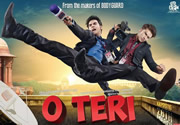
O Teri
Synopsis:
Picture this because it still breaks my brain, Prithvi and PP are literally driving a stolen, insanely expensive luxury car right through a crowded Delhi market while a guy in a bright yellow tracksuit is chasing them on a scooter screaming abuses that would make a truck driver blush.
It is absolute chaos and somebody is throwing cabbages at the windshield, but to make any sense of why two broke journalists are being hunted by local thugs in a vehicle worth more than their entire apartment building, we gotta go back to the start.
The movie is O Teri, and honestly, if you have ever sat through enough bollywood movies, you know we are in for a wild ride involving corrupt politicians and completely ridiculous coincidences.
Our boys Prithvi, played by Pulkit Samrat, and PP, played by Bilal Amrohi, are struggling entry-level reporters at a fictional news channel where they do not actually get any real investigative work, instead fetching samosas and dealing with their raging boss played by Mandira Bedi.
Prithvi has this one specific grey wool jacket with the sleeves rolled up just slightly that he wears for half the runtime, and I spent a full ten minutes staring at the buttons on it trying to figure out if they were metallic or just really shiny plastic, while the entire plot was happening around him at lightning speed.
They are trying to make it big in the brutal world of hindi movies, well, news broadcasting, and they keep messing up their assignments until they accidentally stumble onto the biggest scam of the century involving the upcoming international sports games.
So then they find a dead body stuffed in the trunk of a politician's car, and instead of calling the cops like normal citizens, they panic because classic hindi films always need our heroes to make the worst possible decisions for comedic effect.
They hide the body, which sounds super dark, but trust me, it is played for laughs in that weird way only modern bollywood movies can pull off without completely alienating the audience.
Right after that, they realize the dead guy was a whistleblower carrying pen drives full of evidence proving that massive funds meant for stadium construction have been funneled into Swiss bank accounts by corrupt ministers.
Enter Sarah-Jane Dias as Aanchal, who plays a crusading journalist and also serves as the love interest, and she looks amazing in every single frame even when she is standing in a dusty newsroom arguing about broadcast ratings.
The boys try to impress her by acting like brave reporters, but they are totally winging it, and every time they think they are safe, another henchman pops out from behind a pillar.
The music kicks in randomly because someone decided we needed a full-blown dance number right after a tense confrontation with a corrupt bureaucrat, which completely ruins the pacing but hey, you do not watch this stuff for high art.
Then we hit the interval point where PP gets kidnapped by the main villain's goons, and Prithvi has to eat a very spicy chili pepper to prove his toughness in a weird interrogation scene that goes on way too long.
They escape by faking a medical emergency involving an allergic reaction to peanuts, and they run out of the hideout shouting dialogue about democracy and free press while a heavy techno beat thumps in the background.
The second half is just one massive chase sequence where they try to broadcast the stolen video footage live on every screen in the city before the politicians can scrub the servers.
They sneak into the broadcasting station disguised as catering staff wearing fake mustaches that keep peeling off their sweat-soaked upper lips every time they talk to the security guards.
Anupam Kher shows up as a veteran politician giving these grand speeches about how the youth of today have no respect for authority, and he chews the scenery so hard you can practically see the cardboard sets shaking behind him.
The climax happens at the grand opening ceremony of the sports event where thousands of extras are waving flags in synchronized choreography that must have taken days to shoot in the Delhi heat.
Prithvi climbs up the massive lighting rig holding the laptop with the incriminating video file while a bunch of thugs are throwing plastic water bottles at his shins from the ground level.
He plugs the cable into the giant LED stadium screen just as the main villain is cutting the ribbon with a pair of oversized gold scissors, and the live stream of the corruption confession blasts out to the entire nation.
Police sirens wail from all directions, the bad guys drop their weapons and surrender instantly without putting up a single actual fistfight, and the camera pans up to the sky as confetti rains down on the cheering crowd.
The sound mix on the establishing shot of the newsroom is loud enough to rattle fillings, which is a weird choice for a scene where two guys are just complaining about the coffee machine not working. That noise sets a certain tone for O Teri, a movie that never met a decibel level it didn't want to double. Umesh Bist directs this thing like he's afraid everyone in the back row is falling asleep, cutting between talking heads with the manic energy of a caffeine addict who just discovered the editing bay has a fast-forward button. It is a loud, messy farce that tries to graft the satirical DNA of Jaane Bhi Do Yaaro onto the slick, polished look of a modern corporate office, and if I'm honest, the seams show before the twenty-minute mark. The screenplay, credited to a few different people who seem to have been writing in separate rooms without talking to each other, leans heavily on mistaken identities and corpses that won't stay put, a classic setup that usually gives actors room to bounce off the walls. Here, though, the walls seem made of wet cardboard, and the actors are mostly just shouting their punchlines directly into the lens while waiting for the cue to run down another Delhi alleyway.
Pulkit Samrat is working overtime to sell the charm, flashing a grin that feels permanently installed by the makeup department while Bilal Amrohi looks like he wandered onto the wrong set and is simply trying not to bump into the boom mic. They play two junior reporters at a second-rate news channel who stumble upon a massive corruption scandal involving the upcoming Commonwealth Games, a real-life embarrassment that provides an easy narrative springboard for cheap laughs and righteous indignation. Sarah-Jane Dias shows up as the producer who has to wrangle them, bringing a straight-faced professionalism to scenes that desperately need someone to ground the absurdity, though she spends most of her screen time looking like she's calculating how many days are left on her contract. Watching Samrat try to generate comic friction with Amrohi is a bit like watching someone try to start a lawnmower in a swamp; there is a lot of pulling on the cord, a brief burst of noise, and then immediate silence. Amrohi’s line delivery has this flat, deadpan quality that might have worked in a brooding romantic drama, but in a frantic satire, it just acts as a wet blanket tossed over every joke the writers bothered to set up. It’s a small thing, but it bugged me how often the camera cuts away from a reaction shot just a fraction of a second too late, leaving the actors standing there with their punchline expressions frozen on their faces like wax figures caught in the middle of a sneeze.
The cinematography relies on that hyper-saturated digital look that makes every street in Delhi look like it was scrubbed clean by an army of janitors five minutes before the cameras rolled. There are drone shots sweeping over flyovers that add nothing to the geography of the scene except to remind you that the production budget occasionally left the studio lot. The soundtrack, meanwhile, hits you over the head with remixed Punjabi wedding tracks whenever the energy dips below a certain threshold, which happens roughly every four minutes. One particular club track plays at least three separate times during different montage sequences, and by the final hearing, it starts to feel less like a musical choice and more like an endurance test designed by the sound editor. It's funny to watch Bollywood movies try to tackle political satire when they are so clearly terrified of offending anyone with actual power, turning sharp institutional critique into a series of harmless pratfalls involving politicians who look vaguely like real people but talk like cartoon villains. The film wants to bite the hand that feeds the media, but it ends up just nibbling gently on a rubber finger while making sure to smile for the sponsors.
There is an awkward attempt to channel the frantic social commentary of Munna Bhai M.B.B.S. in the way the heroes use live television to shame the corrupt elite, but the execution lacks the earlier film's genuine affection for its misfits. Instead of earning the emotional beats through character development, O Teri just turns up the background score and hopes the audience won't notice that the plot holes are big enough to drive an OB van through. The supporting cast features Mandira Bedi playing a politician with the kind of theatrical sneer that belongs in a regional stage melodrama rather than a contemporary comedy, chewing the scenery until there is barely any set left for the background extras to stand on. When the third act rolls around and the inevitable rooftop chase begins, the geography of the chase makes zero sense, with characters teleporting from Connaught Place to Old Delhi in the span of a single whip-pan. Hindi films have a long and honorable tradition of social farce, but they usually require a certain lightness of touch that gets completely lost under the weight of so many forced gags and heavy-handed moral speeches about journalistic integrity delivered directly to the camera.
By the time the closing credits start to scroll over yet another reprise of that same club track, you are left wondering who this movie was actually made for, since the satire is too toothless for adults and the comedy is too chaotic for kids. It is neither smart enough to work as a proper political lampoon nor loose enough to function as pure brainless entertainment, landing instead in that awkward middle ground where most mediocre studio comedies go to die. The actors hit their marks, the crew packed up their gear, and the distribution machine pushed it out into theaters, and yet none of it leaves a single footprint in the memory once the projector clicks off. There are worse ways to spend two hours in a dark room with a working air conditioner, but practically all of them involve watching something else.