

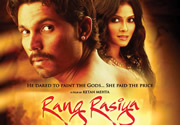
Rang Rasiya
Synopsis:
Randeep Hooda is literally standing in a crowded courtroom with paint-stained fingers looking completely exhausted while the judge yells at him about obscenity and public decency, which is a wild place to be for a guy who just wanted to make art.
So then to understand why he's getting grilled by the British colonial authorities in court, we gotta go back to the start where a young Raja Ravi Varma is running around India trying to capture the exact shade of a sunset on his canvas while nobody takes him seriously yet.
The guy is obsessed with Hindu mythology and he starts painting gods and goddesses with human faces, which sounds normal now, but back then people lost their minds because he used real women as models for divine figures.
Right after that he meets this wealthy patron played by Paresh Rawal who helps set him up in a fancy studio, and suddenly the artist is living the high life surrounded by expensive silks and giant canvases while churning out portraits for royalty.
The funny thing is the movie takes a solid twenty minutes just to show him mixing colors and staring intensely at drapes, like the director really wanted us to feel the texture of oil paint through a flat screen.
Then he meets Sugandha, played by Nandana Sen, who literally walks into his life like a vision wrapped in white cotton and becomes his absolute favorite muse for painting goddess Saraswati and Shakuntala.
They have this heavy chemical attraction that builds up through lingering glances across a room filled with easels and dripping brushes, and she says to him, you see right through me, right before they cross the line from professional art to actual romance.
The song and dance sequence that drops right here makes zero sense because they are supposed to be hiding their scandalous affair from conservative society, yet suddenly they are frolicking in a lush garden with backup dancers out of nowhere just like all the classic bollywood movies do when the budget needs filling.
The interval block hits right when things get super messy and Raja Ravi Varma becomes a massive celebrity whose mass-produced lithographs are selling out across the entire subcontinent, meaning every single household in India now owns a poster of his paintings.
Anyway, fame ruins everything because the British don't like how his art is waking up national pride and religious devotion among the locals, so they trump up charges of obscenity against him for painting nude goddesses.
Sugandha gets dragged into the legal nightmare too because everyone figures out she was the physical model behind the controversial canvases, and the poor girl faces endless social backlash and harassment from orthodox villagers.
Feryna Wazheir shows up later as a glamorous foreign journalist named Anita who tries to help him navigate the changing times and modern photography, but the heart of the story stays locked on the tragic fallout between the painter and his original muse.
The courtroom scenes drag on forever with old men arguing about morality while Randeep Hooda just stares stoically into the middle distance refusing to apologize for his vision.
Rang Rasiya really makes you wonder how traditional art forms survived the collision with colonial censorship, even if a lot of the runtime gets eaten up by lingering shots of naked shoulders and dramatic sighs.
During the climax the court finally delivers its verdict acquitting him of the obscenity charges, but the victory feels hollow because Sugandha has already suffered and died in a tragic fire set by religious fanatics.
He walks slowly out of the courtroom into the blinding sunlight, picks up his paintbrush with trembling fingers, and starts painting her face from memory on a blank canvas until the screen fades to black.
There is a specific kind of yellowish grading in Ketan Mehta’s Rang Rasiya that looks less like late nineteenth-century India and more like an old Kodak slide left too close to a radiator. If I'm honest, it bugged me for the first twenty minutes. The story of Raja Ravi Varma is practically begging for a rich, saturated palette that mimics oil on canvas, but instead we get this digital butter-tint that flattens out the midtones. Still, once you get past the visual sheen, the movie settles into a strange, lurching rhythm that feels closer to a turbulent biography than standard Bollywood fare.
Randeep Hooda plays the artist with his shirt open and his jaw clenched, stalking around his studio like a man who just discovered fire and doesn't know who to show it to first. His Varma isn't just an eccentric painter making goddesses out of ordinary local women; he is an aggressive, sweaty force of nature who believes his own press clippings before the ink is even dry on the printing press. Hooda has this way of chewing his dialogue that suggests his mind is already three rooms away composing the next frame, which works brilliantly when he is ignoring his patrons and terribly when he has to deliver a speech about freedom of expression. He anchors the film through sheer physical presence, sweat glistening on his collarbone as he mixes pigments with the frantic energy of a man trying to outrun a debt collector.
Opposite him, Nandana Sen has the harder job as Sugandha, the muse who eventually becomes the face of Hindu deities on cheap lithographs distributed across the subcontinent. She spends most of the first act wrapped in wet cotton sarees, looking intensely uncomfortable as the camera lingers on her wet shoulders and arched back. It is a tricky role because the script reduces her to a symbol of sacrifice and artistic inspiration long before she gets any internal life of her own. When she finally breaks down and confronts Varma about what his fame is costing her, Sen drops the breathy, ethereal act and gives us something jagged and desperate. The supporting cast is a bit of a mixed bag, though; the British actors playing the various villains and colonial judges are clearly dubbed by local artists whose lip-syncing is off by a crucial half-second, pulling you right out of the courtroom drama.
Mehta directs with a heavy hand that rarely knows when to cut away from a lingering reaction shot. You get scenes where characters stare into the middle distance while a solo sitar plucks out the exact emotion you are supposed to be feeling, a crutch that feels lazy for a director who once made Mirch Masala. Yet, when the film focuses on the mechanics of mass production—the clanking lithographic presses printing thousands of copies of Saraswati—it suddenly wakes up. Those sequences feel tactile and urgent, contrasting sharply with the soapy melodrama happening between the canvases. The screenplay by Mehta and Dilip Patel tries to cram an entire wikipedia entry into two hours, jumping haphazardly from court battles to grand romances without ever letting a scene breathe for more than a beat.
The core conflict hinges on obscenity charges brought against Varma for painting nude models, turning the movie into a period piece about censorship that feels awfully convenient for modern audiences. Varma argues that art cannot be vulgar because the human body is pure, and Hooda spits out these lines with absolute conviction, even if the arguments sound like they were written by a committee of screenwriters trying to score cheap points against moral policing. You can feel the contemporary anxieties about free speech being grafted onto late colonial history, making the courtroom speeches feel less like 1890s jurisprudence and more like a Twitter thread arguing about artistic freedom. It makes for bumpy viewing, especially when the characters start talking directly to the camera about the gaze of the viewer and the power of the mass media.
Cinematographer Renu Saluja’s editing baton—or whoever handled the scissors after her passing—left some baffling transitions between scenes, like an abrupt jump-cut from a romantic interlude straight to a dusty street market that makes you check if your remote accidentally skipped a chapter. The background score by A.R. Rahman is surprisingly intrusive, recycling similar vocal chants every time Varma picks up a paintbrush. It is a small thing, but that recurring flute motif plays so often during the second half that you start timing your blinks to it. Feryna Wazheir shows up later as Parsi journalist Feroz, bringing a breath of fresh air and sharper diction to scenes that were in danger of drowning in their own earnestness, though her character is dispatched with the narrative subtlety of a falling anvil.
Hindi films rarely know what to do with artists who aren't tragic poets dying of consumption or heroic freedom fighters dodging bullets. Rang Rasiya wants Varma to be both a visionary genius and a flawed, arrogant jerk who uses people up for his art, and Hooda manages to hold both contradictions in his head at the same time without smoothing over the rough edges. When he stands in front of his unfinished canvas, arguing with a village elder about whether a goddess can have a mortal face, you forget about the clunky dialogue and the weird yellow grade. He looks possessed by something he cannot control, which is usually the only excuse you need to watch a biopic.
There is a sequence near the end where Varma’s studio is vandalized, and the frames of his life's work are slashed by religious zealots who claim his depiction of sacred figures is blasphemous. It plays out with a grim predictability that feels lifted straight out of recent headlines involving similar controversies in contemporary arts and culture. The movie wants us to connect the dots between the nineteenth century and today without doing the hard work of making the historical specifics matter on their own terms. It treats history as a costume party where everyone is arguing about modern censorship laws while wearing turbans and silk robes.
For all its visual clutter and didactic speechifying, the film works best when it simply observes the physical labor of painting—the scraping of palette knives, the heavy grinding of minerals, the smell of turpentine hanging in the humid air of the studio. Those details ground the performance and save the movie from turning into a dry history lecture about the birth of calendar art. It sits somewhere in the middle of the filmography of Hindi cinema, neither a complete disaster nor a forgotten gem, just a messy, ambitious swing at a complicated life that deserved a steadier hand behind the camera.