

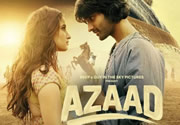
Azaad
Synopsis:
And then the second half starts and we just aggressively hyper-speed through a massive, life-altering plot twist where the main villain's secret identity is exposed in a single throwaway line of dialogue while everyone is eating lunch. Honestly, it was so fast I almost missed it because I was checking my phone, but suddenly alliances shift, the whole plot completely turns upside down, and characters who were friends five minutes ago are now trying to stab each other with rusty daggers in a damp cave. Ajay Devgn is swinging from ropes now, and he's shouting catchphrases, and Rasha Thadani is trapped in a burning fortress firing a crossbow at bad guys who keep dramatically falling off balconies in slow motion. The action choreography gets so loud and chaotic that the sound mixing literally clips, and you can't even hear the dramatic string instruments playing over the sound of explosions and horses neighing. Diana Penty gets a genuinely cool moment where she corners the main antagonist and delivers a scathing line right before slapping him across the face so hard you could hear it echo across the theater. People kept talking about how azaad represents a cool throwback to classic bollywood adventure tropes, and yeah, it really does feel like an old-school masala flick that refuses to take itself too seriously even when people are dying left and right. Characters are bleeding, tears are flowing, horses are galloping through burning rubble, and everyone is screaming slogans about freedom and family honor at the top of their lungs. We are barreling toward the climax now at hundred miles an hour, with zero breathing room between chases and emotional monologues. Ajay Devgn leaps from a collapsing stone bridge onto the roof of a moving carriage, tackles the main villain through a wooden crate, and they both roll around in the mud while the dramatic theme music finally kicks in at full blast. The villains are handcuffed, the rescued villagers cheer wildly while waving flags, and Rasha smiles tearfully at Ajay as the camera slowly zooms into their faces while they stand triumphantly amidst the ruins of the burning compound right before the screen cuts straight to black.
Ajay Devgn wears the kind of weathered, squinting exhaustion in this movie that usually belongs to guys who spent three hours trying to fix a tractor engine before realizing the part they ordered is for a different model entirely. He plays an older horseman in Azaad, though calling it a period drama feels wrong because the time period seems to shift depending on whether the sun is hitting the dust clouds correctly. If I'm honest, the opening twenty minutes mostly consisted of me wondering how many takes it took to get the stallion to stop twitching its ears every time a supporting actor started yelling about honor. It is a noisy picture, full of brass instruments blaring whenever someone mounts a gelding or looks thoughtfully toward the horizon. Abhishek Kapoor directs with the sort of relentless energy that assumes you might wander off to check your phone if a violin doesn't sweep across the soundtrack every forty seconds. The screenplay feels stitched together from three different drafts that never quite agreed on whether they were making a sweeping epic or a modest rustic yarn about land disputes and family feuds. Dialogue bounces awkwardly between high-flown poetic declarations about freedom and modern colloquialisms that sound like they were ad-libbed during a lunch break after the craft services table ran out of paneer.
Rasha Thadani makes her debut here, and she spends a lot of screen time running through brush with a look of intense concentration that suggests she is either deeply invested in the narrative stakes or simply trying not to trip over her own ghagra. She hits her marks with a mechanical precision that is neither particularly thrilling nor outright offensive. It's just there, occupying the frame while the lighting crew tries to bounce enough golden hour sunlight off her face to compensate for some very flat cutting in the editing room. Diana Penty fares a bit better simply because she has learned over the years how to lean against a stone pillar and look profoundly weary without having to deliver any overly dramatic monologues about destiny. Devgn, meanwhile, carries the heavy lifting with that familiar, gravelly reserve we have seen in fifty other Hindi films, though he occasionally flashes a grin that suggests he knows the script is hanging by a thread and finds it mildly amusing.
There was a supporting village elder who kept popping up in wide shots whose voice clearly didn't match his mouth movements by a good half-second, and it bugged me every single time he spoke. Beyond that little technical glitch, the cinematography leans heavily into washed-out browns and bruised oranges, giving the entire landscape the aesthetic of a dusty paperback novel left out on a porch in Rajasthan during a heatwave. The songs keep crashing over the action without warning, interrupting scenes right as they start to build some genuine dramatic momentum. One particular ballad about parental sacrifice plays at least three times too often, sometimes as a background hum and other times swelling so loud that the actors have to literally shout their lines over the snare drum. It reminded me a bit of how Sanjay Leela Bhansali handles musical cues, except without the dizzying spatial choreography that makes those excesses feel earned.
The thematic undercurrents are about as subtle as a brick through a stained-glass window, hammering away at notions of liberty versus loyalty with the finesse of a sledgehammer. Every time a character starts talking about breaking chains, you can practically hear the writers patting themselves on the back for being so relevant to modern anxieties. Yet, whenever the film actually has to engage with the material reality of peasant labor or colonial-era bureaucracy, it retreats safely into familiar tropes involving secret identities and hidden lineage. It wants to be taken seriously as a critique of feudal cruelty, but it also wants to give its marquee star a slow-motion entrance where he catches a flying sword by the hilt without breaking a sweat. That contradiction sits at the core of almost all commercial Hindi cinema, but this project struggles harder than most to stitch those two impulses together into something cohesive.
Watching these characters navigate their endless grievances made me think about how predictable narrative arcs in mainstream Bollywood movies have become lately, relying on the same recycled beats about revenge and redemption that we were watching back in the nineties. There is no real danger here, no moment where the camera lingers on an unresolved ambiguity or lets a scene end on an uncomfortable silence. Every emotional beat is telegraphed five minutes in advance by a booming cello or a dramatic zoom in on a clenched fist. Devgn gives a competent, clock-punching turn that requires zero effort on his part and demands very little from the audience either. By the time the final confrontation rolls around on a dusty cliffside that looks suspiciously like a studio backlot, the outcome is so predetermined that you can practically check your watch and predict down to the exact second when the credits will roll.