

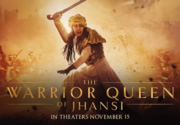
The Warrior Queen of Jhansi
Synopsis:
God, Jodhi May as the British commander's wife is standing right there in a lavishly decorated tent sipping tea with the most intensely bored expression while a literal firefight is exploding outside and bullets are puncturing the canvas like tissue paper, which is honestly hilarious because half the extras in the background are just awkwardly ducking behind decorative pillows that definitely wouldn't stop a musket ball. So anyway, let's talk about The Warrior Queen of Jhansi, this totally wild historical drama that kind of flew under the radar compared to your usual massive bollywood movies, starring Jodhi May, Derek Jacobi, and Rupert Everett, playing out like an epic history lesson that somehow got filtered through a hyper-active indie budget action blender. It all starts back in the Kingdom of Jhansi where young Manikarnika is running around doing sword practice and being generally badass, and then she marries the Raja of Jhansi, becomes Rani Lakshmibai, and wears these gorgeous heavy silk saris that probably weigh fifty pounds while she gallops across dusty plains and yells at corrupt politicians who are trying to steal her land using some shady colonial legal trick called the Doctrine of Lapse. Stuff happens, her husband dies, and she adopts a son, but the British East India Company led by Rupert Everett in a really magnificent coat just refuses to recognize the kid as the rightful heir because they want to annex the whole place for themselves, and honestly Rupert Everett is having so much fun playing the villain that you can't even hate him even though he's literally trying to evict a grieving widow from her palace. And then boom, the movie hits the interval block right when tensions are peaking and everyone's shouting about rebellion, and you're sitting there eating your snacks waiting for the second half, but wait, they didn't even squeeze in a random musical number here like traditional hindi movies usually do, which feels weirdly wrong for a period piece featuring this much horses and sabers. Derek Jacobi shows up as Lord Palmerston in London looking intensely confused by a map while discussing Indian politics with other old dudes in velvet chairs, and his wig is honestly stealing every scene he's in because it has a life of its own, sitting slightly tilted on his head while he pontificates about empire building and how to crush the growing unrest. Back in Jhansi, the 1857 rebellion breaks out and things get super chaotic, with peasants and soldiers uniting under the queen's banner, and Manikarnika puts on full battle armor, rides a white stallion right into the thick of the combat, and starts swinging swords at redcoats while shouting that she will not give up her Jhansi. Look, you expect the standard tropes you see in big hindi films, but this one is an international co-production so it has this slightly disjointed pacing where giant political shifts happen in the blink of an eye and suddenly entire cities are burning without much setup. The British troops lay siege to the fort, and the queen's loyal generals like Tatya Tope fight bravely on the ramparts, but betrayal is in the air because local traitors open the gates at night, and man, the sheer betrayal on Jodhi May's face as the British forces swarm the courtyard is just heartbreaking. She escapes on horseback with her adopted son strapped to her back in a dramatic nocturnal dash through enemy lines, leaping off a sheer cliff into a river because why not go full action hero mode in a historical biopic. She joins forces with other rebel leaders like Tantia Tope and the Rani of Ramgarh to launch a desperate counter-offensive, capturing the fortress of Gwalior in a massive cavalry charge that involves hundreds of extras running in opposite directions while smoke bombs obscure the camera. The final battle arrives with deafening cannon fire and desperate hand-to-hand combat in the dusty courtyards of Gwalior, and Manikarnika charges straight into a volley of British gunfire, taking a fatal bullet to the chest. She slumps forward off her horse, but uses her remaining strength to slash at the nearest soldier before collapsing into the dirt, and her loyal guard quickly scoops up her body to toss it into a burning funeral pyre so the enemy can't desecrate her remains.
Derek Jacobi sounds a bit bored in the first ten minutes, which happens when you cast English character actors to lend imperial gravity to British colonial blunders they would rather forget. Swades might have handled this scale of nationalist fervor with room to breathe, but director Swati Bhise is in a terrible rush to get everyone on horses and keep them there. The screenplay crams a massive historical revolt into a standard running time, resulting in narrative leaps that leave characters explaining their motivations directly to the camera because nobody took the time to write subtext. It is a messy affair, not great, not bad, just there, yet it stumbles through the mid-nineteenth century with a stubborn sort of earnestness that occasionally overrides the budgetary constraints.
At the center of it all stands Jodhi May as Rani Lakshmibai, dragging the entire enterprise forward by sheer willpower when the editing flags. She does not play the historical figure as a marble statue of revolutionary perfection, which keeps the picture watchable even when the supporting cast is chewing the scenery to bits. Rupert Everett arrives wearing mutton chops and a sneer, playing Lord Palmerston with the sort of broad theatricality you usually find in a provincial pantomime, and he seems to be enjoying every second of his limited screen time despite the stiff dialogue. The chemistry between the leads is strictly functional, forged in council chambers and battlefields rather than shared personal moments, though May manages to find a quiet dignity in the pauses between orders.
One small sound-mixing choice bugged me throughout the battle sequences: the same identical cannon-fire percussive thud repeats three times in every single skirmish, as if the audio department ran out of library assets on a Tuesday afternoon and just looped the first file they found. It pulls you right out of the period immersion, right when the cinematography is trying desperately to mimic the epic scope of classic Hindi films without the matching financial backing. The lenses flare too often, bathing the dusty plains of Uttar Pradesh in golden-hour light that looks gorgeous for about ten seconds before you realize nineteenth-century ordnance wouldn't have looked this clean. Costumes look suspiciously fresh off the rack, too, which is a common hazard of historical dramas shot on digital sensors.
Bhise handles the action choreography with an admirable clarity, staging cavalry charges that make spatial sense even when the extras are visibly struggling to hold their formations. You can always tell who is fighting whom, a basic competency that eludes many contemporary action directors who rely on shaky-cam to hide choreography gaps, though the pacing here still suffers from breathless exhaustion. The narrative tackles complex issues of British annexation and patriarchal succession laws without flattening every historical actor into a simple hero or villain, acknowledging the fractured alliances of the Indian princely states during the rebellion. It resists the urge to turn every enemy into a mustache-twirling caricature, mostly because Everett already has that corner of the market locked down tight.
When the film shifts its focus toward the structural inequalities of the Doctrine of Lapse, the dialogue gets terribly clunky, trading human drama for exposition dumps that sound lifted straight from a history textbook. Yet there is an undeniable energy in the battle scenes that follow, fueled by a sweeping orchestral score that refuses to let the audience rest for even a moment. It avoids the polished sheen of modern prestige television while also lacking the raw grit of a truly independent historical feature, sitting awkwardly in the middle as an ambitious passion project that needed about six more months in the editing bay. May's performance lingers in the memory long after the credits finish scrolling, proving that a committed lead actor can anchor even the most uneven historical drama.