

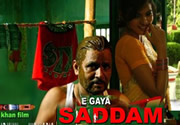
Le Gaya Saddam
Synopsis:
There is just something wild about watching Raghubir Yadav suddenly lose his absolute mind over a stray piece of luggage while screaming at the top of his lungs in a dusty alleyway and honestly, it sets the exact chaotic tone you would expect from the weirdest corners of bollywood.
So then, to understand why he's screaming, we gotta go back to the start and look at how this whole bizarre ride begins with a remarkably simple village setup that somehow spirals completely out of control because people can't mind their own business.
Le Gaya Saddam is definitely one of those hidden gems from the vast ocean of classic hindi movies that nobody talks about enough, starring Raghubir Yadav alongside Ganesh Yadav and Sufi Sayyad, bringing this super quirky rural drama to life.
The story kicks off by introducing us to the everyday struggles of ordinary folks dealing with strange social pressures, gossip, and the kind of petty neighborhood drama that only happens when everyone knows everyone's business.
Right after that, we see Sufi Sayyad trying to navigate a genuinely awkward romantic angle that keeps getting interrupted by interfering relatives who have way too much free time on their hands.
Let's talk about that one random background extra sitting on a wooden bench outside the local tea stall for literally twenty minutes of screen time wearing a neon yellow vest that completely clashes with the muted earth tones of the entire village set, like why was he even there, did the director just forget to tell him to move, because he doesn't react to any of the shouting matches happening right beside him and honestly, he became the main character of my heart for a solid five minutes.
Anyway, Ganesh Yadav shows up and immediately starts making things ten times more complicated by stirring up old feuds and spreading rumors about who owns what.
Then they all get dragged into this ridiculous political dispute over a local landmark that nobody even cares about, but suddenly everyone's ready to throw punches in the middle of the market square.
Suddenly a random song and dance number breaks out right when the two main factions are about to attack each other with farming tools, which is just peak bollywood movies logic for you, completely ruining the narrative tension just so people can shake their shoulders to a very synthetic 90s beat.
After the musical break ends, we smash right into the interval point where everything goes completely sideways and a massive secret gets dropped in front of the whole village, leaving everyone staring in absolute shock.
The second half is basically just pure panic mode where Raghubir Yadav tries to fix a cascade of terrible decisions while running through dusty fields and yelling at people who are already ignoring him.
They tried to make the climax super emotional with sweeping orchestral strings playing over slow-motion shots of characters running toward each other across a railway platform, but it just looks hilarious because everyone looks completely exhausted by the heat.
Ganesh Yadav gets cornered behind a stack of burlap sacks by a bunch of angry villagers demanding answers about the missing funds.
Everything wraps up in a giant scuffle where people start throwing watermelons and rolling around in the dirt until the police finally show up late, flashing their bicycle lights and blowing whistles.
Raghubir Yadav grabs the last remaining suitcase, turns around, and walks away down the empty dirt road as the screen cuts directly to black without any explanation.
The third time the titular dictator's face flickered across a cracked plastic placard in "Le Gaya Saddam," I found myself wondering if anyone on the sound crew had actually checked the phase cancellation on the Foley tracks for the alleyway scenes, because that low-end rumble under the dialogue was driving me slightly nuts. It is a small thing, sure, but when a picture asks you to settle into its particular brand of localized farce for two hours, every little abrasive frequency in the mix grates on the nerves just a bit more than it ought to. Not that the film lacks ambition, exactly, but it often operates on that strange frequency of Indian indie cinema where the budgetary constraints become characters in their own right, elbowing their way into the frame whether you invited them or not.
Director Amol Shetge doesn't bother with grand establishing shots or sweeping overviews of the provincial Maharashtrian landscape that houses this madness. We are thrown immediately into cramped rooms, dusty verandahs, and the sort of claustrophobic corridors where every dropped tea glass sounds like a thunderclap. The screenplay by Sanjay Navgire works overtime to keep the machinery of the plot clanking along, hinging on an absurd local election gimmick involving a stray donkey named after Saddam Hussein. That kind of high-concept satire could easily curdle into pure groan-worthy sketch comedy, and occasionally it does, yet the sheer stubbornness of the writing prevents it from blowing away in the afternoon wind. There is a looseness to the scene construction that feels almost accidental, like scenes were shot on the fly whenever the market square cleared out of traffic, giving the whole affair a pleasantly bruised, unpolished skin.
Raghubir Yadav walks through this chaos with the weary grace of a man who has played this exact variation of the put-upon small-town patriarch in a dozen other Hindi films yet still manages to find a fresh twitch or a new sigh to make it feel lived-in. He does not phone it in, though there are moments where he looks like he'd rather be taking a nap behind the prop truck, which honestly just adds to his charm. When he argues with Ganesh Yadav over the ownership of the political animal in question, the verbal sparring matches have the ragged, unscripted timing of real neighbors who have been feuding over boundary walls for decades. Sufi Sayyad cuts through the testosterone-heavy bluster with a dry, observational stillness that grounds the broader comedy without ever feeling like she is doing homework for the role. It reminds me a bit of Seema Pahwa’s work in "Ankhon Dekhi," that same ability to hold an entire room's attention simply by looking thoroughly exhausted by everyone else's nonsense.
The cinematography by Udaysingh Mohite refuses to pretty anything up, embracing the blown-out midday sun and the murky yellow interior bulbs with equal indifference, which works surprisingly well for the material. There are no artfully composed shadows here, just harsh light bouncing off peeling blue paint and dust motes hanging thick in the stale air of a municipal office. The background score, however, leans heavily on jaunty accordion motifs that feel imported from a completely different European arthouse comedy, playing catch-up with the rustic proceedings on screen and missing the beat by a fraction of a second more often than not. It is an odd sonic choice, one of those decisions where you can practically hear the producer saying it adds a quirky international flavor to the village antics, even if it mostly just distracts from the actors' timing.
Beneath the political posturing and the animal-wrangling slapstick, the film is digging at something genuinely uncomfortable about how ordinary people adopt distant geopolitical horrors as local football team loyalties. We see how global news filters down into municipal gossip, mutating into weaponized insults traded across tea stalls where nobody knows the actual geography of the Middle East, they just know the name sounds funny enough to yell at a political rival during a municipal rally. Bollywood movies have historically used small-town settings as either pristine postcard backdrops or melodramatic pressure cookers, but "Le Gaya Saddam" prefers to treat its fictional village as a messy, confused ecosystem where ideology is just another commodity to be bartered, traded, or painted on a donkey's flank.
That reluctance to provide a clean moral takeaway is perhaps the movie's best asset, even if it leaves the third act feeling a bit like a car coasting downhill with the engine turned off. The narrative resolution doesn't solve the town's underlying political rot, nor does it grant any of its bumbling characters a sudden epiphany about the foolishness of their ways; instead, everyone simply packs up their banners, sweeps up the discarded campaign flyers, and prepares to argue about something entirely different by tomorrow morning. Hindi movies love a grand courtroom summation or a tearful train-station reconciliation to tie off their themes, but this thing just sputters out with a shrug and a final, lingering shot of an empty intersection where nobody is paying attention to anything at all.