

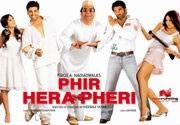
Phir Hera Pheri
Synopsis:
That specific tilt of Paresh Rawal’s head just before he realizes he has, yet again, completely misunderstood the basic mechanics of a financial transaction is a small miracle of modern physical comedy. If I'm honest, nobody outside of classic screwball directors captures panic quite like Neeraj Vora does in the second half of this picture, rushing characters through hallways that seem to shrink by the foot while the background score plinks away like a demented music box. People talk about the original Priyadarshan film as some untouchable sacred text of Hindi cinema, but Vora took over the directing reins for this sequel and somehow infused the proceedings with a manic, cartoonish energy that feels closer to Tex Avery than anything else in the standard rotation of mainstream Bollywood movies. It is louder, it is dumber, and it frequently abandons logic for the sake of a quick gag about a blind man holding a shotgun. Yet the momentum never really slackens because the three leading men have an almost telepathic timing that survives even the most desperate writing choices.
Raju, Shyam, and Baburao start this story right where they left off, flush with cash for about ten minutes before a smooth-talking con artist played by Bipasha Basu convinces them to double their money through a fraudulent investment scheme that would not fool a moderately alert terrier. That setup gives way to an elaborate sequence of mistaken identities, revolving doors, and frantic phone calls involving local gangsters who look like they wandered off the set of an entirely different, much cheaper action flick. Rajpal Yadav pops up as a diminutive local villain named Pappu. His oversized suit does half the heavy lifting for the characterization, flapping around his frame every time he tries to look menacing while standing on a stool. The plot doesn't just stretch credibility; it snaps the elastic band entirely and simply keeps running anyway, daring the audience to keep up with the cascading financial ruin.
Akshay Kumar plays Raju with a sleazy, wide-grinned charm that relies entirely on his ability to sell complete nonsense with absolute conviction. He wears neon shirts that hurt the eyes from three rows back and delivers every lie with the breezy confidence of a man who believes he is the smartest person in the room despite overwhelming physical evidence to the contrary. Suniel Shetty plays the straight man, though his straight man is still prone to rolling up his sleeves and threatening physical violence over twenty rupees, bringing a dry, exhausted frustration that anchors the surrounding lunacy. Then there is Paresh Rawal, whose Baburao Ganpatrao Apte remains one of the greatest creations in the history of comedy from this part of the world. He communicates entire lifetimes of debt, confusion, and accidental wisdom through the simple act of adjusting his dhoti or shouting into a rotary phone that isn't plugged into the wall.
The supporting cast gets thrown into the meat grinder with varying degrees of success. Rimi Sen is mostly there to look startled and stand in doorways, which feels like a waste of the comic timing she occasionally showed off in other Hindi films. Johny Lever shows up late in the game as an eccentric smuggler with a tic, chewing the scenery with such enthusiasm that you half expect him to bite through the camera lens. The editing in those chaotic climax sequences on the farm gets a bit sloppy, occasionally lingering a fraction of a second too long on a reaction shot that has already made its point, robbing the punchline of its sharpest edge. It’s a small thing, but it bugged me every time the rhythm stumbled right before a visual payoff.
Visually, the film looks like it was lit with three very bright desk lamps and a prayer, trading any sense of cinematic polish for the flat, primary-color brightness of a television sitcom. The songs are largely forgettable intrusions that exist solely to shift the location to some generic beach or a brightly painted set where backup dancers wave colored fabric around the principals. Yet the choreography of the physical violence and the rapid-fire dialogue exchanges keep the machinery turning. It reminds me a bit of the way Blake Edwards used to let his comedies spiral out of control in the seventies, piling complication upon complication until the only possible resolution was a massive, destructive pileup of bodies and props. No one is watching this for deep social commentary, though the underlying obsession with quick wealth in a rapidly liberalizing economy definitely runs through the background like a low-frequency hum, reflecting a culture desperate to gamble its way out of the middle class.
The laughs come fast enough that you tend to forgive the stretches where the script simply repeats a joke three times because the actors are selling it with such desperate commitment. When Baburao tries to explain his logic to an increasingly unhinged gangster, the sheer geometry of the misunderstandings creates a dense web of comedic frustration that few other contemporary comedies manage to sustain for more than ten minutes. It is a messy, exhausting, and frequently brilliant exercise in controlled chaos that doesn't care about your refined taste or your desire for narrative coherence. You just surrender to the noise, the shouting, and the endless running through dusty courtyards, hoping against hope that Baburao finally gets to keep his house.