

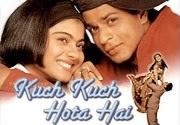
Kuch Kuch Hota Hai
Synopsis:
Picture this, you are sitting there watching a massive late nineties Bollywood hit where Shah Rukh Khan is literally crying over a basketball court because his best friend is leaving him, and you just have to pause and wonder how anyone survived this specific brand of emotional manipulation. But to understand why grown adults are weeping over collegiate sports and chunky knitwear, you have to go all the way back to the beginning when Rahul and Anjali were just two college students at St. Xavier's, which is a place that apparently only exists in hindi movies where nobody ever studies and everyone just spends their entire day dancing on tables and wearing matching denim jackets. Rahul is this total arrogant player who thinks he owns the campus, and he's got this catchphrase about how pyar is friendship that he repeats like twenty times, and Anjali is his tomboy best friend who wears oversized basketball jerseys and plays sports with the guys while totally hiding the fact that she's deeply in love with him. She doesn't even own a dress or put oil in her hair until she gets a sudden makeover that literally changes nothing about her personality except for the fact that she starts wearing sarees, and right when she's finally about to confess her feelings, the college president's gorgeous daughter Tina shows up played by Rani Mukherjee and she writes poetry and wears sparkly western clothes and Rahul falls instantly head over heels for her instead. So then Anjali gets her heart completely shattered into a million pieces and she packs up her bags and leaves college in the middle of the night without even saying goodbye, and honestly it's so dramatic that you can't help but stare at the screen in disbelief. Fast forward eight years and Tina has passed away after giving birth to a baby girl whom she named Anjali after her college rival, and Tina left behind a series of eight annual birthday letters for her daughter to read when she gets older, which is a completely normal thing for a dying mother to do. Little Anjali reads the final letter and finds out about the original Anjali and decides she needs to reunite her dad with his old college best friend because her mom's ghost or memory or whatever is lingering around telling her to fix it. So the kid goes to summer camp in Shimla where the adult Anjali happens to be teaching, and she runs into her and realizes she hasn't aged a single day and is still doing that exact same weird laugh. The kid hatches a plan and invites Rahul to the camp under the pretense of a family reunion trip, and he shows up looking slightly older but still rocking the exact same leather jacket and gelled hair, and he immediately runs into Anjali and they have this insanely awkward slow motion reunion where the wind blows through their hair for an ungodly amount of time. The funny thing is, Anjali is already engaged to this totally nice, normal guy named Aman played by Salman Khan who wears pastel cardigans and loves her unconditionally, but nobody seems to care about his feelings because the plot demands a love triangle. Aman is just chilling in his nice house and singing songs about how much he loves his fiancee, but she's too busy getting nostalgic with her college ex who shows up out of nowhere. They play basketball again, they recreate old memories, and everyone's feelings from eight years ago come rushing back in a massive wave of denial and confusion. Right after that, they go to Aman's hometown for the wedding preparations, and the wedding planning involves entirely too many musical numbers and people wearing extremely shiny pink sherwanis that probably cost a fortune. The bride is walking down the aisle in a massive red lehenga that weighs like fifty pounds and she looks like she can barely breathe, and she's crying because she's realizing she's about to marry the wrong guy while Shah Rukh Khan stands in the background looking deeply conflicted in a way that only he can pull off. Salman Khan realizes what's actually happening because he's a decent human being and he gracefully steps aside at the very last second, telling Anjali to go to the man she actually loves. Anjali drops her heavy wedding dupatta and runs across the courtyard in slow motion, crying uncontrollably as she embraces Rahul, and the wedding guests just stand there clapping as if they didn't just waste an entire weekend preparing a massive ceremony for nothing.
That stupid blue headband Rani wears in the first half of the film still takes up way too much space in my head, honestly. It sits right there across her forehead like a stubborn little speed bump every time she tries to look like a serious college student at Oxford, or wherever the hell St. Xavier's was supposed to be standing in for. Karan Johar had about a million dollars worth of pastel knitwear at his disposal and somehow that bandanna was the hill he chose to die on.
People forget that Johar was basically a kid when he made this, barely twenty-six and swimming in Spielberg and Aditya Chopra's wake. He took the basic skeleton of Dilwale Dulhania Le Jayenge and stripped away the European train stations, substituting them with basketball courts that looked like they were constructed out of pure sugar and high-end retail lighting. The framing throughout the first hour relies heavily on Dutch angles and crane shots that sweep down on Shah Rukh Khan the second he opens his mouth to deliver a terrible pun, treating every single hallway in that fictional campus like it is the Sistine Chapel of puppy love. It is sloppy and over-enthusiastic, but it moves with an aggressive, greasy speed that makes it almost impossible to turn off even when the dialogue starts scraping against your nerves.
Shah Rukh plays Rahul, a man who treats consent like an optional software update and responsibility like a bad cold. He is loud, he is obnoxious, and he has this habit of biting his lower lip whenever he realizes he has said something deeply misogynistic that somehow passed for charm in nineties Hindi movies. He bounces around the frame like a pinball made of hair gel and dimples, shouting at Kajol's Anjali until her tomboy act shatters into standard-issue domestic longing. It is a performance that requires zero nuance and gets even less. Yet there is a genuine, greasy electricity to the way he uses his body to bully the space around him, leaning over railings and grabbing collars with an urgency that suggests the world might actually end if he stops moving for four seconds.
Kajol, on the other hand, is doing ninety percent of the heavy lifting with her eyebrows and her knees. Her transformation from basketball-playing menace to chiffon-wearing martyr is the kind of narrative gymnastics that usually snaps an actor's spine in half, but she plays the transition with a bruised, twitchy realism that almost fools you into thinking the plot makes sense. She runs weird, she laughs with her whole chest, and when she finally stands on that rain-soaked railway platform in her red sari, she looks like she would rather swallow battery acid than read another line of Karan's script. Salman Khan shows up later in a series of sleeveless black vests that belong in a mid-range music video, playing Aman with the placid, glazed-over expression of someone who was told his check would clear after he signed off on his third slow-motion jog across a lawn. He is entirely decorative, a human speed bump placed between Rahul and his redemption, smiling that tight little smile while everyone else is screaming their feelings into the monsoon.
The soundtrack is mostly Jatin-Lalit reheating the stuff they did for Jo Jeeta Wohi Sikandar, minus the bicycle grease. Every time the title track drops, which is roughly once every twelve minutes, it sounds like an accordion falling down a carpeted flight of stairs while someone plays a Casio keyboard in the next room. Santosh Thundiyil's cinematography looks like it was dipped in melted butter and left to dry under a desk lamp, giving every single exterior shot that fuzzy, vaseline-on-the-lens glow that defined the aesthetic of wealthy domestic melodrama for an entire decade. It is glossy to the point of nausea, refusing to let a single pore or stray hair exist without being haloed by artificial fog or afternoon sun.
The ideological architecture of the thing is a bit of a mess, predicated on the notion that women only achieve their true form once they swap their track pants for kurtas and learn how to make tea without burning the kitchen down. Anjali starts the film as an independent person who beats boys at basketball and ends it as a weeping prop waiting for permission to sit next to a man who ignored her for eight years because she didn't wear enough makeup. It's a standard-ish domestic template for the era, sure, but Johar pushes the traditionalist panic so far into the red that it starts looking like a parody of itself, especially during those summer camp sequences where little Sana Saeed runs around reciting lines that sound like they were written by an eighty-year-old priest who hates teenagers.
And then there is Farida Jalal, who spends two hours wandering through large houses looking vaguely disappointed in everyone she has ever met, muttering wisdom about true love while wearing silk scarves that cost more than a small car. Her voice is dubbed in places so poorly you can hear the studio echo bouncing off the walls, a small technical glitch that reminds you how fast they were rushing these things out the door back then. It doesn't ruin the scene where she drops the final letter into the mailbox, but it adds this weird, jarring layer of artifice to a moment that was already drowning in fake rain and violins.
The second half settles into a gray, sluggish rhythm from which it never quite recovers, trading the annoying energy of the college years for the suffocating boredom of a high-society wedding that never seems to end. Everyone spends twenty minutes staring at each other across dinner tables while the string section goes to work on your remaining brain cells. It is not subtle, it is not particularly smart, and yet there is something strangely hypnotic about the sheer volume of cash they threw at every single frame just to make sure Salman's wardrobe matched the curtains.
By the time the children start reading those damn letters aloud in the middle of a school talent show, you are too exhausted to care about who marries who or what happens to the basketball court. Rahul gets the girl, Anjali gets her sari, and the audience gets a headache that lingers long after the credits fade to black on another overly saturated freeze-frame.