

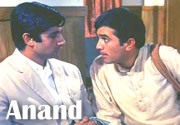
Anand
Synopsis:
Halfway through the movie, Rajesh Khanna is sitting in a wheelchair wearing this totally ridiculous oversized safari hat and he's barking orders at everyone like he owns the hospital, and honestly it's just such a bizarrely joyful moment because you know he's secretly dying inside. But to understand why we're even at that point, you have to look at how this whole thing started, which goes back to when Amitabh Bachchan enters the picture as Dr. Bhaskar Banerjee, this super grumpy oncologist who hates how poor people are treated in India and writes angry poetry about it instead of just trying to live a normal life. Amitabh plays this brooding, constantly irritated doctor who doesn't smile ever, and then Rajesh Khanna bursts into his life playing Anand, a terminally ill guy with lymphosarcoma of the intestine who refuses to stop laughing and crying and bothering everyone he meets. Anand is one of those classic characters from older bollywood movies that just completely changes the vibe of every single room he walks into, and right from his very first scene, where he's diagnosing his own fatal illness with a massive grin on his face and calling Amitabh babu, you realize this isn't just another standard tearjerker from the golden era of hindi movies. Amitabh's character is initially annoyed out of his mind by this guy who won't stop talking and calling him Babu Moshai, but they become fast friends because how can you not love Rajesh Khanna flashing that signature dimpled smile even when he's got like six months left to live? So then Anand moves in with Amitabh and immediately starts meddling in everyone's personal business, like when he spots Ramesh Deo playing Dr. Prakash Kulkarni and Sumitra Sanyal playing his wife Renu, and he just injects himself into their marriage and tries to play matchmaker for the entire neighborhood. The funny thing is, everyone gets so used to Anand bossing them around that they totally forget he's actually supposed to be a patient who's fading away fast, and he spends half his time running around Bombay fixing strangers' problems and giggling. There's this one random scene where Anand is trying to buy a specific type of pickle from a vendor on the street and he argues with the guy for ten solid minutes over whether the mangoes were picked in Ratnagiri or somewhere else, and he's wearing this striped woolen scarf that looks like it's falling apart at the threads while he gestures wildly with his hands and laughs that big loud laugh that draws a whole crowd of people staring at him. He didn't even care about the pickle, he just wanted to chat with the vendor about his grandkids. Anyway, Anand also gets involved with a poor singer named Manju and helps her become famous while falling for her sister or something, and he brings this weird chaotic energy to all these serious medical settings. The film is basically a total standout among bollywood, blending heavy drama with goofy comedy in a way that feels very natural even if it makes you sob your eyes out by the end. As time ticks down and Anand's health takes a massive nosedive, Amitabh tries desperately to find a cure or at least ease the pain, but there's nothing anyone can do because the disease is just too aggressive. Anand slowly loses his ability to walk and has to use that wheelchair, but he's still cracking jokes and refusing to let anyone mope around him. The pain gets worse and worse, and he's coughing up blood and looking completely exhausted, but he still insists on staging a little play for the hospital staff just to cheer them up one last time. Right at the very end, Anand passes away quietly in bed while a tape recorder he rigged up earlier keeps playing his voice saying goodbye and calling out to Babu Moshai, leaving Amitabh sobbing uncontrollably as the camera stays frozen on his grief-stricken face.
Rajesh Khanna wears a brown corduroy jacket in the second half of Anand that looks remarkably stiff, like something tailored out of upholstery fabric rather than proper suiting, and every time he leans back against a hospital pillow you hear the fabric creak against the linen. It is a small thing, completely divorced from the heavy themes of mortality and grace that usually dominate discussions of Hrishikesh Mukherjee’s 1971 classic, but cinema lives in those irritating textures. Bombay cinema of that decade was churning out frantic melodramas and star vehicles designed to make audiences forget inflation and political unrest, yet here is a modest studio picture about a man with lymphosarcoma of the intestine who refuses to stop smiling. People talk about the film as an emotional wringer, which is true enough, but they forget how much of it feels like a low-budget stage play shot on cramped indoor sets with terrible acoustics that catch the boom mic drifting overhead during quiet conversations in the dispensary.
Mukherjee directs with an invisible hand that sometimes borders on laziness. He cuts away from reaction shots a beat too late, leaving actors hanging in awkward silence while they wait for the next cue, and the pacing in the middle third sags under the weight of repetitive comic relief from Asit Sen playing an irritable doctor with a chronic cough. There is an amateurish quality to the editing in the outdoor sequences shot around Bombay, where the sound design drops out entirely and leaves you listening to the hollow echo of footsteps on fake gravel. Gulzar’s dialogue saves the enterprise from sinking into pure sentimentality, giving the characters a conversational rhythm that feels lived-in rather than scripted for maximum impact. When Khanna’s character drops philosophic aphorisms about life being a circus, it could easily sound gratingly precious, but the casual delivery strips away the pretense. Hindi cinema has rarely produced a better working relationship between a director and his writer, because Mukherjee lets the scenes breathe long after the dramatic point has already been made, trusting the audience to sit in the quiet corners of a shabby apartment.
Rajesh Khanna was at the absolute peak of his superstardom when this came out, riding a wave of adulation that made him behave like a minor deity on sets, and you can see a strange sort of self-awareness leaking into his performance. He plays Anand Sehgal not as a saintly victim but as an intrusive, hyperactive pest who crashes into people’s lives uninvited and refuses to leave until they acknowledge his joy. His smile is relentless, flashing in almost every frame, yet he manages to inject a subtle exhaustion behind the eyes that prevents the character from turning into a cartoon of perpetual sunshine. It is a massive contrast to his work in Aradhana, where he relied heavily on glossy romantic mugging and swinging hips to hold the screen. Here, confined largely to a hospital bed or a cluttered suburban bungalow, he has to do the heavy lifting with vocal modulation and slight twitches of his fingers. Amitabh Bachchan, by contrast, is practically vibrating with nervous energy as Dr. Bhaskar Banerjee, known to everyone as Babu Moshai. Bachchan was essentially a nobody at this point, tall and gangly and possessing a deep baritone that sounded completely wrong for romantic leads of the era, and Mukherjee uses that awkward physical presence to perfection. He stands too close to people. He clutches his stethoscope like a talisman. He glares at the world through thick-rimmed spectacles with the intense, joyless fury of a man who takes his medical textbooks far too seriously. Watching the two of them interact is fascinating because Bachchan looks genuinely intimidated by Khanna’s casual authority, and that real-world hierarchy bleeds into the fictional dynamic between the erratic patient and the severe oncologist.
The supporting cast does heavy lifting without ever drawing undue attention to themselves, though Ramesh Deo as Dr. Kulkarni plays the sensible mediator with a slightly too eager earnestness that occasionally borders on school-play acting. Sumitra Sanyal as the quiet, long-suffering wife exists mostly as a sounding board for the two male leads, yet she manages to convey volumes with just a tired nod while pouring endless cups of tea in a kitchen that always looks cramped and dusty. Salil Chowdhury’s score is anchored by two unforgettable numbers penned by Yogesh, particularly Kahin Door Jab Din Dhal Jaye, which plays on a faint radio in the background of several scenes until it becomes an auditory ghost haunting the narrative. The cinematography by Jaywant Pathare is strictly functional, lit with the flat, high-key studio illumination typical of Hindi movies from that period, which robs the hospital scenes of any genuine grit but forces the actors to carry the emotional atmosphere entirely on their own backs.
What keeps the picture from aging into a dated tearjerker is its stubborn refusal to offer easy consolations about death. Anand does not die with a grand, inspiring speech about the beauty of existence, nor does he impart some profound moral lesson that transforms Babu Moshai into a happy-go-lucky humanitarian. He just gets weaker, his voice drops to a dry rasp, and the inevitable arrival of the end feels sudden and messy rather than poetic. The famous tape-recorded monologue at the very end, where Khanna’s voice plays back after he has already passed away, risks tipping the entire enterprise into manipulative sentimentality, but it works because the film has earned that raw, ugly sob from Bachchan in the final minutes. Hindi movies have spent decades trying to replicate that specific emotional punch without understanding that you have to spend two hours making the audience annoyed by the protagonist before you can break their hearts. It is a messy, uneven, structurally lopsided piece of work that somehow hits every right note simply by refusing to care about cinematic polish.