

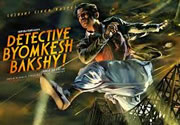
Detective Byomkesh Bakshy
Synopsis:
There is literally this one random scene where Sushant Singh Rajput is just sprinting across a Calcutta rooftop while dodging bullets and looking intensely confused, and honestly, that pretty much sums up the entire chaotic energy of Detective Byomkesh Bakshy.
Right, so to understand why he's jumping over laundry lines in a dhoti, we gotta go back to the start where this fresh-out-of-college guy named Byomkesh teams up with a nervous medical student named Ajit Banerjee, played by Anand Tiwari, because some old chemistry professor named Sashibhushan has gone missing.
The guy just vanishes into thin air, and his son wants answers, which leads our boys to this sketchy boarding house filled with the weirdest collection of characters you will ever see in typical bollywood movies, including a dentist who talks to ghosts, a guy who might be a revolutionary, and Anguri Devi, played by Swastika Mukherjee, who looks like absolute royalty in her vintage sarees and just owns every single room she walks into.
Anyway, they find Sashibhushan’s dead body floating in the river with opium inside him, and things get way too real when the son who hired them gets murdered too, and by this point, Byomkesh is smoking bidi cigarettes and pacing around his tiny rented room while connecting strings on a corkboard like every classic detective in history.
Right after that, out of nowhere, there is this massive musical montage that feels super out of place because people are dancing in an opium den while jazz music plays, which is pretty wild for hindi films that usually stick to dhol beats, but hey, directors love experimenting in modern bollywood.
The funny thing is, right around the interval block, everything hits the fan when Byomkesh realizes the opium trade in Calcutta is connected to a shadowy criminal mastermind known only as Yang, and trust me, the interval leaves you staring at the screen wondering how on earth he's gonna get out of this mess.
So then the second half kicks off and it is just non-stop chaos where people are getting poisoned left and right, and Ajit is stressing out big time while Byomkesh keeps eating rasgullas and irritating the local police officers who can't stand his attitude.
We need to talk about this one background extra who is standing outside the tea stall in scene forty-two wearing the most aggressively striped yellow vest you've ever seen, and honestly, that vest deserves its own award because I couldn't stop looking at it while major plot exposition was happening.
The investigation gets crazier and crazier until Byomkesh figures out that Dr. Guha, this seemingly polite doctor who helps out at the clinic, is actually the evil mastermind Yang running a massive counterfeit currency and drug ring from a printing press hidden right under their noses.
Dr. Guha tries to play it cool and offers him tea, dropping the iconic line that evil is just a matter of perspective, but Byomkesh isn't falling for any of it because he's already figured out the whole trap.
A massive brawl breaks out in the printing facility with ink flying everywhere and guns going off, proving that detective stories in hindi movies don't always need to follow the same old boring formula, especially when Sushant Singh Rajput brings so much raw energy to the role.
Yang gets away into the foggy Calcutta night, leaving Byomkesh standing outside with Anguri Devi, realizing the city is way bigger and darker than he ever imagined.
Byomkesh sits down at his desk, puts his feet up, types out his new agency name on the typewriter, and looks straight into the camera.
Sushant Singh Rajput had this habit of squinting at his own dialogue like he was trying to read a license plate through a rain-streaked windshield. It is a small thing, but it bugged me every single time he did it in Detective Byomkesh Bakshy, and if I'm honest, it kept pulling me right out of 1943 Calcutta whenever the movie needed me to just buy in. Dibakar Banerjee didn't make a period film so much as he built a damp, coughing organism that smelled of cheap tobacco and rotting jute, pushing the entire enterprise miles away from the polished surfaces of most Hindi films released in that decade. We get opium dens that actually look like they haven't been swept since the partition murmurs started, wet wool jackets that drag down the shoulders of men who clearly cannot afford another coat, and alleys so tight you feel like you need to exhale just to turn the page.
The screenplay refuses to hold your hand through the geography of the city or the labyrinth of the plot, dropping names and factions with the casual cruelty of a local train conductor who assumes you already know where the terminal is. Byomkesh isn't yet the legendary consulting detective of the Bengali pulp pages; he is just a skinny, slightly greasy kid from a provincial college who graduated six months ago and now finds himself squatting in a boarding house run by an old woman who looks at him like he owes her back rent in teeth. Anand Tiwari plays Ajit Banerjee as this sort of nervous anchor, a guy who follows Byomkesh into dark warehouses with the panicked reluctance of a golden retriever being dragged into a bath, giving the whole setup a lived-in friction that feels miles away from the usual swagger of Bollywood heroes.
The sound design is where the movie actually gets under your skin, layering these abrasive industrial scrapes and heavy bass thumps over vintage jazz records until you feel like your own head is vibrating from the trams rattling outside. Nikos Andritsakis keeps his camera locked into these tight, suffocating corners where nobody ever looks comfortable, tracking characters down narrow corridors with a relentless curiosity that makes you wish you could just pause the frame to look at the peeling wallpaper and grease stains. It reminds me a bit of David Fincher working on Zodiac, that same obsession with the procedural dirt and the way historical reconstruction can start to feel less like a museum and more like a crime scene that hasn't cooled down yet. Swastika Mukherjee drifts through the smoke as Angoor Bala with a tired, predatory grace that suggests she has survived five different regimes of bad men and expects the sixth one to knock on her door any minute now. Neeraj Kabi brings a theatrical, almost vibrating intensity to Dr. Guha that occasionally threatens to chew through the walls of the set, but Banerjee keeps him reined in just enough that he feels dangerous rather than silly.
The central mystery involves missing fathers and illegal chemical shipments, but the plot mechanics quickly become secondary to the way Banerjee uses the frame to show how easy it is to buy a soul in a city that is starving to death while waiting for the Japanese to drop the next bomb. There are long stretches where nobody solves a single clue, opting instead to sit in cramped tea stalls while rain drums against tin roofs, arguing about politics or nothing at all. That pacing is risky as hell, and it definitely lost half the multiplex audience on opening weekend, but it gives the film a bruised, lingering texture that stays in your teeth long after the lights come up. You get the sense that everyone on screen is sweating through their clothes because the wardrobe department actually soaked the wool instead of just spraying it with glycerin, and that kind of tangible discomfort seeps directly into the performances.
The needle-drop involving that aggressive modern rock track during the climax feels completely jarring, though, and I wish someone in the editing bay had just cut it out entirely because it stomps all over the period atmosphere they spent two hours building. Aside from that one bizarre sonic miscalculation, the production design deserves every bit of praise it gets for refusing to make 1943 look like a postcard from a heritage hotel. Byomkesh isn't clever because he has a shiny deductive method; he is just slightly more stubborn than the thugs trying to push him into the Hooghly River, and Rajput sells that exhausted tenacity without ever leaning into hero worship. Hindi movies rarely let their protagonists look this greasy and confused for two straight hours without offering a clean moral takeaway by the time the credits roll. Banerjee leaves a lot of loose ends dangling in the damp air, refusing to tie up the geopolitical rot with a neat bow, and the film is far better for that refusal.