

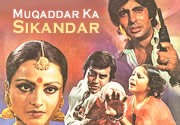
Muqaddar Ka Sikandar
Synopsis:
Picture the scene, Amitabh Bachchan is just totally losing it in the middle of a graveyard, crying his eyes out and clutching a fistful of dirt while shouting o saathi re, which is honestly one of those classic moments that just sticks in your brain forever. But to understand why he's having such a massive breakdown in the middle of the night, you have to look at how this whole messy story started back when he was just a dirt-poor orphan kid named Sikandar who couldn't even catch a break in life. As a little boy, he works as an orphan servant in the massive mansion of a super harsh and cold-hearted man who literally won't let him breathe, and what makes it worse is that he falls head over heels for the man's adorable little niece, Kaushalya, sharing these sweet secret moments with her that totally break your heart. I swear, the way the director lingers on this one specific cracked blue teacup they use to share water in the stable is wild, like they spent ten minutes of screen time just zooming in on a chip in the ceramic handle and the weird rust stain running down the side of the saucer, before she has to pack up and move away to the city with her snobby family. Sikandar gets kicked out into the freezing streets, and then he grows up to become Amitabh Bachchan in all his peak angry young man glory. So then, fast forward through like twenty years of grinding and hustling where he basically builds an entire underground criminal empire from absolute scratch, becoming this terrifyingly wealthy don who owns half the city but still feels like that lonely kid in the stable. The funny thing is, he never really forgot about Kaushalya, even though he's now running the streets and hanging out with shady characters. Right after that, he bumps into a gorgeous courtesan named Zohra, played by Rekha, who looks absolutely stunning in this one particular green velvet outfit with heavy gold embroidery on the sleeves that probably weighed twenty pounds, and she falls madly, hopelessly in love with him because he's just so brooding and tragic. She sings and dances for rich guys all night, but she only has eyes for Sikandar, who's too busy nursing his broken heart to notice how much she cares about him. The plot moves fast from here because he also meets a straight-laced lawyer named Vishal, played by Vinod Khanna, and they become best buddies even though Vishal is basically everything Sikandar isn't. Vishal doesn't even know that Sikandar is a wanted criminal most of the time, and they just hang out talking about life and drinking tea like normal bros. Then, out of nowhere, Kaushalya comes back into the picture all grown up, but she doesn't recognize Sikandar at all because he's all dressed up in expensive suits and goes by a totally different vibe now. This creates the most ridiculous love triangle you'll ever see in old school hindi movies, where Sikandar is low-key pining for Kaushalya, Zohra is pining for Sikandar, and Vishal is completely oblivious to the whole soap opera unfolding around them. Things get super messy when Vishal falls in love with Kaushalya, because of course he does, and Sikandar has to sit there and watch the girl he's wanted his whole life get scooped up by his new best friend. You'd think a powerful don would just do something dramatic, but he's too soft-hearted and just drinks his pain away while Zohra watches him self-destruct with so much sadness in her eyes. It's the kind of over-the-top melodrama that made bollywood movies such a trip in the seventies, blending romance and crime and family trauma into a three-hour marathon that somehow keeps you glued to the couch. Anyway, the villains from Sikandar's past come back to haunt him, and they hatch this elaborate scheme to ruin his life and take away his empire, leading up to a chaotic climax where bullets start flying everywhere and people are crashing cars into brick walls. During all this massive shoot-out madness, Sikandar gets fatally shot by the main bad guy, and he stumbles away bleeding out all over his fancy white shirt. He manages to drag his broken body all the way to the graveyard where Kaushalya and Vishal are standing around, completely shocked, and he falls right into their arms. He mutters his final dramatic lines about how he finally found peace, takes one last ragged breath, and dies right there on the grass.
The sound design on the train sequence near the beginning of Muqaddar Ka Sikandar is flat out weird, the kind of dialogue replacement where the audio track doesn't quite match the ambient track of the carriage, but nobody really cares because Amitabh Bachchan is staring past the camera with that specific heavy-lidded glare that makes plot holes look like deliberate artistic choices. Prakash Mehra directs with a heavy hand, piling on melodrama until the frames groan under the sheer weight of orphan misery, yet the whole thing moves with a strange propulsion that keeps you from checking your watch during the endless musical interludes. We have seen this orphan-to-riches arc play out across a dozen other Hindi films from the era, particularly in Deewaar, but Mehra approaches the material less like a sociological study and more like an opera staged in a noisy warehouse.
Bachchan plays Sikandar, the downtrodden waif who turns into a brooding billionaire with a permanent glass of scotch in his hand and a death wish written into the corners of his mouth. It is a massive, loud performance that swallows up the supporting cast whenever he shares the screen, chewing the scenery with a mix of genuine anguish and pure star magnetism. Vinod Khanna provides a necessary counterweight as the principled lawyer, though the script gives him very little to do besides look noble in well-tailored suits and deliver monologues about the law that feel entirely disconnected from the actual emotional weather of the scenes. Then there is Rekha, whose courtesan Zohra Jan carries the genuine heart of the movie without ever sliding into cheap caricature, bringing a weary dignity to a character that lesser directors would have reduced to weeping in the background. Her chemistry with Bachchan crackles with unspoken history, anchored by glances that tell you more about their shared past than any expository flashback ever could.
The cinematography leans hard into high-contrast lighting, casting deep shadows across stairwells and palace floors to emphasize the moral ambiguity of a man who has conquered the city but lost his own soul in the process. It's a small thing, but it bugged me how often the same instrumental cue for tragedy repeats during the second half, cropping up every time Sikandar looks out a rain-streaked window or pours another drink. Kalyanji-Anandji's score otherwise works overtime, pumping out tracks like Roti Kapda Aur Makan style anthems that somehow fit the oversized emotions on display, even if the mixing makes the brass section sound like it is playing inside a tin can. The lyrics do the heavy lifting that the dialogue sometimes skips, mapping out the trajectory of a tragic hero who climbs to the top only to discover that the summit is just a cold, empty room.
Class mobility and romantic self-sabotage drive the narrative engine, pitting the wealthy elite against the underbelly of urban life through a series of increasingly implausible coincidences that somehow work because the conviction of the actors never dips below one hundred percent. Sikandar cannot accept happiness because his entire identity is built on the grievance of past rejection, turning every gesture of affection into a battlefield where he must either conquer or destroy. This makes him exhausting company for three hours, but Bachchan makes you feel the hollow center behind the silk kurtas and the lavish parties, translating a generic angst into something specific and bruised. The supporting players orbit this black hole of ego and trauma, desperately trying to anchor him to reality while the plot drags everyone steadily toward a cemetery finale under a torrential downpour.
By the time the credits roll, the film has exhausted every narrative trick in the book, from misplaced lockets to deathbed confessions, yet it leaves behind an odd, lingering aftertaste that standard masala entertainments rarely manage. It is a sprawling, messy beast of a movie that doesn't care about economy of storytelling, preferring instead to wallow in its own grandiosity until the viewer surrenders to the rhythm of the melodrama. You walk away remembering the way Bachchan tilts his head when he is cornered, or how Rekha holds a glance just a beat too long, details that transcend the formulaic mechanics of the plot and justify the sheer exhaustion of sitting through a runtime that refuses to quit.