

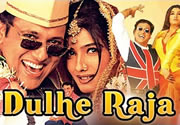
Dulhe Raja
Synopsis:
Picture Raja standing right there on top of a giant mechanical earth-mover in the middle of a massive construction site, completely soaked in sweat, wearing a violently bright yellow shirt that looks like it's glowing in the dark, and he's just screaming at the top of his lungs at Kader Khan while a bunch of extras in matching blue overalls pretend to shovel dirt in slow motion.
So then to understand why Raja is yelling at a rich guy on a bulldozer, we gotta go back to the start of this absolute classic among 90s bollywood movies where Govinda plays Raja, this smooth-talking, street-smart dhaba owner who is just trying to make ends meet in Ooty, but he's got this massive mountain of debt hanging over his head.
The funny thing is that Kader Khan plays Singhania, this ultra-snobby, filthy rich hotelier who hates poor people with a burning passion, and he wants to buy Raja's land to build a five-star hotel called Kuber Group, but Raja refuses to sell because that dhaba is his whole life, and he's got this sidekick Bankey played by Johnny Lever who is constantly cracking jokes and making the weirdest facial expressions you've ever seen.
Right after that conflict gets established, Raveena Tandon enters the frame as Kiran, who happens to be Singhania's spoiled daughter, and obviously she and Raja bump into each other in the most cliché way possible, start arguing immediately, and fall madly in love because that is just how romantic hindi movies work back then.
We need to talk about Kiran's sunglasses for a second because they are these huge, ridiculous plastic things that cover half her face, glowing neon pink, and she wears them indoors while sitting in a luxury suite just staring out the window, which makes zero practical sense but perfectly captures the insane fashion choices of the era.
Anyway, Raja disguises himself as a super-wealthy prince named Mangal Singh Kapoor to trick Singhania into renting out a luxury suite at his own half-built hotel, and Singhania falls for the scam completely because he only cares about money and status, which leads to so many ridiculous hallway chases and doors slamming back and forth like a stage play.
The interval block hits right when Singhania invites this fake prince over for a fancy dinner party, completely unaware that his beloved daughter is secretly making googly eyes at him across the table, and everyone is sweating bullets while the background music goes totally berserk with these screeching violin noises.
Then out of nowhere, right after the break, the movie forces all the characters to drop what they're doing and dance in the freezing snow wearing matching sequined winter coats for a song sequence that has literally zero connection to the plot and lasts for like six whole minutes.
Prem Chopra shows up as the stereotypical bad guy villain who tries to expose Raja's true identity to ruin the wedding plans and steal the family fortune, but his evil henchmen are so clumsy they keep tripping over each other and falling into swimming pools.
Things escalate super fast when the fake identity gets completely busted in front of the entire elite high-society guest list, Singhania has a massive cartoonish rage stroke, Kiran gets locked in her bedroom, and Raja gets thrown out of the mansion by a pack of angry security guards.
They have a big dramatic confrontation at the train station where Raja tries to leave town forever, but Kiran breaks free from her dad's grip and runs through a ridiculous amount of fog just to dive into his arms while Johnny Lever makes one final crying face in the background.
Singhania finally realizes that being rich doesn't mean anything if your family is miserable, so he completely changes his mind about poor people, gives them his blessing, and welcomes Raja into the family with open arms.
Govinda and Raveena hug tightly while the rest of the supporting cast forms a giant human circle around them and starts dancing enthusiastically as the final credits roll across the screen.
Johnny Lever pronounces a certain English loan word with an extra syllable that the script clearly didn't ask for, and the sound recordist left it right there in the mix because frankly, what difference did it make in 1998. Nobody was listening to the fidelity of the foley work anyway. They were waiting for Govinda to drop his shoulders, twist his pelvis into an impossible three-quarter angle, and sell a line delivery that has no business working on paper. You watch enough of these ninety-nineties hindi films and you start to notice the seams where the continuity person gave up. Not great, not bad, just there. The plot of Dulhe Raja moves with the frantic, sweaty desperation of a man running through a swamp while carrying an upright piano. Raja is a small-time con artist who smells an opportunity to fleece a wealthy hotelier named K.K. Singhania, played by Kader Khan with the kind of theatrical bombast that requires an entire proscenium arch just to contain his eyebrows. The narrative mechanics involve rented suites, fake identities, mistaken inheritances, and a romance with the hotelier's daughter Kiran, essayed by Raveena Tandon with a level of radiant patience that borders on clinical saintliness. Director Kuku Kohli doesn't so much guide this material as he stands back and lets the actors throw themselves against the drywall until something funny sticks. It is chaos captured on thirty-five millimeter stock. The framing in the outdoor sequences often feels like the camera operator was jogging backward away from an angry swarm of bees. You get horizon lines that tilt five degrees to the left for no discernible dramatic reason. Sometimes a boom mic dips into the top corner of the frame for a full second, bobs around like a confused seagull, and then gets yanked back up while characters are in the middle of a screaming match about property deeds.
Govinda approaches comedy with the absolute kinetic abandon of a man who just found out his parachute is packed with old laundry. Watch the way he negotiates the physical space of Kader Khan's meticulously decorated office. He doesn't just walk across a room. He slides, he stumbles, he pivots on one heel with the grotesque grace of a drunken ballet dancer, and he uses his eyebrows as semaphore flags to communicate total panic. This performance is a masterclass in controlled hysteria. Well, let me rephrase that because critics use the word masterclass too much. It is an unhinged onslaught of pure charm that manages to make a thoroughly obnoxious character genuinely endearing. When he tries to impress Singhania with high-society manners, his mouth does things that seem biomechanically impossible. He squints, he puffs his cheeks, and he delivers insults with such blinding velocity that the recipient usually just blinks twice and accepts the defeat. It stands in direct opposition to the dour, self-serious posturing you see in a picture like Border, where every man on screen looks like he is personally carrying the weight of the subcontinent on his collarbones. Govinda refuses to carry anything except his own trousers, which he hitches up with a theatrical snap every thirty seconds. Raveena Tandon has a much harder job because her character exists purely to react to the surrounding madness with a mixture of amusement and mild exasperation. She doesn't get to run wild. She has to anchor the scene while two men twice her age scream at each other about bankruptcy and family honor. She manages this by deploying a smile that looks entirely genuine despite the ridiculousness of the dialogue she is forced to mouth. The supporting cast features Prem Chopra doing his standard sneering villain routine, though he looks mildly confused about whether he is supposed to be menacing or merely a setup man for the next physical gag. The editing during the comedy sequences occasionally lingers a beat too long on a reaction shot, draining the punchline of its momentum before the next gag can land, which is a small thing that bugged me every time it happened.
The visual language of the film belongs to a specific era of bollywood movies where every song sequence looked like a paint factory exploded inside a shopping mall. Anand-Milind provided a soundtrack that relies heavily on synthetic brass samples and dholak loops that could induce a migraine if played at high volume in a small room. Yet the title track remains an earworm of terrifying persistence. You can try to scrub it from your memory banks with aggressive amounts of silence, but it will crawl back into your head three days later while you are waiting for the bus. The choreography by Chinni Prakash is less about dancing and more about emergency crowd control. Govinda and Raveena are surrounded by forty background dancers wearing neon vests and plastic hats, all of them moving at slightly different tempos as if they received their instructions via telegram ten minutes before the camera rolled. The cinematography has that flat, harshly lit video-look that digital enthusiasts pretend to hate until they realize how much cheaper it is to shoot that way. Colors are saturated to the point of violence. Reds bleed into yellows, skin tones occasionally take on the waxy sheen of a department store mannequin, and night scenes are lit with such glaring blue gel filters that characters look like they are standing inside a frozen seafood locker. It lacks subtlety. It lacks restraint. It is loud in every possible sensory dimension, from the screech of the synthesizer cues to the booming baritone of the sound effects used whenever someone gets slapped on the back of the head.
Beneath the superficial gloss of matrimonial farce and slapstick humiliation, the story operates on a familiar anxiety about class mobility in modern hindi films. Singhania is a man obsessed with pedigree, capital, and the preservation of his corporate empire, while Raja represents the fluid, opportunistic spirit of the pavement dweller who refuses to stay in his assigned socioeconomic bracket. The conflict is resolved not through moral awakening or structural reform, but through deception, emotional blackmail, and a remarkably convenient plot twist involving a forged will. It is a cynical worldview wrapped in bright pastel packaging. The wealthy are depicted as pompous fools who deserve to be swindled, and the poor are depicted as lovable rogues who deserve a penthouse suite simply because they can dance better than the management. Nobody in this universe has a real job that involves actual labor. They are all hustlers, managers, tycoons, or professional relatives. The script treats money as a prop, a shifting numerical value that appears and disappears based on the immediate comedic requirements of the scene. When Raja needs to look rich, bags of cash materialize from nowhere. When he needs to look desperate, his pockets are literally turned inside out to reveal a solitary postage stamp and a half-eaten lollipop. This transactional morality is treated as a harmless joke, a natural way to navigate a world where institutions are useless and family ties are negotiable.
The closing stretch of the narrative abandons all pretense of logical coherence and plunges headfirst into a chaotic farce involving multiple weddings, mistaken identities, and enough screaming to wake the dead. By the time the principals are running around a fake garden set while local policemen wave their batons in slow motion, you stop asking questions about plot holes or character motivation. It is an artifact of a specific industrial pipeline that churned out product with relentless efficiency. The projection print I watched had a scratch running down the center of reel three that looked like a lightning bolt, and frankly, it added a nice tactile grain to the proceedings. Govinda doesn't save the movie because the movie doesn't want to be saved. It just wants to keep moving until the film stock runs out. If you walk into this expecting a precise satire of the hotel industry or a nuanced critique of patriarchal marriage customs in urban households, you will leave empty-handed. If you are willing to watch a man in a yellow suit lose his mind for two and a half hours, it gets the job done without fuss.