

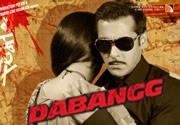
Dabangg
Synopsis:
‘I dont want to be shattered from dangers, I want to be fearless while facing them’ It means Fearless.
Set in Laalgurj, Uttar Pradesh, It is a story of Chulbul Pandey (Salman Khan), a totally fearless but corrupt police officer with unorthodox working methods.
But even the most fearless at times face a tough fight with their innermost demons. Chulbul has had a bitter childhood. His father passed away when he was young and mother Nalini (Dimple Kapadia) married Prajapati Pandey (Vinod Khanna). Together, they had a son Makhanchan (Arbaaz Khan).
Prajapati favours Makhanchan which does not go down well with Chulbul. He decides to take the control of his destiny and detaches himself from his stepfather and half brother. His sole attachment is his mother. However after his mother’s demise and an unsuccessful attempt to mend wounds, Chulbul snaps all ties with his stepfather and half brother.
Rajo (Sonakshi Sinha) with her unique perspective of life enters his world and turns upside down. Chulbul starts to see life more positively and also gets sensitized to the value of a family. But his detractors especially the dubious Cheddi Singh (Sonu Sood) have their own vested interests. And emerge as spokes in the wheel, pulling one brother against the other.
Makhanchan ends up carrying out acts oblivious to the consequences. When he realizes he has been used, he turns to Chulbul. Will Chulbul take his extended hand? Will the brothers be able to threat their detractors? Well this time, Chulbul’s fearlessness channelizes itself positively and reunite him with his family.
It is a hard-hitting, entertaining, emotional narrative that unfolds grippingly in a region that has place only for the fearless.
Sonu Sood’s voice doesn't quite match his chest cavity in the second reel, and if I'm honest, that little dubbing mismatch bothers me way more than it should. Let's just say sound design in modern Hindi movies occasionally forgets that a giant human being requires a certain bass frequency to sound authentic. Abhinav Kashyap steps into the director’s chair with Dabangg and immediately decides that gravity is merely a polite suggestion for Salman Khan. He directs the thing like a series of heavily stylized comic book panels that someone dragged through the red dust of Uttar Pradesh. The screenplay operates on a logic where bad guys exist solely to be thrown through wooden tables, which keeps the pacing frantic and prevents anyone from getting bogged down in actual police procedural details. Chulbul Pandey introduces himself by kicking a door off its hinges and then cracking a joke about his stepfather’s liver condition, setting a tone that is aggressively nonchalant about violence. You get chase sequences through narrow alleys where every clay pot shatters on cue. The camera shakes with a kind of nervous energy during the fistfights, trying to convince us that a man flying backward thirty feet after taking a single open-palm slap is happening in our actual physical universe. Lalit Pandit and Sajid Wajid handle the musical cues with a brassy, unapologetic volume that makes dialogue scenes feel like the quiet preamble to another dance number in front of an abandoned warehouse.
Salman Khan does not stretch his range here, choosing instead to lean entirely into the specific brand of amused menace that worked for him in Wanted, minus the long leather coats and brooding silences. He wears his mustache like a weapon. Every sideways glance at Sonakshi Sinha carries this weird, predatory charm that somehow avoids feeling entirely repulsive because he plays it with a wink. Speaking of Sinha, her debut performance as Rajo relies almost exclusively on chewing on the corner of her dupatta and looking suitably unimpressed by Chulbul's pathetic attempts at courtship. She has this way of narrowing her eyes that suggests she has already calculated how many times she will have to bail him out of a local jail. Vinod Khanna and Dimple Kapadia drift through the background as the fractured family unit, playing the classic mother-son dynamic with a weary exhaustion that feels imported directly from a 1970s melodrama. Then you have Cheddi Singh, played by Sood with enough sneering arrogance to make you wish the script gave him an extra twenty minutes of screen time just so he could chew more scenery. The supporting cast populates the frame with sweating municipal officials and corrupt constables who all look like they haven't slept a full night since the monsoon season ended.
There's an obsession with sunglasses in this movie that borders on the clinical. Khan flips them onto the back of his collar, catches them mid-air, slides them down his nose to peer over at a dying informant, and it becomes the primary mechanism through which he expresses emotion. Color grading leans heavily into a scorched-earth yellow palette, making everything look like it was shot inside a tandoor oven during a heatwave. The action choreography by Master Vijayan lacks the intricate wire-work of Dhoom 2, opting for old-school impact where stuntmen just hurl themselves backward into walls with maximum enthusiasm. It is loud. It is completely unbothered by plausibility. Characters monologue about honor while standing inches away from fifty-pound sacks of grain. That title track hits the speakers with a relentless brass hook that repeats so often during the fight scenes you start hearing it in your molars long after the credits stop rolling.
Beneath the bluster, the film is essentially a Western dressed up in khaki and aviators, operating on the same frontier justice logic you see in Clint Eastwood pictures. The police station isn't a government office; it's a feudal fiefdom where Chulbul dispenses rough justice with a leather belt and a smile. Morality is entirely transactional here. You pay your protection money, you get to keep your kneecaps. When the state does appear, it arrives in the form of completely useless bureaucrats who exist to be humiliated by the hero in front of a cheering crowd of villagers. This political cynicism runs through a lot of mainstream Bollywood cinema from this particular decade, where heroes don't reform the system because fixing the machinery of government is boring compared to punching the guy who runs it.
The pacing sags right around the middle when the romance takes center stage, forcing us to sit through two consecutive songs involving tractor trailers and colored powder that do nothing to advance the plot. Kashyap seems slightly out of his depth when he has to film two people talking in a room without someone smashing a window. Yet the sheer kinetic momentum of Khan’s star power drags the whole enterprise across the finish line whether the script deserves it or not. You leave the theater thinking about the sound of that belt whistling through the air and the way the frame freezes on a grinning face every time a punch lands, which is probably all the production team wanted in the first place.