

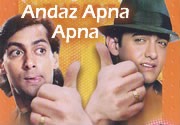
Andaz Apna Apna
Synopsis:
There is a specific sound Paresh Rawal makes when he is trying to comprehend a lie about an underground pool table that sounds less like human speech and more like a deflating pool float. It sits there in the mix, slightly too loud because the foley work in Rajkumar Santoshi’s 1994 comedy was clearly finished on a Tuesday afternoon while someone important had already left for lunch. If I'm honest, that small acoustic imbalance bothered me more than the logic gaps in the second half where the plot about an heiress and her kidnapped father simply stops mattering for twenty minutes so the principals can argue over a pair of fake diamonds in a graveyard. Hindi films from the nineties rarely worried about keeping their narrative engines greased, preferring instead to let stars improvise until the reels ran out.
Santoshi had previously directed Ghayal, a brutal and relentlessly serious revenge drama that won national awards and terrified suburban audiences with its sheer volume of blood. Moving from that kind of heavy-handed vigilante justice to a sprawling, door-slamming farce about two greedy ne'er-do-wells trying to fleece the same wealthy family required a certain looseness of the wrist. The screenplay, credited to Santoshi and Dilip Shukla, operates less like a structured narrative and more like a collection of running gags that stubbornly refuse to die. Amar and Prem are lazy, unemployed, and entirely devoid of charm on paper, yet Aamir Khan and Salman Khan play them with such desperate, wide-eyed hunger that the movie sidesteps the usual smugness of the genre. They are small-time crooks who couldn't organize a lunch break, let alone a kidnapping, and the direction exploits this incompetence by framing every wide shot to make them look as small and ridiculous as possible against the dusty Mumbai backlots and aggressively fake Goan hotel rooms.
Aamir Khan is playing straight-faced larceny with a pencil-thin mustache that looks like it was glued on with Elmers while he sleeps, and his delivery of lines about future wealth has a shrill, twitchy desperation that separates him from the usual romantic leads of Hindi movies. Salman Khan counters with a slack-jawed, shirtless vanity that feels genuinely goofy, leaning heavily into physical comedy without worrying about looking cool for the camera. When the two of them share a tiny bed, kicking each other in their sleep while plotting how to murder a rich girl's uncle for his money, the rhythm of their bickering has the chaotic energy of a radio play performed by exhausted teenagers. Raveena Tandon and Karisma Kapoor mostly stand around in neon knitwear looking mildly annoyed by the men throwing themselves at their feet, though Tandon gets a few sharp reactions in during the mistaken-identity sequences that suggest she knew the script was pure nonsense and decided to have fun anyway.
The cinematography by Ishwar Bidri rarely does anything flashy, sticking to flat, brightly lit interior setups that mimic television sitcoms of the period, which actually helps the theatricality of the jokes land without distraction. Tushar Bhatia’s soundtrack is full of synth-heavy hooks that arrive out of nowhere, occasionally stopping a scene dead in its tracks just so everyone can dance in front of a painted backdrop of a European street. That title track remains an earworm that refuses to leave your head for days, even if the audio mixing on the brass section gets fuzzy every time the chorus hits. It's a small thing, but the transition edits between the musical numbers and the dialogue scenes are so jarringly abrupt that you can practically see the splice marks on the celluloid.
What keeps the film from dissolving into complete nonsense is its cynical view of greed in middle-class families during a decade when liberalization was promising everyone a quick path to wealth. Amar and Prem do not want love or adventure; they want cash, bungalows, and enough gold to impress their fathers, and every romantic gesture they attempt is immediately undermined by a calculation of how much the girl's family owns. The humor comes from how easily their grand schemes fall apart the second someone offers them a free meal or a place to sleep. They are quintessential products of a cinematic landscape where heroes were no longer angry young men fighting the system, but ordinary idiots trying to cheat it and failing miserably at every turn.
Nobody walked out of the theater in 1994 predicting that this particular box-office disappointment would slowly mutate into a cult object watched on bootleg video cassettes until the tape wore thin at the edges. Time has a strange way of scrubbing the stink off commercial failures, smoothing out the pacing issues and turning erratic editing into charmingly haphazard spontaneity. The supporting cast, featuring Mehmood and Shehzad Khan, leans so hard into cartoonish villainy that the movie sometimes resembles a live-action Tom and Jerry cartoon with more dialogue and worse hair. It remains a messy, overlong artifact of an industry figuring out how to laugh at itself right before the multiplex era changed everything about how movies were made and consumed.