

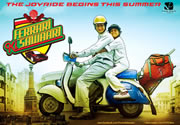
Ferrari Ki Sawaari
Synopsis:
Picture this, Sharman Joshi is frantically running around the streets of Mumbai trying to get a very specific, incredibly shiny red sports car for just a few hours because his young son is obsessed with it, and honestly, if you have ever tried to rent a vintage Italian luxury vehicle in the middle of a bustling metropolis, you know it is basically impossible. But to understand why he's going through all this absolute madness, you have to look at how this whole thing started, back when Rustam, played by Sharman, was just a humble, mild-mannered guy working a desk job at the cricket board office, and he didn't want much out of life except to see his kid happy and maybe eat a simple meal with his eccentric, cricket-obsessed father who used to play the sport back in the day and won't stop talking about his glory years. Right after that quiet setup, we are thrown into the absolute core conflict of the movie because Kayo, the sweet little boy played brilliantly by Ritvik Sahore, gets selected for a prestigious cricket coaching camp at Lord's in London, which sounds amazing and like a total dream come true for any kid growing up loving the sport in India, except for one tiny, budget-crushing detail that changes everything.
The camp costs an outrageous sum of money, and Rustam's wallet is practically crying empty tears, and he doesn't have the cash, and he doesn't want to break his son's heart by telling him they can't afford it, so he goes running around to every single bank and loan shark he knows, only to hit dead ends everywhere. The funny thing is, while he is stressing out about rupees and paisas, he overhears that a very famous politician played by Boman Irani is looking to rent out his prized possession, a gorgeous, impossible-to-miss red Ferrari, for a grand wedding happening over the weekend, and whoever gets the gig will get paid a ridiculously huge amount of cash that would instantly cover the entire cost of the London cricket camp. So then, Rustam hatches this wildly illegal and totally insane plan to somehow steal the car for just one evening without the owner noticing, return it in pristine condition, and collect the envelope full of money. It sounds foolproof if you don't think about it too hard, but this is where Ferrari Ki Sawaari enters its most chaotic stretch, and things get out of hand so fast it makes your head spin.
Before he even gets the car out of the parking garage, he has to deal with a security guard who has an extremely annoying tick and refuses to look away, and I swear they spent at least ten minutes of screen time just showing Rustam trying to distract this one guy with a box of stale sweets and a fake phone call about a gas leak, and it was so painfully awkward to watch because you just know security guards don't fall for that kind of amateur hour nonsense. Anyway, he finally manages to swipe the keys and drive the beast out onto the chaotic streets of the city, and the engine roars, and pedestrians turn their heads in absolute shock, and for a split second, it feels like all his problems are solved. Bollywood movies love a good impossible heist, and this one has all the goofy, heartwarming tropes you'd expect, except the car gets dented. Just a tiny scratch, but still. A disaster.
Paresh Rawal shows up briefly as a quirky character who adds to the general madness, and Satyadeep Mishra makes an appearance too, keeping the supporting cast pretty solid throughout this wild ride, but let's be real, the movie belongs entirely to the dynamic between the father, the son, and the grandfather, because it's really about generational expectations and family baggage disguised as a sports comedy. They aren't just making lighthearted hindi films here; they're digging into that classic middle-class anxiety where every single rupee counts toward a better future for the kids. Rustam gets caught, obviously, because you can't just drive away with a politician's favorite toy and expect to get away with it, and the confrontation scene with Boman Irani is dripping with stern looks and shouting matches in a fancy living room, but instead of calling the cops right away, the politician actually listens to why Rustam did it, because even rich, grumpy politicians have a soft spot for kids wanting to play cricket. They share a moment of mutual understanding, the debt gets sorted out through some hard truth and community service or whatever, and Kayo gets his bag packed.
The very last shot of the film shows Rustam standing on the edge of the cricket ground, watching his son practice with a bright, proud smile on his face while the evening breeze picks up.
The sound design during the opening reel of Ferrari Ki Sawaari feels slightly overcooked, like the foley artist fell in love with the particular crunch of gravel under a bicycle tire and refused to dial it back. It is a small thing, but it bugged me every single time Rustam pedaled across the frame during the first twenty minutes. Rajesh Mapuskar directs this thing with a sort of relentless, breathless earnestness that makes you want to offer him a glass of water and tell him to sit down for a minute. He used to be an assistant to Rajkumar Hirani, and that DNA is smeared all over the screen in ways that are both helpful and deeply exhausting. Every scene has to punch you in the ribs to make sure you are feeling the correct emotion, which leaves zero room for accidental discoveries or quiet corners where the actors can just breathe. The screenplay is structured like a series of interlocking domestic crises that all somehow trace back to the absence of a proper playground or the exorbitant cost of cricket coaching gear, rendering the entire middle stretch a sequence of escalating hurdles that Rustam must clear with his perpetually anxious face. You get the sense that everyone involved was terrified the audience might check their phones if someone wasn't crying or shouting by the end of every single scene.
Sharman Joshi plays Rustam with his shoulders permanently hunched near his ears, radiating a kind of middle-class exhaustion that feels completely lived-in even when the writing forces him into increasingly absurd logistical corners. He is not doing the manic, high-wire act he pulled off in 3 Idiots, choosing instead to flatten his affect into the grey, dusty timbre of a man who spends his life dodging municipal fines and worrying about school fees. When he looks at his young son Kayozo, played with a remarkable lack of preciousness by Ritvik Sahore, there is a genuine, unforced tenderness that rescues the film from its own worst instincts. Sahore doesn't do that irritating child-actor thing where every line is delivered with a winking knowingness; he just acts like a kid who really, really wants to play at Lord's Cricket Ground and doesn't understand why his dad is sweating through his shirt over a ten-lakh deposit. Boman Irani shows up as the grandfather, a retired cricketer whose bitterness has crusted over his personality like hard water stains on a tap, and he manages to find a few sharp edges in a role that could easily have been reduced to a walking pile of generational clichés. The supporting cast is packed with reliable faces who seem to have been cast strictly on their ability to look bewildered on Mumbai street corners while traffic honks in the background. Satyadeep Mishra pops in for a scene or two as a fast-talking fixer, bringing a brief, oily charm to proceedings that are otherwise drowning in pure, unfiltered virtue.
Visually, this is a very beige piece of work, shot through a permanent golden-hour filter that makes every chawl and housing society look like it was scrubbed with lemon detergent right before the cameras rolled. The cinematography by Satyendranath Patra relies heavily on sweeping crane shots that try to give a middle-class Dadar housing complex the epic scale of a sports stadium, which feels entirely unearned given the actual stakes of the narrative. Speaking of the soundtrack, there is one particular background cue that sounds suspiciously like a stock library track from an inspirational corporate training video, and it reappears every single time Rustam has a minor epiphany about honesty or fatherhood. Bollywood movies have a long, tedious history of leaning on musical shorthand to tell the audience when to feel lump-in-the-throat sentimental, and this one milks that particular cow until it's dry. The editing by Rameshwar S. Bhagat is generally snappy, though it has an annoying habit of lingering on reaction shots for just one second too long, robbing the punchlines of their natural rhythm and forcing the comedy to land with a heavy, wet thud.
The central premise hinges on renting a vintage Ferrari for a single day because Sachin Tendulkar’s son needs it for a wedding or some such nonsense, which is the kind of high-concept nonsense that works better on a coffee napkin than it does across two hours of screen time. It touches on themes of parental projection, corruption in sports, and the crushing weight of societal expectations, but it treats these heavy subjects with the subtlety of a brass band marching through a library. You can see the gears turning behind every plot point, every moral dilemma, every single time Rustam has to choose between doing the right thing and paying off a local goon. Hindi films have spent decades obsessing over the sanctity of the father-son bond, and this picture adds very little to that conversation beyond swapping the usual village backdrop for the claustrophobic alleys of Parsi colonies and municipal offices. It wants to be a feel-good caper about ordinary people brushing against extraordinary luxury, but it gets bogged down in its own moralizing every time the red car actually enters the frame. If I'm honest, the titular Ferrari feels less like a narrative catalyst and more like a rented prop that everyone was terrified of scratching.
There is a mechanical efficiency to the way the third act resolves itself that feels less like a narrative conclusion and more like a bus finally arriving on schedule after you've waited in the rain for forty minutes. You leave the theater without feeling much of anything except a mild ringing in your ears from the relentless background score and the lingering memory of Sharman Joshi’s worried eyebrows. It is neither a disaster nor a triumph, occupying that vast, grey middle ground where so many middle-of-the-road Hindi movies go to live and die without ever causing a ripple in the cultural conversation. Mapuskar wanted to capture the frantic pulse of the city alongside the quiet dignity of a struggling father, but he ended up with a machine too loud for its own good and parts that never quite clicked together under the hood.