

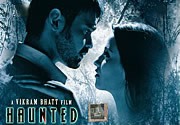
Haunted
Synopsis:
Halfway through the film, Mahakshay Chakraborty is just staring intensely at this weirdly shaped old wooden music box that's sitting on a dusty table, and honestly, the lighting in this particular room is so aggressively blue that it looks like they shot the whole thing inside a massive aquarium, and he keeps touching the brass latch like he's expecting it to bite him or something, which is hilarious because earlier he couldn't even be bothered to lock his front door. But to understand why he's hanging out in a haunted house staring at antiques, you have to look at how this started, because he plays this guy named Rehan who inherits a massive estate called Glen Manor and he decides he's gonna sell it, only he doesn't know it's got a super dark history. He's an estate agent or something similar, and he shows up at the property expecting a quick payday, but the place is giving off major bad vibes right from the very first minute he steps onto the creaky porch. So then he meets the caretaker, played by Arif Zakaria, and this guy has the creepiest mustache in the history of hindi movies, and he's just lurking in the shadows dropping vague warnings about how nobody ever leaves the place alive, but Rehan doesn't care because he's got dollar signs in his eyes and he thinks everyone's just being dramatic. That's ghost logic for you.
Anyway, the real terror kicks off when he finds this hidden diary tucked behind a loose brick in the library, and it belongs to a young woman named Meera, played by Twinkle Bajpai, who lived there years ago and went completely mad before meeting a terrible end. The diary entries are read in this echoing voiceover while flashbacks show Meera walking around in this bizarrely bright yellow Victorian dress that looks like it was rented from a cheap costume shop in a hurry, and she's constantly clutching a blue velvet handkerchief to her face and weeping about her cruel piano teacher who locked her in the basement. I swear they spent at least ten minutes of screen time just focusing on the lace trim of that handkerchief fluttering in slow motion against a gray brick wall, and then suddenly she's possessed, the ghosts are defeated, and Rehan falls in love with her spirit through time travel. That escalated quickly.
The funny thing is, Achint Kaur shows up as this terrifying psychic medium named Margaret who tries to warn Rehan about the main evil entity haunting the grounds, and she wears these massive purple tinted glasses indoors that make her look like an extra from a low budget sci-fi flick rather than a spooky horror movie. She's yelling stuff about how the past cannot be changed and he's meddling with forces he doesn't understand, but Rehan just ignores her completely and keeps digging deeper into the property's cursed history because he's determined to save Meera from her tragic fate across dimensions. Right after that, the house starts shaking like it's stuck in an earthquake, furniture is flying everywhere, and spectral hands are grabbing at his ankles every time he tries to walk down the hallway. Total chaos. It's wild how much supernatural nonsense gets packed into these specific kinds of bollywood movies, and this one really leans hard into the digital effects, which look super dated now, but back then they probably thought it was cutting edge. They weren't right.
So Rehan actually manages to slip back into the past by just walking through a foggy bedroom door, and he finds Meera trapped in that damp basement with the evil piano teacher played by Arif Zakaria again, only this time he's wearing an even scarier coat. They have this massive supernatural showdown where Rehan has to fight off phantom attackers using nothing but a heavy iron poker he found lying around, and he keeps shouting leave her alone at the top of his lungs. He grabs Meera by the hand and they run through a burning hallway while walls are literally melting around them, and they jump out of a second-story window right as the entire manor explodes into digital flames. They wake up lying together on the grass outside the ruins of the house in the present day, completely safe, and they walk off into the sunrise holding hands.
There is a specific kind of digital sheen that instantly drains the dread right out of a horror movie, and Vikram Bhatt’s 2011 stereoscopic experiment coated every single frame of its runtime in that exact brand of glossy, lifeless varnish. 3D was having a desperate moment back then, with every director chasing the novelty of having things poke you in the eye, and the technology forced a severe, clinical lighting setup that completely ruined whatever moody shadows a supernatural thriller actually needs to function. It starts right away with the cameras, or rather the way the digital intermediate grade crushes the blacks into a murky grey soup that looks less like a cursed Victorian mansion and more like the lobby of a suburban multiplex after closing time.
Mahakshay Chakraborty plays the haunted hero with a kind of bewildered earnestness that sometimes crosses the line into complete blankness, standing in the middle of creaking hallways with his mouth slightly open as if he forgot why he walked into the room. If I'm honest, the burden of carrying a massive supernatural vehicle was always going to be a heavy lift for an actor still trying to find his footing, and the sheer volume of green-screen nonsense he had to react against didn't do him any favors. He shares the screen with Twinkle Bajpai, whose performance relies heavily on staring intensely into the middle distance while dramatic strings swell on the soundtrack. She gets possessed by a vengeful ghost with a tragic backstory, standard Bollywood ghost lore stuff, and she throws herself into the physical contortions of the possession with a lot of loud screaming that quickly becomes exhausting rather than scary.
The supporting cast features Achint Kaur and Arif Zakaria, both pros who know how to chew through expositional dialogue with straight faces, though they are frequently let down by a screenplay that treats logic as a minor inconvenience. Characters constantly wander into locked basements alone, or decide to inspect strange weeping noises coming from damp cellars without bringing so much as a candle, let alone a flashlight. That sort of lazy plotting has plagued horror cinema for decades, but it feels especially egregious here because the dialogue is so relentlessly literal. Whenever something spooky happens, someone has to immediately explain out loud what just happened for the benefit of the back rows, destroying any ambiguity the scene might have built up. It's a small thing but it bugged me the way every single paranormal manifestation requires a 1980s-style wind machine to blow curtains around, even inside rooms with closed windows.
Vikram Bhatt has always been obsessed with bringing Western genre tropes into the mainstream Hindi film industry, often pulling heavily from Hollywood hits without quite figuring out the mechanics of what made them work. There are massive chunks of this movie that feel like a direct carbon copy of What Lies Beneath, right down to the bathtub scares and the domestic betrayal angle, but missing Robert Zemeckis's patient pacing and visual discipline. Bhatt shoots scenes in endless, looping tracking shots that circle the actors while they talk, a stylistic tic that gets old about three minutes in and never lets up. The camera never just sits still. It constantly swoops and glides and swoons, treating even a boring conversation about real estate deeds like a high-speed car chase.
The visual effects are a mixed bag, leaning heavily on translucent blue ghosts that recall Casper the Friendly Ghost rather than a genuinely terrifying apparition from the beyond. When the spirit of Lisa comes out to play, she is rendered in a soft-focus digital blur that refuses to lock into the physical space of the room, making her look like a badly cut-and-pasted sticker sliding across the lens. Yet the sound design genuinely works overtime to compensate for these visual shortcomings. Creaks, whispers, and sudden orchestral stabs slam into the mix with aggressive force, occasionally managing to jolt you awake just when the narrative drag threatens to put you to sleep. Chirantan Bhatt's music cues hit the melodramatic notes hard, recycling romantic motifs that sound suspiciously like rejected tracks from 1920, another one of the director's supernatural efforts from the same era.
There is an underlying theme about the sins of men and the absolute hell women go through in patriarchal isolation, but the movie is too loud and too fast to actually explore any of it with genuine depth. It wants to be a tragic romance wrapped in a ghost story, which means endless flashbacks to sunny days in Scotland where the lovers frolic in slow motion against misty green hills. Those flashback sequences go on forever, breaking the momentum of the modern-day haunting scenes every single time they start up again. You find yourself waiting for the ghost to show up just so the terrible picnic dialogue will stop. And yet, there is a weird, ramshackle sincerity to the whole enterprise that prevents it from being entirely disposable.
It lumbers from one set-piece to the next without much grace, dragging its digital baggage behind it like a heavy chain, but it commits to its own ridiculous premise with a straight face. The climax involves a church exorcism complete with flying debris, chanting, and a crucifix being shoved into the face of the CGI spirit, wrapping up every emotional loose end with maximum blunt-force trauma. Nobody is going to mistake this for a high-water mark of cinematic terror, but it occupies that strange, lower-middle tier of mainstream hindi movies where ambition vastly outstrips execution. You watch it, you shake your head at the terrible CGI, and twenty minutes later you can barely remember how the third act resolved itself.