

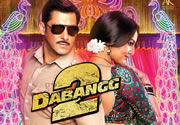
Dabangg 2
Synopsis:
Halfway through Dabangg 2, Salman Khan is standing in a dusty courtyard wearing this intensely bright, perfectly ironed turquoise shirt with the sleeves rolled up to his elbows just so, and he's having this totally bizarre staring contest with a guy who has the most ridiculous fake mustache I've ever seen on screen, and they're just glaring at each other while a goat loudly bleats in the background for what feels like a solid three minutes of unedited screen time. But to understand why Chulbul Pandey is glaring at a guy next to a farm animal, you have to look at how this whole messy sequel started, which was back in Kanpur where our favorite corrupt cop has transferred with his wife Rajjo, played by Sonakshi Sinha, who mostly spends her time wearing these incredibly vibrant pastel sarees and looking mildly concerned whenever her husband decides to beat up twenty guys using a frozen fish or whatever object happens to be lying around. So then, Chulbul's stepdad Prajapati, played by Vinod Khanna, is still nagging him about family values, and his goofball brother Makkhi is still messing up simple tasks, but the real plot kicks in when local politician Bachcha Bhaiya, played by Prakash Raj with this menacing smirk that he doesn't drop for two and a half hours, decides he wants to run the whole city through sheer terror and extortion. The funny thing is, Bachcha's brothers are even more annoying, especially the tall one played by Nikitin Dheer who just looms in the background like a big angry lamp post, and Deepak Dobriyal pops up as this cowardly sidekick who gets slapped around for cheap laughs, which is pretty standard for commercial bollywood movies where sidekicks only exist to absorb physical comedy slaps. Anyway, Bachcha starts causing major problems for local businesses, demanding protection money and throwing people off rooftops, and Chulbul doesn't like anyone stealing his thunder or breaking the law unless he's the one doing it, so he marches right into Bachcha's lair and delivers that iconic line about how he punches people until they forget their own names. Right after that, things get super personal because Bachcha's goons attack Chulbul's family during a religious festival where everyone's throwing colored powder at each other, and they tragically kill a close relative, which sends Salman into a massive, shirt-ripping rage that you usually only see in the loudest hindi movies. Then Chulbul goes totally off the grid and starts hunting down Bachcha's entire criminal empire one warehouse at a time, beating up hundreds of nameless henchmen who fly backward through wooden crates with zero regard for physics or basic human anatomy. The action scenes are totally wild, and Salman is just strutting around swinging a belt like it's a laser sword while the background score blasts this heavy brass remix of his signature theme music. You kind of forget about the plot because you're just staring at the sheer volume of dust flying everywhere. Pure chaos.
So then Bachcha realizes he's in way over his head and tries to kidnap Rajjo to use as leverage, which is a huge mistake because nobody touches Chulbul's wife and gets away with it, especially not a guy in a silk kurta. Chulbul tracks them down to this massive, abandoned industrial shipyard that looks like it was built entirely out of rusty barrels and dramatic shadows, and he doesn't even bother calling for backup because that would ruin the fun. He just kicks the main gate open, and it flies off its hinges and squashes a guy, and then he starts walking down this long metal walkway while fifty henchmen rush him all at once. He takes them out using iron chains, heavy wrenches, and occasionally just headbutting them so hard they spin around twice before hitting the concrete floor. The fight goes on for ages, moving from the outdoor docks into a dark warehouse filled with hanging chains and flickering overhead lights, and Sonakshi is tied to a chair in the corner looking mildly annoyed rather than terrified, shouting encouraging bollywood style dialogue over the sounds of breaking bones. Finally, Chulbul corners Bachcha Bhaiya in the middle of the room, and they have this massive fistfight where both of them take turns getting thrown through drywall until they're both covered in sweat and white dust. Chulbul pins Bachcha to the ground, delivers one last sarcastic quip about local elections, and lands a massive, slow-motion punch that knocks the villain out cold. The cops finally show up with sirens wailing, but they just stand by the door and salute because they know better than to mess with Chulbul Pandey when he's had a long day. Chulbul unties Rajjo, slings his arm around her shoulders, and they walk out into the blinding morning sunlight together while the credits start rolling over a totally unnecessary dance number featuring the entire cast in matching sunglasses.
The sound design on the punch that opens Dabangg 2 is weirdly bright, like someone snapping a frozen celery stalk inside a hollow plastic bucket, and it sits too high in the mix. You hear it over the studio logos before a single character is on screen, setting an immediate baseline of artificiality that the rest of the runtime refuses to abandon even when it tries to look gritty. If I'm honest, that specific audio choice bugged me more than the recycled plot mechanics or the digital grain they slapped across the nighttime exteriors to pretend there was actual atmosphere.
Abhinav Kashyap sat this one out after the massive success of the first outing, handing the directorial reins to Arbaaz Khan, who mostly seems interested in keeping the cameras pointed squarely at his brother's right profile for two and a half hours. The screenplay by Dilip Shukla tries to manufacture a sense of ongoing family lore by transplanting Chhedi Singh’s ghost into the shape of Prakash Raj's Bachcha Bhaiya, a local politician who operates out of a sprawling courtyard in Kanpur with far too many henchmen standing around holding outdated firearms. There's an exhausting rhythm to how scenes are built here, where every conversation between Chulbul Pandey and his aging step-father Prajapati Pandey, played by Vinod Khanna with the weary patience of a man who knows he is just there to cash a paycheck, has to immediately pivot into a joke involving aviator sunglasses or a pelvic thrust. It lacks the weird, loose energy that made the original hindi films of that specific era occasionally feel alive, replacing spontaneity with a heavy-handed adherence to brand identity that feels less like storytelling and more like franchise maintenance.
Salman Khan knows this character inside and out, which is both a blessing and a total dead-end for the drama. He doesn't stretch himself by even a millimeter, sliding back into the turquoise tinted shades and the torn-open khaki shirt with the bored efficiency of a factory worker clocking into a shift he has performed a thousand times before. Sonakshi Sinha gets even less to do as Rajjo, relegated to standing by the doorway of their brightly painted police quarters delivering sassy retorts that sound like they were pulled straight from WhatsApp forward messages while holding a baby who looks perpetually confused about what is happening on the other side of the lens. Sonu Sood and Nikitin Dheer are entirely absent this time around, leaving Prakash Raj to chew the scenery with such unbridled enthusiasm that he occasionally forgets he's supposed to be menacing, choosing instead to deliver threats while making weirdly expressive facial contortions that belong in a silent comedy.
The cinematography by Aseem Mishra leans heavily into saturated primary colors that bleed at the edges whenever the sun hits a car hood or a pile of marigold flowers, giving the whole affair the distinct visual texture of a high-end detergent commercial directed by someone who watched Wanted twice on a long flight. Then there's the soundtrack by Sajid-Wajid, which recycles the rhythmic DNA of Munni Badnaam Hui into tracks like Fevicol Se, a song that features Kareena Kapoor walking through a warehouse set surrounded by extras who look like they were plucked off the street five minutes before the cameras rolled. It is loud, aggressively tuneless in its lower frequencies, and deployed with such relentless frequency that you start praying for scenes of pure silence, which the editing room resolutely refuses to grant you.
Bollywood movies have long relied on the charismatic pivot from domestic comedy to bone-crunching vigilante justice, but this particular entry treats that transition as a bureaucratic chore rather than an emotional release. Chulbul Pandey beats up hundreds of nameless goons without ever breaking a sweat or dirtying his collar, draining the action sequences of any actual tension because the outcome is never in doubt for even a single microsecond. It feels structurally very similar to Rohit Shetty's Singham, yet it lacks that film's genuinely hysterical commitment to vehicular destruction, settling instead for mid-air slow-motion punches where you can clearly see the stunt double waiting for Salman's fist to arrive half a second before impact.
Supporting players like Deepak Dobriyal are brought in to provide texture to the background, but the script gives him nothing to sink his teeth into, reducing a genuinely talented performer to background noise who shows up to deliver exposition before disappearing into the crowd. It is a small thing, but the post-production dubbing on several of the police station extras is so terribly out of sync that you can watch their lips moving long after the audio has finished playing, a basic technical failure that points to a rush job in the editing bay. When the credits finally roll, you are left with the distinct impression of having watched a product that was assembled by committee in a very cold room.