

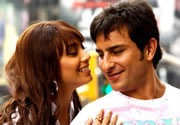
Ta Ra Rum Pum
Synopsis:
The steering wheel in the stock car racing sequences of Siddharth Anand's Ta Ra Rum Pum has this infuriating habit of wobbling even when Saif Ali Khan is apparently steering in a straight line on an oval track, which is a small thing to fixate on during a major studio picture, but once you notice it you spend entire laps watching the tires instead of the drama.
You cannot really talk about this movie without talking about the mid-2000s Yash Raj Films factory floor where everything rolled off the assembly line looking like a glossy furniture catalog that had been left out in the sun, polished to an impossible sheen that occasionally stripped the dirt right out of the New York City street corners where the first half of the story is supposed to be happening. Rani Mukherjee plays a rich girl turned struggling mother with a strange vocal affectation in the early reels that sounds like she is trying to swallow her syllables, and it takes an hour for her to settle into the sheer exhaustion required for the second act pivot where the money vanishes and the brownstone becomes a drafty box.
Before the bankruptcy and the hospital bills and the children crying over empty cereal bowls, the film spends a generous amount of time establishing that Raj, called RV, is a hotshot racing driver who can afford absurd leather jackets and a loft apartment that defies any sane real estate logic for a mid-tier NASCAR competitor. The script by Javed Siddiqi and Abbas Tyrewala leans hard into sports movie clichés without bothering to learn how points work in actual professional stock car racing, choosing instead to treat the track like a vertical obstacle course where the hero must overcome his fear of crashing after a particularly nasty wreck leaves him with a limp and a mountain of debt.
Saif Ali Khan has this casual, slightly bored charm that saved him in Dil Chahta Hai and keeps him afloat here even when he is asked to cry while staring at a dead battery in a freezing garage. He handles the transition from cocky track star to desperate father scrubbing greasy floors with enough actual grit to make you forget the artificial lighting for a few minutes, though the kid actors playing his children are directed to perform with that specific shrillness that makes you want to reach for the volume knob on your remote control.
Vishal-Shekhar's soundtrack dominates the proceedings with dhol beats and synthesized string sections that swell up every time someone looks pensively out a window, and if I'm honest, the titular track is pretty much inescapable once it gets lodged in your brain during the opening montage. The cinematography by Binod Pradhan captures the neon blur of the American highways with the kind of hyper-saturated gloss that defined popular Hindi films of that decade, making even a roadside diner look like a commercial for breakfast cereal.
There is an entire sequence where the family has to live on one dollar a day that plays like a middle-class fantasy of poverty, complete with clean thrift-store flannels and a kitchen that remains suspiciously organized despite the total lack of groceries in the pantry. Victor Banerjee pops up briefly as the stern racing team owner, delivering his lines with the exhausted authority of a man who knows he is in a movie that requires him to be severe for ten minutes and then forgiving for five.
We are supposed to buy into the emotional stakes of a father risking his spine just to pay for his daughter's braces and some milk, which feels like a strange domestic miniaturization for a sport that usually traffics in corporate sponsorship and roaring V8 engines. Anand directs these racing scenes with choppy editing that chops up the spatial geography until you have no idea whether RV is in first place or dead last, relying entirely on close-ups of Saif's sweaty brow to tell you how fast the car is moving.
It sits in that strange middle tier of Bollywood releases that tried desperately to capture an international visual standard while holding onto traditional melodrama about family honor and sacrifice, resulting in a strange hybrid where characters eat hot dogs in New York parks while agonizing over whether they can afford a birthday cake. The children are eventually forced to enter a local talent show to win prize money, leading to a stage performance that drags on for twenty minutes of pure auditory torture involving rap verses about parental love.
Rani Mukherjee manages to ground some of the more preposterous plot turns simply by refusing to overplay her scenes of marital tension, bringing a weary realism to arguments about unpaid electric bills that feel entirely divorced from the glossy art-direction surrounding them. When the film finally circles back to the racetrack for the redemption arc, you can see the finish line coming from three reels away, yet the execution has just enough clumsy sincerity to prevent you from completely dismissing it as cynical product.
The dialogue swings wildly between awkward English banter and heavily stylized Urdu poetry spoken by characters who have no business quoting Ghalib while fixing a carburettor in a New Jersey backyard. You watch it now and wonder how the studio system managed to churn out these expensive, highly artificial entertainments that felt simultaneously massive and completely insular, cut off from any real social reality outside the soundstage.
That wobbling steering wheel stays in your head long after the credits roll on the final family hug in the pit lane, a minor technical glitch that accidentally reveals the hollow construction underneath all the digital color correction and star power.