

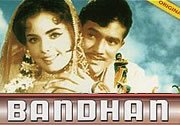
Bandhan
Synopsis:
Rajesh Khanna wears this particular greyish achkan about twenty minutes into Bandhan that looks three sizes too heavy for him, bunching up around the collar in a way that drove me nuts every time he turned his profile to the camera.
That kind of careless tailoring usually tells you everything you need to know about a 1969 Hindi film rushed to the editing table before the prints were even dry. But K. Murali Mohan Rao, working from a screenplay that owes a massive structural debt to Aradhana while lacking its effortless, floating grace, keeps things moving with enough brute force that you forgive the slack pacing in the second reel. He directs actors with broad strokes, favoring lingering close-ups of tear-streaked faces over anything resembling subtle blocking. It is a loud movie, brassy and unashamed of its melodramatic mechanics, pushing every emotional beat until the strings in the orchestra pit sound like they are about to snap. The narrative hinges on sacrifice, duty, and the rigid moral arithmetic that rural melodramas of that era lived and breathed by, refusing to let its characters make a single modern choice.
Mumtaz enters the frame with an infectious sort of energy that instantly exposes the stiffness of the dialogue around her, playing the village girl with a grounded, earthy lack of affectation that saves several otherwise leaden domestic scenes from utter collapse. She anchors the picture. When she looks at Khanna during their early conversational sequences, her expression is sharp, skeptical, entirely unimpressed by the trademark tilt of his head that usually sent audiences into a frenzy. Khanna is giving us standard-issue late-sixties romantic heroics here, all soulful gazes and dramatic pauses, but he dials down the arrogance just enough to make his transformation into a humbled, suffering provider believable by the time the tragedy really starts to pile up. There is a moment during a confrontation with Jeevan where Khanna's voice drops an octave, losing its theatrical polish entirely, and you get a tiny, genuine glimpse of the actor who actually understood screen grammar better than almost anyone else working in Bollywood at that specific historical moment.
Supporting players like Aruna Irani and Sanjeev Kumar fill out the margins with varying degrees of success, though Kumar is chronically underused as the secondary obstacle in a plot that didn't really need a conventional villain to complicate matters. Jeevan chews the scenery with such ferocious enthusiasm that you can practically see the greasepaint melting under the studio lights, playing the grasping uncle with a repertoire of sneers and guttural laughs that belonged in a silent movie. It's a small thing, but it bugged me how the background score uses the exact same four-note motif every single time Sanjeev Kumar walks into a room, as if the audience needed a musical sledgehammer to remember his character's internal conflict. The cinematography by Jal Mistry captures the dusty, sun-baked expanses of the village sets with a flat, functional brightness that avoids the romanticized golden glow of later blockbusters, keeping things harshly literal. Kalyanji-Anandji's soundtrack fares much better, deploying dholak-heavy folk rhythms that cut through the heavier dramatic sequences with a necessary dose of kinetic life.
Hindi movies of this vintage are usually discussed as historical artifacts rather than living pieces of cinema, but Bandhan occasionally breaks through its own didactic framing to touch on something raw about economic desperation and family obligations. The script is obsessed with debt, both financial and moral, treating every relationship as a transaction that must eventually be balanced out through suffering or renunciation. No one is allowed to just exist; they are always paying for the sins of a father or sacrificing their own happiness so a younger sibling can eat meat twice a week. This creates a claustrophobic atmosphere where the outside world barely exists except as a vague threat represented by creditors and corrupt landlords. Yet, beneath the didactic moralizing, there is a fascinating anxiety about the erosion of traditional community structures that makes these older hindi films feel oddly prescient when viewed against the backdrop of rapidly industrializing cities.
The print quality available on current streaming platforms is murky, muddying the darker interior scenes and turning the night shoots into gray digital soup, which makes it hard to appreciate the framing choices. That technical hurdle aside, the movie remains an interesting pivot point for its lead actor, sitting right in the middle of that dizzying period when he could do no wrong at the box office and every studio in the country was trying to clone his specific brand of melancholic charm without understanding the timing required to sell it. If you strip away the padding and ignore the way the supporting cast occasionally addresses the gallery instead of each other, what remains is a surprisingly tough little drama about pride and poverty. It doesn't reinvent the wheel, and it certainly doesn't reach the emotional peaks of its more famous contemporaries, but it works as a functional, frequently moving piece of commercial storytelling that deserves more than a passing glance from anyone interested in the machinery of mid-century popular cinema.