

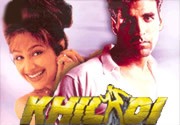
Khiladi
Synopsis:
About an hour and fifteen minutes into Khiladi, Deepak Tijori is hanging upside down from some rafters wearing this genuinely ridiculous neon striped shirt that looks like it cost thirty rupees at a street market in Mumbai, and honestly I couldn't take my eyes off the sleeves because they had these strange fringe details that kept swaying every time he tried to swing himself toward a rope, but anyway he's sweating profusely and shouting threats at some guys in the room while Akshay Kumar is somewhere else doing god knows what. To understand how they got into this mess, you have to go back to the beginning of the movie where a bunch of college students are sitting around complaining about being broke, and they decide to play a stupid prank or a bet that spirals totally out of control. Akshay Kumar plays this cocky student who's always up for a challenge, and he's joined by Ayesha Jhulka, and they've got this whole dynamic going on where they argue constantly but you already know they're going to fall in love by the time the interval hits. So then they pull this fake kidnapping scam to extort money from a rich uncle played by Prem Chopra, who is chewing the scenery so hard you'd think he hadn't eaten in three days, and the whole plan is supposed to be just a harmless joke to get some cash. The funny thing is, it's a staple trope in old-school bollywood movies where characters think they are being clever, but they are actually just signing their own death warrants without realizing it. Right after that, the prank goes horribly wrong because someone actually ends up dead, and the fake kidnapping suddenly turns into a real murder investigation led by a couple of cops who are completely useless. Johnny Lever shows up somewhere in the middle to provide comic relief with facial expressions that had me laughing out loud on my couch, and there is this one scene where he's wearing a fake mustache that is slowly peeling off his face and nobody in the scene acknowledges it at all. The investigation takes forever and involves a lot of running around in dark warehouses and abandoned mills that look like they were built out of cardboard. Akshay Kumar has to clear his name because he's framed for the murder he didn't commit, and he's jumping off balconies and fighting henchmen while wearing a leather jacket that looks two sizes too big for him. The plot gets super messy with blackmail tapes and hidden identities and double-crossing friends, and I honestly lost track of who was working for whom because people keep changing sides every ten minutes. Sharat Saxena is lurking around looking menacing in sunglasses indoors, which is always a great touch in 90s cinema, and he has this deep voice that makes even the most ridiculous dialogue sound like a matter of life and death. The romantic subplots get shoved to the side whenever things get serious, but then they pop back up out of nowhere with a random song sequence in the middle of a desert or a studio set designed to look like a Swiss chalet. Hindi films from this era just loved to interrupt a tense thriller with a 1990s dance number where the backup dancers are wearing matching silver outfits for no discernible reason. So anyway, we finally get back to the climax where all the surviving characters converge on this dusty industrial yard to settle scores once and for all. Akshay Kumar corners the actual villain, who monologues for way too long about his master plan involving corporate fraud and family betrayal, and they start brawling through stacks of wooden crates and oil drums. The villain pulls a knife, but Akshay disarms him with a flying kick that knocks over a pile of metal pipes with a massive clanging sound. Akshay pins the villain to the ground with his knee, the police finally show up with their sirens blaring and guns drawn, and he slaps the handcuffs on the bad guy.
That specific blue tint in the night-exterior sequences of Abbas-Mustan thrillers always looks like someone spilled ink across the lens, and Khiladi starts off swimming in it. Deepak Tijori is already sweating through a pastel windbreaker when the first reel kicks in, leaning against a convertible that probably belonged to the production manager's cousin. It is a small thing but it bugged me how the boom mic dips right into frame during the third establishing shot of the college gate, hanging there like an accidental pendulum while characters yell dialogue about semester exams. Hindi films from the early nineties rarely bothered with safety takes when the sunlight was dying on location, so you take the swinging shadow and move on. Nobody involved in putting this together suspected they were architecting a blueprint for a whole decade of star vehicles. They just wanted to finish the chase scene before the campus police shut down the quad.
Abbas and Mustan Burmawalla shoot everything with the frantic energy of guys who just discovered a new zoom lens in the rental locker and decided to point it at every single face in the room. Their direction relies heavily on Dutch angles during conversations that should probably be shot flat and straight, creating an unnecessary sense of vertigo while two actors talk about a missing ledger or a skipped lecture. The screenplay, credited to the duo working from a plot that feels structurally similar to Deewana though with half the budget and twice the leather jackets, moves between comedy tracks and blackmail plots with dizzying abruptness. One minute we are watching Johnny Lever do a routine involving an oversized stethoscope and a rubber reflex hammer that goes on for four agonizing minutes, and the next we are knee-deep in a murder mystery involving a body falling off a balcony in slow motion. The tonal whiplash is constant. The filmmakers never met a reflective surface they didn't want to place behind an actor's head, filling every frame with glass partitions, chrome railings, and puddles of water on marble floors.
Akshay Kumar plays Raj Malhotra with the kind of chaotic, unpolished swagger that disappeared the moment he learned how to pose for posters on the correct side. He isn't the martial arts machine yet, just a guy with broad shoulders, questionable knitwear, and an easy grin who looks like he might try to sell you a used scooter in the parking lot. His chemistry with Ayesha Jhulka, who plays Neelam Choudhry with a permanent look of mild exhaustion, works purely because they both look slightly confused about why the plot requires them to be hiding in a deserted warehouse at two in the morning. Ayesha Jhulka has this habit of blinking rapidly whenever she delivers an emotional line, which somehow makes her character feel more real than the ridiculous noir tropes swirling around her feet. Then you have Prem Chopra, chewing scenery that wasn't even built yet, deploying his standard menacing chuckle whenever he enters a wood-paneled office to threaten someone about an inheritance.
The supporting players are a mixed bag of working-class character actors who clearly spent their per diems on local snacks between setups. Sharat Saxena shows up as a heavy with a mustache that appears to have its own weather system, though his voice is dubbed by someone who sounds like they recorded their lines inside a steel drum with a wet microphone. Anant Mahadevan brings a frantic, nervous energy to his role as the compromised professor, sweating through his tie in a way that suggests the costume department only brought one shirt for the entire three-day schedule. Then there is Deepak Tijori, whose entire performance consists of looking betrayed while wearing sleeveless denim vests that expose shoulders tanned the exact color of walnut furniture. They all run around through identical-looking stairwells and campus corridors that must have been standing sets at Mehboob Studio, giving the whole affair the cozy, claustrophobic feel of a high-school play mounted by people who watched too many imported VHS tapes.
Viju Shah's soundtrack hits the ground running with synthesizer presets that sound like they were pulled straight from a Casio keyboard left out in the rain, but you cannot get those hooks out of your head once the credits roll. The background score drops these heavy, thumping bass notes whenever a character looks suspiciously at a telephone, signaling tension with all the subtlety of a falling anvil. It is loud. It is brassy. It uses the same four-note suspense motif approximately eighty-two times before the intermission hits, and yet it anchors the nonsense happening on screen with a weird, hypnotic rhythm. Cinematographer Akram Khan keeps the camera moving in circles around the actors during romantic duets, capturing choreography that looks like it was improvised in the parking lot five minutes before the cameras rolled. The lighting design changes color temperatures mid-scene without any narrative justification, bathing characters in violent magenta because it looked cool on the monitor.
Hindi movies of this vintage often get retroactively draped in irony by audiences who grew up on slicker stuff, but Khiladi retains an earnest, sloppy charm that resists easy mockery. It is not great, not bad, just there, taking up ninety minutes of your afternoon with car chases that top out at forty miles per hour and fistfights where the stuntmen fall over before the punch actually connects. The thematic underpinnings are practically nonexistent, resting entirely on the notion that rich kids are generally untrustworthy and middle-class heroes will eventually win the girl by running really fast across a cricket field. When you compare it to something like Baazigar, which came out the following year and figured out how to make this exact same thriller formula actually lethal, this movie looks like a rough draft scribbled on the back of a grocery receipt. Yet that roughness is precisely the point. The seams are frayed. The dubbing is out of sync by three full frames during the emotional climax in the hospital. The sound design drops dialogue tracks completely during wide shots because the boom operator lost his grip. You leave the viewing not with a profound appreciation for the genre, but with the distinct impression that everyone on set had a sandwich waiting for them as soon as the director yelled cut.