

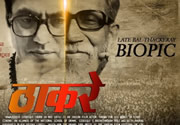
Thackeray
Synopsis:
Look, Thackeray is one of those biographical hindi films that just throws subtlety out the window right from the jump, starting with Bal Thackeray drawing cartoons for a daily newspaper before getting utterly fed up with South Indian migrants taking up local jobs in Bombay, which makes him ditch the pen and start inciting absolute chaos in the streets.
Honestly, Nawazuddin Siddiqui plays the fierce leader with this intense, gravelly voice that totally sells the transformation, and Amrita Rao is right there beside him as his wife Meena Tai, keeping him grounded while he's busy flipping tables and launching the Shiv Sena party.
And then boom, the narrative jumps through decades of Maharashtrian regional politics, street fights, and fiery speeches against communists and anyone else who dared cross his path, and oh my god, can we talk about that one random extra in the background of a riot scene who is wearing a neon yellow sweater that looks like it was knitted in 1994 by someone who had never touched yarn before?
Anyway, Abdul Quadir Amin shows up and does his thing as Jaishant, and the whole movie just accelerates past massive historical milestones, court trials, and government bans like it is running late for a local train.
Right when things get super tense during a court scene, we hit the interval point, and you can just grab your popcorn while processing how wild bollywood movies are for putting an intermission right in the middle of a guy getting interrogated about instigating riots.
After the break, things get even crazier because the Babri Masjid demolition happens, and the film doesn't hold back at all in showing how Thackeray took total pride in it while his supporters danced in the streets, and then he gets arrested, but he just sits in the back of the police van smoking a cigarette like he owns the entire city of Bombay.
Health issues start catching up to him because he is coughing and wheezing through rallies, and then he just passes away in his bed surrounded by crying family members and thousands of mourning fans.
His funeral procession winds through massive crowds of grieving people blocking every single street in the city while police try to maintain order.
Bal Thackeray speaks into a microphone with his neck craned forward like a striking bird, and Nawazuddin Siddiqui has that physical adjustment dialed in so tight you almost forget you are watching a heavily made-up actor in a biopic produced by the subject's own party. If I'm honest, the whole enterprise smells faintly of a sanitized hagiography from the very first frame, but it moves with a kind of gritty momentum that keeps you from checking your watch too often. The narrative follows the transition from a political cartoonist drawing for a daily newspaper to a firebrand leader mobilizing the masses in Bombay through sheer rhetoric and intimidation tactics. There is very little space given to self-doubt or internal conflict, which makes the early scenes feel rushed, almost as though the filmmakers were in a terrible hurry to get to the iconic yellow scarf and the raised fist.
Director Abhijit Panse treats the historical record with the reverence usually reserved for religious texts, shooting his subject from low angles that make standard office corridors look like cathedral naves. Every single speech delivered from a podium is staged with billowing flags and dramatic lighting that feels lifted straight from a propaganda reel, yet there is a raw vitality to the chaos on screen that prevents it from turning into total boredom. The screenplay, penned by Thackeray himself in spirit if not strictly on paper, neatly sidesteps the darker complexities of regional politics, focusing instead on the external conflicts with South Indians, Communists, and Muslims as a series of righteous crusades. It is a peculiar kind of storytelling where the protagonist is never truly wrong about anything, only misunderstood by bureaucrats and rival politicians who lack his native passion.
Then there is Nawazuddin Siddiqui, who drags the entire project across the finish line by sheer force of his peculiar, twitchy charisma. He captures the gravelly cadence of the original voice without resorting to crude caricature, dropping his chin and fixing his eyes with a cold intensity that makes you understand why thousands of young men followed him into the streets on his word alone. It is a performance that reminds you why he became one of the most reliable actors in Hindi films, even when the material he is given asks him to simply sneer at weak-willed opponents. Amrita Rao, playing his wife Meena Thackeray, gets very little to do besides stand in doorways looking concerned or serve tea during crucial political strategy meetings, but she invests those brief moments with a quiet dignity that grounds the more bombastic sequences.
Abdul Quadir Amin pops up as a younger version of a rival leader, and while his screen time is limited, he holds the frame well enough against the overwhelming presence of the lead actor. One small thing that bugged me throughout the second half was the looping of the crowd noise during the rally scenes, which sounds suspiciously like the exact same looping track used in half a dozen other contemporary political dramas from the same studio. The camera work by Sudeep Chatterjee brings a slick, golden-hour sheen to the gritty streets of Dadar and Shivaji Park, though it occasionally makes the slums look a bit too picturesque for their own good. It reminded me a bit of how Ram Gopal Varma shot the underworld in Sarkar, trading naturalistic grime for high-contrast shadows that flatter the men in white khadi while obscuring the messy reality of their actions.
The soundtrack relies heavily on brass-heavy anthems that swell whenever the protagonist makes a sharp decision, hammering the emotional beats home with zero subtlety. You never have to guess how you are supposed to feel about a particular policy or riot because the brass section will tell you in the next bar. Bollywood movies have always had a complicated relationship with political figures, often choosing between blind worship and toothless satire, and Thackeray settles firmly into the former camp without a shred of irony. The film treats the formation of the Shiv Sena not as a dangerous escalation of communal tensions, but as a necessary correction for a local population that felt ignored by the federal government in Delhi.
There is an entire sequence dedicated to the demolition of a prominent mosque that is handled with a frustrating ambiguity, neither condemning the act nor fully celebrating it, opting instead to frame it as an inevitable emotional outburst of a neglected demographic. This is where the lack of critical distance from the subject matter hurts the drama most, turning historical violence into a misunderstood folk hero's moment of passion. You are left wishing the filmmakers had trusted their audience enough to show the human cost of these political games instead of constantly retreating to the safety of heroic slow-motion walks and adoring crowds.
Despite these glaring ideological blind spots, the pacing never really drags, and Siddiqui's commitment to the mannerisms never slips even for a single shot. He manages to humanize a polarizing figure without ever apologizing for his actions, a tightrope walk that requires immense technical skill and emotional control. When he sits quietly in his armchair smoking a pipe while the city burns outside, the image packs a genuine punch that lingers long after the house lights come up. It is not a complete picture of the man or the era, and it certainly won't change the minds of anyone who already detests his legacy, but as a piece of star-driven commercial cinema, it has enough raw energy to hold the room.
The supporting cast largely functions as a Greek chorus of nodding loyalists who exist solely to marvel at the leader's foresight, which grows tiring long before the credits roll. Yet whenever Siddiqui leans into the microphone and starts working the crowd with that raspy, hypnotic delivery, the screen comes alive in a way that very few recent Hindi movies manage to pull off. You walk out of the theater thinking about his posture, that slight tilt of the head, and the way he could make a simple threat sound like an invitation to dinner. That is the power of a great actor wrestling with flawed material, finding a pulse inside a monument built of clay and myth.