

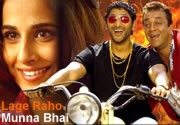
Lage Raho Munnabhai
Synopsis:
Arshad Warsi’s plastic watch is about five minutes fast in that one scene near the bench and honestly that is all I could look at for a solid stretch of the second act. You get locked into these weird visual tics when you are watching a Hindi movie for the fourth time on a tired Tuesday afternoon, waiting to see if the seams hold up under the weight of cultural ubiquity. Everyone remembers the Gandhi bit or the radio station booth where Sanjay Dutt starts losing his mind to hallucinations of a bald man in khadi, but nobody talks about the continuity errors in the background extras during the property dispute scenes. That lack of slickness somehow works in its favor because the whole apparatus feels slightly cobbled together out of spare parts, duct tape, and sheer charisma.
Director Rajkumar Hirani and writer Abhijat Joshi took the basic chassis of the previous film and threw out the medical school grime for a sun-dappled Mumbai that exists entirely within a soundstage imagination. It is a world of bright colors, impossibly cheerful neighborhood parks, and old-age homes that look like expensive resorts. The screenplay relies on a premise so utterly absurd that pointing out its plot holes feels like complaining about the aerodynamics of a cartoon anvil. A local gangster starts seeing the ghost of Mahatma Gandhi because he read too many self-help books to impress a radio jockey who hates criminals. If I am honest, the mechanism of the hallucination makes no physiological sense, but the camera frames Dutt so affectionately against these sunlit walls that you just nod along and accept the magical realism of municipal ward offices.
Sanjay Dutt plays Munna not as a hardened criminal with a heart of gold anymore, but as a cozy middle-aged uncle who happens to carry a heavy gold chain and wear loud shirts. His comic timing relies on a sleepy, befuddled delivery where every punchline sounds like he just woke up from a nap on a park bench. Beside him, Arshad Warsi as Circuit provides a frantic physical counterweight, bouncing off walls and inventing slang that somehow didn't age into embarrassing cringe. When the two of them sit on that stone wall arguing about historical dates, the rhythm of their banter has the loose, greasy-spoon cadence of actors who spent years figuring out how to inhabit characters written by people who actually listen to how street vendors talk.
Then you have Dilip Prabhawalkar walking through the frame as Gandhi with an ethereal lightness that prevents the character from turning into a high school play caricature. He doesn't bellow or preach from a pedestal. He just sits there looking slightly disappointed and mildly amused by modern nonsense, like a grandfather watching you struggle to parallel park. Boman Irani matches that energy from the opposite end of the spectrum as Lucky Singh, sweating through polyester safari suits while his eyes bulge with capitalist panic. The supporting cast fills in the margins with that lived-in comfort you rarely find in contemporary Bollywood movies, where everyone looks like they just stepped out of a gym shoot for a protein brand. Even Jimmy Shergill, playing the tragic betrothed yet again with his trademark doleful spaniel eyes, manages to wring a bit of genuine dignity out of a character whose primary narrative function is to stand around looking dumped.
The visual style borrows heavily from television sitcom blocking, wide master shots that hold for ages while actors mill about, and occasional zooms into blinking eyes that feel aggressively retro even for 2006. Nirav Shah’s cinematography bathes everything in a buttery, golden-hour glow that makes even the seediest real estate office look like an architectural digest spread. Shantanu Moitra’s soundtrack rolls in with these acoustic strums and whistling interludes that signal emotional beats before the characters even open their mouths, a bit like how Shaan used to soundtrack every rainy afternoon in nineties pop videos. It is all terribly earnest, lacking the cynical self-awareness that ruins most modern comedies where the actors look like they are checking their phones between takes.
The ideology of the thing is messy if you press on it with any kind of political pressure, reducing complex socio-economic anxieties about property grabs and generational debt to a matter of sending greeting cards and speaking politely to your oppressors. But that is missing the wood for the trees because the movie is less a political tract and more an extended sketch about civic decency dressed up as a romance. It asks you to laugh at your own pettiness while feeding you a very digestible fantasy about moral stubbornness winning out over corporate greed. It resembles Shrikant Dahake's more recent regional dramas in its obsession with municipal bureaucracy, only swap out the existential dread for cheerful ukulele chords and a catchy brass section.
There is a sequence near the end where Boman Irani’s character breaks down in front of a portrait that lasts about three beats too long, letting the dead air stretch out until the emotional payoff starts to feel slightly forced. You can feel the gears grinding in that specific paragraph of the script where the characters all have to learn their lesson simultaneously so the runtime doesn't spill past the two-and-a-half-hour mark. It is a small thing, but that lingering reaction shot pulls you right out of the illusion, reminding you that you are sitting in a room watching actors hit their marks on cue. Still, when Vidya Balan smiles that specific, slightly lopsided grin from behind a microphone and the brass band kicks in for the reprise of the title track, the cynicism just slides right off the glass.