

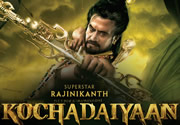
Kochadaiiyaan
Synopsis:
The film is the story of a legendary warrior, It (Rajinikanth), who lives in Kottaipatinam and his son, Rana. Rishikodagan, the Maharaja of Kottaipatinam (Nassar) starts feeling jealous of his trusted army commander, It''s popularity in his kingdom. One day, when It is returning by ship to Kottaipatinam with his army, after buying horses and ammunition, he is attacked by the army from Kalingpuri. It allows the rival army men to return to their kingdom although he could have defeated and killed them. Before going back, the enemy army poisons the food on the ship, after consuming which It''s armymen fall seriously ill. To save the lives of his men, It goes to nearby Kalingpuri with the ailing men and pleads for medical help before Raja Mahendra(Jackie Shroff) of Kalingpuri. Instead of providing medical assistance, the evil Raja Mahendra takes away all the horses and ammunition of It and holds back the sick army men with a promise to cure them and treat them well. When It returns to Kottaipatinam, Maharaja Rishikodagan, jealous as he is, orders his execution, holding him guilty of letting down his army men. Even as inhabitants of Kottaipatinam express unhappiness over Maharaja Rishikodagan''s execution order, he goes ahead and has It killed.
The film begins with It''s younger son, little Rana, leaving Kottaipatinam and reaching Kalingpuri. Not revealing his identity to anybody, he trains as a warrior there and grows up to become a fearless warrior (Rajinikanth). He wins the confidence of Maharaja Mahendra Raj and tricks him into letting him take the armymen of Kottaipatinam, who were being treated as slaves by Mahendra Raj, to fight the Kottaipatinam army. Once he reaches the border, he asks the enslaved armymen, originally belonging to Kottaipatinam, to cross over to Kottaipatinam. Maharaja Mahendra Raj and his son, Veera Mahendra (Aadhi), are livid at being tricked by Rana. Here, in Kottaipatinam, Maharaja Rishikodagan is alarmed at seeing It''s son return with the armymen his father had given to Mahendra Raj and for which he (Rishikodagan) had had him killed. Rana revives his friendship with Rishikodagan''s son, Sengodagan (R. Sarathkumar), his childhood friend. He learns that his mother Yaahavi (Shobana) has since died, his elder brother is missing, and his sister, Yamuna (Rukmini Vijayakumar), is in love with Sengodagan who also loves her very much. Like a true brother, Rana gets his sister married to Sengodagan after making Maharaja Rishikodagan agree to the alliance despite class difference between the two families. However, Maharaja Rishikodagan, angered by having to let his son marry a girl from a family not matching his status, seeks revenge by disowning his son for having married Yamuna. Disgusted with his father, Sengodan walks out on him, taking his newly-wed wife with him. Rana and Maharaja Rishikodagan''s
There is a specific kind of digital uncanny valley that opens up the moment Rajinikanth’s computer-generated eyes blink for the very first time in Kochadaiiyaan. It’s not that the rendering lacks fidelity, because you can see every individual pore mapped onto the superstar's digital skin, but rather that the pixels refuse to carry the weight of thirty years of genuine charisma. Sound designer Resul Pookutty tries his absolute best to anchor these floating avatars to the earth with heavy footfalls and whistling wind channels, yet the digital duplicate of the actor feels perpetually unmoored from gravity. If I'm honest, the whole enterprise starts looking less like a motion-capture epic and more like a very expensive cutscene from a video game that refuses to let you press start. You sit there in the dark waiting for the skin to sweat or the breath to catch, but the performance-capture tech developed by Soundarya Rajinikanth and her team has flattened the man into a ghost of himself. And it is a weird sort of ghost, too, because the voice coming out of this polygonal chin belongs to an aging legend who sounds entirely uninterested in reading dialogue about ancient kingdoms and betrayal.
Soundarya directs the film with a reverence that actively works against the pacing, lingering on sweeping digital vistas of medieval Pandya and Chola territories that look suspiciously like old Windows screensavers. The screenplay by K.S. Ravikumar feels like it was dragged out of a filing cabinet from 1995, dusted off, and crammed into a new software pipeline without any thought given to how human beings actually talk to one another during a war council. Sentences arrive in bursts of stilted classical Tamil or clunky exposition, delivered by supporting actors who clearly recorded their lines in a quiet booth months later and forgot to match the room tone of the outdoor battle sequences. Even the background extras have this floating, weightless quality to their movements, sliding across the dirt arena floors as though the physics engine forgot to calculate friction. That supporting cast problem gets really annoying during the dramatic standoffs, where Nasser or Jackie Shroff will deliver a passionate speech, but their digital counterparts’ eyebrows stay frozen in a mild state of polite surprise. It creates a strange emotional disconnect where you are watching a brutal revenge tragedy played out by very shiny plastic dolls.
Rajinikanth pulls double duty playing both the father and the son, a narrative trick that usually allows for some meaty psychological conflict, but here it just means twice as many scenes of men standing in front of green screens staring into the middle distance. When the elder warrior swings his twin swords, the animation tries to mimic his iconic style, but the movements lack that sudden, violent snap that made his physical fights in Baashha so thrilling to watch on a crowded Friday afternoon. Deepika Padukone shows up as the royal love interest, and her digital twin is perhaps the most convincing face in the production, though she spends most of her screen time gazing longingly at pixels that aren't actually looking back at her. The romance plays out in song sequences where the characters teleport from snowy mountains to golden palaces in the span of a single drum beat, a visual trickery that CGI allows but narrative coherence deeply resents. There is a supporting warrior played by Aadi Pinisetty who actually manages to inject a bit of actual menace into the proceedings, mostly because his motion-capture actor clearly put some venom into the physical combat choreography before the animators smoothed all the edges away.
A.R. Rahman provides a score that tries to rescue the movie from its own rendered stiffness, pumping out heavy percussion and soaring vocal tracks that deserve to be attached to a much better piece of cinema. Yet his music often ends up highlighting the artificiality of the scenes it accompanies, swelling dramatically while two expressionless digital avatars slowly walk toward each other on a rocky path. The sound department uses a particular low-frequency drone every time a character remembers a past trauma, and by the fourth time it hits within a single twenty-minute stretch, it stops feeling like a dramatic cue and starts feeling like a migraine warning. Bollywood movies occasionally fall into this trap of over-relying on sonic wallpaper to manufacture emotion when the camera has failed to capture it, but Kochadaiiyaan takes that bad habit and loops it indefinitely. The sound mixing is loud enough to rattle the theater floorboards, which helps wake you up whenever the dialogue scenes begin to drag down the momentum.
The thematic underpinnings lean heavily on loyalty, honor, and the heavy burden of wearing a crown, drawing from the same mythological well that has fueled historical dramas since the silent era. We are told repeatedly that the protagonist is a man torn between his duty to the state and his thirst for vengeance against a corrupt king, but the digital medium strips away the sweat and blood that usually make those moral dilemmas compelling. It feels less like a grand historical epic and more like an animated experiment that got completely out of hand before anyone involved had the courage to pull the plug and start over with actual cameras. When you watch a movie like Gladiator, you feel the heat of the sand and the grit of the armor biting into the actor's shoulders, whereas here you just feel the hum of the rendering farm burning through electricity. There is a moment near the end where a massive army charges across a valley, and the repetition in the character models becomes so obvious that you start playing a game of spot-the-clone rather than following the plot. Hindi films have sometimes struggled to blend traditional storytelling with cutting-edge technology, but this specific brand of digital distancing makes you wonder why anyone thought throwing away the physical reality of cinema was a good idea in the first place. You leave the theater thinking about what could have been if they had just hired a few hundred stuntmen and built some real wooden sets instead of trusting the algorithms to recreate a soul that simply refuses to digitize.