

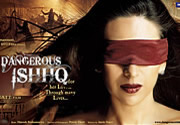
Dangerous Ishq
Synopsis:
There is a specific sound a 3D glasses hinge makes when it snaps just right, though in the case of Dangerous Ishq, that plastic click was easily the most tactile thing in the auditorium. I keep thinking about a throwaway reaction shot of Jimmy Sheirgill standing near a doorway during a fairly pivotal confrontation, staring at a patch of carpet with the vacant, unblinking intensity of a man who just remembered he left his car lights on in the parking structure, and honestly, if I'm honest, that level of checked-out detachment kind of sets the baseline for the whole production. Vikram Bhatt wanted to construct this sweeping, centuries-spanning epic about soulmates jumping through time from the turbulent Mughal era straight down to the slightly less glamorous corporate corridors of modern-day Karachi-adjacent London aesthetics, but the technical seams pull apart almost immediately. The screenplay relies heavily on historical flashbacks to explain why Karisma Kapoor and Rajneish Duggal are destined to keep running into each other across four hundred years of mortal peril, yet every single past-life sequence feels remarkably like an outtake from a lavishly budgeted music video that lost its director halfway through the morning shoot.
Karisma Kapoor is working against a tremendous amount of CGI fog and purple lighting in her grand return to the screen, tasked with anchoring four different historical incarnations of the same devoted woman without ever really being given distinct dialogue to make the shifts legible to anyone not already reading the poster synopsis. She stands there in elaborate heritage costumes, delivering lines with that characteristic star-powered authority that somehow used to carry entire nineties blockbusters like Raja Hindustani through sheer force of will, but here the sheer weight of the concept drags her down into a sort of monotonous solemnity. The supporting players drift in and out of the narrative with alarming casualness. Divya Dutta pops up to provide the necessary exposition or emotional friction, though her scenes seem to have been edited with a chainsaw, leaving narrative gaps so wide you could literally drive a vintage ambassador car straight through them. Ruslaan Mumtaz and Gracy Singh wander through the modern segments looking like they wandered onto the wrong soundstage entirely, waiting for a cue that never quite arrives, while Samir Kochhar and Aarya Babbar chew the scenery with varying degrees of success.
Bhatt has never been particularly shy about his affection for paranormal thrillers and genre pastiche, often borrowing heavily from whatever Hollywood was doing five years prior, but Dangerous Ishq feels less like an homage and more like an algorithm trying to remember what a Hindi film looks like after getting hit on the head with a heavy object. The cinematography by Pravin Bhatt treats every single decade with the exact same washed-out, digital-video sheen, completely flattening the visual distinction between a royal court in 16th-century Rajasthan and a contemporary art gallery that clearly had its corporate branding taped over by the art department. It is a small thing, but it bugged me how the same stock sound effect of a creaking door was used for a wooden fortress gate in one scene and a sliding glass partition in the next. The soundtrack by Chirantan Bhatt plods along with predictable bombast, recycling musical motifs every time the characters experience a sudden rush of déjà vu, which happens roughly once every six minutes whether the plot demands it or not.
There is an ambition buried beneath all the plastic jewelry and terrible blue-screen work that almost makes you feel bad for picking it apart. The underlying idea that human bonds might survive the brutal erasure of death and rebirth is a solid enough hook for pulp entertainment, the kind of melodramatic machinery that used to keep single-screen theaters packed back when mainstream hindi cinema relied on grand emotional gestures rather than pristine color grading. Yet the execution is so thoroughly mechanical that the romantic stakes register around absolute zero. When Duggal’s character has to rescue Kapoor from yet another historically inconvenient peril involving poisoned wine or jealous rivals, you just watch the clock, waiting for the inevitable contemporary transition scene where someone looks at a dusty artifact in a museum and gasps audibly. No one on screen seems to actually inhabit the danger they are supposedly facing, treating the multi-century curse like a mildly inconvenient scheduling conflict that will be resolved as soon as the director yells cut for lunch.
It is genuinely difficult to sustain momentum when every plot twist is telegraphed thirty minutes in advance by a sudden swelling of orchestral strings and a lingering close-up on a prop that looks like it was bought on clearance from a party supply store. Yet amidst all this sluggish pacing, there are brief, accidental moments of camp value that briefly wake the audience from their collective slumber. When the supernatural elements finally collide with a modern police investigation, the film briefly flirts with the kind of gloriously unhinged energy that made Raaz such an entertaining ride, before immediately retreating back into tedious exposition and endless flashbacks about star-crossed lovers making solemn promises by glowing artificial rivers. Kapoor deserves better than being trapped inside a digital snow globe of someone else's half-baked nostalgia trip, but the movie she is in is simply too inert to be saved by a single committed performance. We are left with a collection of glossy, forgettable images that dissolve the second the projection cuts to black, leaving no imprint on the memory whatsoever.