

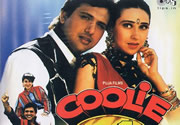
Coolie No 1
Synopsis:
Govinda is literally getting hurled into a pile of smelly garbage cans while Kader Khan screams bloody murder at him for pretending to be a billionaire prince from Singapore! God, what a moment. Let us rewind just a bit because this absolute masterpiece of nineties chaos needs some context. So we have this insanely arrogant and wealthy matchmaker named Shadiram who gets publicly humiliated by a ridiculously rich patriarch named Chaudhary because Shadiram dares to suggest a poor groom for Chaudhary's snooty daughter Malti, played by Karisma Kapoor, and honestly Shadiram is so mad he swears revenge. And then boom, Shadiram stumbles across a broke, quick-witted guy named Raju working at a train station, and Raju's friend Harish is just hanging around being chaotic, and Shadiram decides that Raju is going to pose as the fabulously wealthy Kunwar Raj Pratap Singh to trick Chaudhary into marrying his daughter to a fake prince as ultimate payback! Bollywood movies have pulled off some wild schemes, but this one is pure gold. Raju dresses up in the loudest, most eye-watering neon blazers imaginable, and I swear I cannot stop staring at this one background extra during the village scenes who is wearing a lime-green sweater with glowing orange ducks on it, like, why is that even there. Anyway, Raju shows up and immediately starts wooing Malti with total nonsense charm, and she falls for him instantly because she is just as snobby and dramatic as her dad. They sing a bunch of high-energy songs that stop the narrative dead in its tracks, which is standard for 90s hindi films, but honestly you do not even care because Govinda's dance moves are pure physics-defying insanity. Stuff happens and Malti finds out Raju is actually a poor coolie, but instead of walking away, she loves him anyway and they hatch a ridiculous plan where Raju pretends to be his own nonexistent, identical twin brother named Raj to keep the massive charade going with Chaudhary. And then we hit the interval point. The interval block arrives right when the chaos reaches maximum velocity, leaving you sitting there at the popcorn machine wondering how on earth these characters are going to keep this ridiculous web of lies spinning without getting caught.
Look, the second half of this wild ride gets even crazier because now Raju has to keep switching back and forth between the fancy prince and the humble coolie while dealing with Shadiram's nagging doubts and Chaudhary's intense suspicion, and honestly the sheer amount of running around Govinda does in this movie is exhausting to watch. Malti's dad decides he wants the fake prince to marry his other daughter too, or wait, no, he just invites the whole family over for massive misunderstandings that lead to doors slamming everywhere in classic farce style. And then Harish shows up playing another wacky character to help maintain the endless web of lies, and nobody has any idea who is actually who anymore. A bunch of thugs get involved, secret identities get completely scrambled, and Raju has to pretend to be dead at one point just to trick everyone, which is genuinely hilarious. And then out of nowhere, in a single rushed scene that skips past all logic, all the deceptions blow up completely in everyone's faces and Chaudhary finds out he got tricked by a station worker. But because this is one of those classic hindi movies where nobody can stay mad for long, Chaudhary realizes Raju is actually a good guy at heart despite the massive fraud. They hug it out, the weddings happen for real, and everyone is suddenly dancing together in a giant technicolor finale. Raju dives right into a final choreographed dance number, flashing his biggest grin as the screen cuts directly to black.
Karisma Kapoor's hair has this aggressive crimp in the opening reel that belongs in a court proceeding about crimes against styling. It’s hard to focus on the plot when the scalp geography is that distracting. David Dhawan made forty of these things, give or take, but this one has a specific manic energy that refuses to sit still even during the boring parts where the dialogue is just exposition delivered through a megaphone.
The plot makes zero sense if you spend more than three seconds thinking about it. Kader Khan plays a rich matchmaker who gets insulted by a filthy rich businessman played by Sadashiv Amrapurkar, so Khan decides to trick the businessman into marrying his daughter off to a broke porter who is pretending to be a billionaire prince from Singapore. That porter is played by Govinda with his eyes constantly darting around like he is late for a flight. He wears red pants in one scene that hurt to look at. The comedy relies heavily on people hiding behind curtains and saying things they didn't mean to say out loud while the other person stands right behind them pretending not to hear. It’s pure farce, the kind of writing where logic gets tossed out the window so two guys can hit each other with baguettes or whatever else is lying around the set.
If I'm honest, the whole sham-marriage conceit is stretched so thin it practically snaps by the interval. You have Harish showing up as the actual rich guy in a subplot that gets so tangled up with mistaken identities and wig changes that even the boom mic operator probably stopped caring about where the sound was coming from. Dhawan’s direction is less about framing a shot and more about pointing the camera at Govinda and yelling action while something loud happens in the background. The editing by Waman Bhonsle is frantic in a way that suggests the negative was edited with garden shears. Nobody has a moment to breathe because if they did, the audience might realize that the joke they just laughed at was the exact same joke from twenty minutes ago, just with different colored waistcoats.
Govinda is operating on a frequency that no other human actor in Hindi movies has ever managed to tap into. He doesn't just deliver lines; he contorts his entire ribcage while speaking them, turning simple sentences into physical acrobatics. When he gets caught in his own lie about owning an offshore oil rig, his face goes through four distinct shades of panic before he settles on a goofy grin that makes the falsehood even more obvious. Compare this to his work in Shoshana, where he was forced to be a brooding romantic lead and looked like he was reading tax forms in his head. Here, he is entirely untethered. Karisma Kapoor matches his velocity by screaming most of her dialogue and running down hallways in heels that look like they could puncture a tire. They have this chemistry that feels less like romance and more like two kids who just ate too much sugar and got locked in a gym together.
The supporting cast does the heavy lifting when the leads need to catch their breath. Shakti Kapoor as the sidekick Chacha is loud, sweaty, and entirely shameless in a way that feels authentic to the genre. There is a specific background extra in the hotel lobby scenes who keeps reading the same newspaper upside down in three different cuts and it has been bugging me for years. Anand-Milind’s soundtrack dominates the runtime with brassy synths and dhol beats that sound like they were recorded inside a tin shed. The main title track hits your eardrums with a force that makes you want to check if your windows are intact. It repeats during scene transitions so often that you start hearing it in your sleep, bouncing around your skull long after the television has been turned off.
Class mobility is the supposed engine driving all this chaos, but the film doesn't care about poverty except as a costume change. Govinda takes off the porter’s uniform, puts on a blazer with shoulder pads that could double as landing strips, and suddenly he is part of the ruling class. Nobody questions his accent. Nobody checks his bank statements. The rich people are uniformly depicted as pompous idiots who deserve to be tricked by working-class guys with quick wits and flashy shoes. It is a very comforting fantasy for anyone sitting in a crowded single-screen theater in 1995 who just wanted to watch a guy from the railway station punk a snob. The social commentary begins and ends with the idea that rich folks are uptight and poor folks know how to throw a better party.
The pacing completely falls apart in the final half hour when the movie has to wrap up all twenty-five subplots involving forged documents and angry fathers. Characters show up in rooms they have no business being in, shouting lines that were clearly dubbed three weeks later in a tiny room with poor acoustics. It gets messy. Yet there is something strangely hypnotic about the sheer volume of noise being thrown at the screen. You don't walk away from this feeling changed or enlightened. You walk away slightly dazed by the primary colors and wondering how Govinda’s knees didn't give out during that third dance number in the rain.