

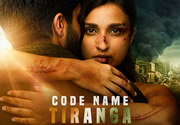
Code Name -Tiranga
Synopsis:
Durga is literally dangling by a wire while holding a smoking gun and screaming at a terrorist in Turkey. And then boom, a massive explosion goes off right behind her face. It is absolute chaos. God, what a ride. Let us back up for a second because Code Name -Tiranga starts us off right in the thick of things before we even know who's who or what's what. Parineeti Chopra plays this elite RAW agent named Durga, though she spends a good chunk of the movie undercover under the alias Ismat, and she is on a desperate, high-adrenaline mission to hunt down a ruthless and terrifying international terrorist named Omar, played with absolute menacing glee by Sharad Kelkar who has this shaved head look and a scar that honestly makes him look like every single cartoon villain from our childhoods brought to terrifying live-action life in a gritty spy thriller.
So anyway, Durga is sent on this covert operation because national security is threatened, obviously, and she has to infiltrate these dangerous extremist networks scattered across Turkey and other parts of the Middle East. Honestly, the plot moves at this bizarre speed where characters just teleport from country to country without ever explaining how booking airline tickets works in the secret agent universe. We meet Harrdy Sandhu playing a doctor named Abid, and he is just hanging out being all sweet and heroic and handsome, and he gets tangled up in Durga's chaotic web of lies and bullets because he falls in love with her during an undercover operation, which is basically the oldest trick in the spy playbook. But hey, this is a classic bollywood movie so we gotta have that romance angle shoved in right between a knife fight and a shootout.
And let us just talk about the background props for a second because I could not stop staring at this one extra in a cafe scene who was wearing a bright neon green sweater that looked like it was knit out of actual moss while everyone else was wearing serious spy trench coats, and it distracted me for five full minutes. Stuff happens so fast though. Durga and Abid pretend to be a couple, they share some lingering looks, and then boom, we hit the interval block. The interval point arrives right when a major safehouse gets raided by Omar's thugs, and everyone is shooting machine guns at each other in slow motion while glass shatters everywhere.
Right after the intermission, we get a random song and dance sequence that feels completely out of place because they were literally just running from a hail of bullets two minutes ago, but hey, modern hindi movies just love jamming a romantic track in there to slow down the pacing to a crawl. Durga's true identity as a RAW agent eventually gets exposed to Abid, and he is totally shocked, but he still decides to help her because he is just that nice of a guy. Rajit Kapur shows up playing some high-ranking intelligence boss who gives mysterious phone calls and orders people around from a dimly lit room with too many computer monitors.
The second half gets even wilder with betrayals and double-crosses. Durga gets captured, she gets tortured a little bit, but she totally escapes by using a paperclip or a hairpin or something equally cliché, and then she goes straight back on the warpath. We see countless henchmen getting kicked off balconies in a way that defies all laws of physics. Hindi films love a good gravity-defying stunt, and this one delivers big time on that front. Abid gets dragged deeper into the violence, and he has to pick up a gun himself, which is hilarious because he is supposed to be a peaceful doctor saving lives.
Everything builds up to this massive final showdown at Omar's heavily guarded desert compound where bullets are literally flying from every single direction and explosions are happening behind every corner. Omar catches Durga and they have this brutal hand-to-hand combat scene involving knives and broken pipes, and it is just messy and sweaty and intense. Abid tries to intervene to save her, and things get really bloody and emotional for a minute there. But Durga refuses to give up, and she manages to overpower Omar in the end. She grabs her service weapon, takes aim, and shoots Omar right in the chest, watching him collapse onto the dusty ground as he takes his very last breath.
The sound design during the interrogation sequence in Code Name - Tiranga features a distinct digital click every time a character blinks, or at least that is what it sounds like, and once you notice it you cannot focus on anything else happening in the room. If I'm honest, the whole opening twenty minutes play out like an extended cutscene from a mid-tier tactical shooter that nobody asked for. Ribhu Dasgupta directs with an apparent allergy to static frames, keeping the camera vibrating even when two people are simply sitting across a table discussing visa papers. There is a relentless, exhausting urge to manufacture momentum out of thin air, filling every quiet moment with synthetic bass drops and drone shots of Istanbul that look suspiciously like stock footage purchased in bulk. The screenplay lurches forward through a series of aggressively perfunctory text cards that tell us we are in Tehran or Srinagar without ever letting the geography settle into anything believable. It is a spy thriller that treats espionage as an aesthetic accessory rather than a logistical nightmare. Characters hand over thumb drives containing codes that could destroy nations while standing in the middle of crowded bazaars, and nobody ever looks around. Parineeti Chopra plays Durga, a RAW agent whose primary character trait is staring blankly into the middle distance while holding a suppressed pistol, evoking memories of Sridevi in Khuda Gawah if stripped of all operatic grandeur and human warmth.
Harrdy Sandhu plays Dr. Mirza Ali, a man whose medical expertise consists mostly of looking concerned while bandaging bullet wounds in dimly lit safe houses with ambient blue lighting. Their romance develops at the speed of a high-speed rail network through a series of montages set to acoustic guitars that sound plucked from royalty-free libraries. They share bowls of soup and look out at balconies. They talk about their pasts in lines of dialogue that sound like first drafts translated from English into Hindi and back again by someone who has never been in love. Chopra tries hard, carving a physical toughness into her frame through gritted teeth and rigid posture, but the material keeps pulling her back toward melodramatic tropes she has outgrown. When she has to cry over a dead contact, the tears arrive on cue, yet the emotional resonance is completely swallowed by the sound effects team cranking up the wind machine. Sharad Kelkar shows up as Omar, the rogue agent with a grievance against the state, and he delivers every single line through clenched molars like a man trying to pass a kidney stone while holding a hostage. He is having fun, certainly, chewing on Persian rugs and barking orders at subordinates who exist only to be shot during the second-act warehouse raid. Rajit Kapur appears briefly, looking intensely confused as a senior official who clearly realizes halfway through his scene that his paycheck might bounce.
Cinematographer Savita Singh bathes everything in an amber-and-teal wash that has become the default color grading for modern Bollywood action cinema, draining the warmth out of outdoor daylight scenes until they look like frozen urine. The action choreography relies heavily on quick cuts that obscure the geography of the fights, leaving you to guess whether Chopra just kicked a henchman in the ribs or merely tapped him on the shoulder while the editor applied a digital blur. It is a small thing, but it bugged me how the guns never seem to run out of ammunition during long corridor shootouts. Characters swap magazines with the casual indifference of people checking their phones. Aimee Blackpool’s background score hits every emotional beat with a sledgehammer, swelling triumphantly when Durga manages to jump over a low fence and groaning mournfully whenever a national security threat is mentioned. Hindi films have a long tradition of patriotic espionage dramas that manage to balance geopolitical paranoia with genuine human stakes, but this one prefers to substitute actual tension with slow-motion shots of boots kicking open wooden doors. The editing rhythm is remarkably uniform, meaning every scene runs for roughly three minutes and forty seconds regardless of narrative weight, creating a monotonous drumbeat that lulls you toward sleep.
The thematic underpinnings of the plot are aggressively simplistic, dividing the world cleanly into noble patriots who sacrifice personal happiness for the motherland and mustache-twirling terrorists who commit atrocities because they are inherently bad. There is no ideological gray area, no messy moral compromise that makes stories about intelligence agencies genuinely compelling to sit through. When Durga is asked to choose between her duty and her love for the doctor, the dilemma feels entirely mechanical because the script never establishes why she fell for him in the first place beyond the fact that they both exist in the same frame. We get flashbacks to training montages involving rope climbs and target practice, but none of it feels rooted in any psychological reality. It is just plot mechanics grinding against one another in a vacuum. By the time the third act rolls around, involving a kidnapping at a heavily guarded compound that looks suspiciously like an abandoned cement factory outside Chandigarh, the fatigue has set in so deeply that even the explosions fail to register as sensory events. Not great, not bad, just there, occupying space on a hard drive until Netflix or some late-night satellite broadcast swallows it whole.
There is a distinct lack of textural specificity in how these characters inhabit their environments, as if the production design team was working solely off architectural blueprints rather than lived-in observation. The safe houses are too clean, the weapons too shiny, the suits worn by the diplomats too sharply pressed even after a three-day stakeout in the desert. It creates a distancing effect where you are constantly aware of the lights, the cameras, and the catering truck parked just out of frame. Harrdy Sandhu remains handsome throughout his ordeal, his hair miraculously refusing to lose its styling gel even after a brutal interrogation involving a car battery and a wet towel. That kind of vanity ruins whatever grit the director is desperately trying to claw out of the mud. Hindi movies used to let their heroes look genuinely distressed, bruised, and sweaty by the climax, but here everybody looks ready to step onto a red carpet the moment the director yells cut. The supporting cast pop in and out of the narrative like video game NPCs waiting for their trigger condition to be met. You watch, you wait for something genuinely surprising to happen in the margins of the frame, and then the credits roll over a patriotic anthem that sounds identical to five other songs you heard in the previous hour.