

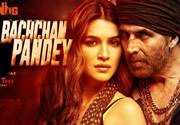
Bachchan Pandey
Synopsis:
Akshay Kumar is literally staring right down the barrel of a camera while casually carving an apple with a massive switchblade and looking like he’s bored out of his absolute mind, and honestly, if you’ve ever watched modern bollywood movies you already know you’re in for a wild, chaotic, loud ride.
So anyway, this whole mess actually starts because Kriti Sanon plays this aspiring filmmaker named Myra who is dead set on making a gritty, authentic gangster flick about a terrifying, stone-cold criminal named Bachchan Pandey, played by Akshay of course, who lives in this dusty, lawless town in Uttar Pradesh where everybody's apparently terrified of him because he has a glass eye and a penchant for chopping people up with various farming implements.
Myra teams up with her buddy Vishu, played by Arshad Warsi, and they head straight into the belly of the beast to interview people who survived Bachchan Pandey's wrath, which sounds like a smart documentary idea until they actually meet the guy and realize he's just as psychotic in person as the rumors say, especially because he catches them spying on him and things get super awkward and dangerous very quickly.
Look, Jacqueline Fernandez is also in this movie playing Sophie, who is Bachchan's tragic past love interest in a series of overly saturated flashbacks that honestly feel like they were shot through a jar of strawberry jam, and she gets brutally murdered to give our main villain his requisite dark backstory because hey, it wouldn't be a classic masala action flick without a dead girlfriend motivating the anti-hero to commit more acts of extreme violence.
And then boom, the interval hits right in the middle of a massive shootout where Vishu and Myra are running for their lives through a dusty courtyard while background extras in lime-green turbans awkwardly fire vintage rifles into the air, and you're just sitting there eating your popcorn wondering how the director managed to shove a completely unrelated, hyper-energetic romantic song and dance sequence featuring glittering outfits right after someone just got their head smashed through a wooden table.
After the break, the plot gets even crazier because Vishu tries to pull off this elaborate scheme to get close to the gang by pretending to be an aspiring actor, and Bachchan Pandey actually decides to produce a movie about his own life story with Vishu directing it, which leads to this bizarre meta-comedy track where Akshay Kumar is critiquing his own cinematic portrayal while still casually threatening to murder everyone on set if the lighting isn't dramatic enough.
God, there is this one random background extra sitting outside a tea stall for three entire scenes wearing this blindingly neon pink woolen sweater that looks like it was knitted in 1994, and I honestly couldn't stop staring at it while major plot twists about secret identities and betrayals were happening right behind him.
Stuff happens so fast near the end that you barely have time to process that Bachchan's loyal henchman, played by Pankaj Tripathi's spirit animal or someone who looks just like him, turns on the boss because of a misunderstanding about a goat or a camera lens or something equally ridiculous.
Myra eventually figures out that making a movie about a psychotic criminal isn't actually worth getting decapitated over, so she tries to scrap the whole documentary project while dodging flying bullets and screeching car tires in a massive finale that crams about four different emotional resolutions into five minutes of deafening explosions.
Bachchan Pandey has a sudden change of heart about his entire life of crime because of a single tear shed by a child or some deeply cheesy cinematic trope, and then he willingly lets the police slap handcuffs on him while staring stoically into the setting sun.
The glass prosthetic eye that Akshay Kumar wears as the titular gangster in Bachchan Pandey keeps catching the studio lights from unexpected angles, turning a dead-eyed stare into something that looks suspiciously like a lighthouse sweep across the horizon. It is a distracting piece of plastic, rattling around in his socket with the kind of indifferent loose fit that suggests nobody on the prop truck bothered with custom fittings before calling action.
Farhad Samji directs this machinery with the steady, numbing efficiency of a man assembling flat-pack furniture under fluorescent lights in a warehouse parking lot. Every conversation in the village of Bagwa plays out in wide-medium-wide coverage that treats geography as an optional suggestion rather than a narrative constraint, letting characters materialize behind each other without footsteps or warning. If I am honest, the screenplay feels less like a finished script and more like a stack of loose index cards that got spilled in the parking lot and picked up in whatever order the production assistants managed before the tea break.
Akshay does not give you the terrifying, grounded animal menace he found in Khiladi forty years ago or even the weary exhaustion of his better streaming work, choosing instead to lean entirely on a prosthetic jaw and a permanent snarl that makes every line reading sound like he is trying to dislodge a particularly stubborn piece of gristle from his molar. He postures through scenes with his shoulders hiked up to his ears, swinging a spiked pipe with the lumbering casualness of a guy killing time at a bus stop while Arshad Warsi bounces around his ankles like a nervous terrier trying to avoid getting stepped on.
Warsi is doing heavy lifting here as a documentary filmmaker dragged into the badlands to make a bio-pic about a local butcher, playing straight man to a cartoon while the camera swoops in for reaction shots that linger a beat too long. Kriti Sanon wanders through the dusty frames looking like she just dropped in from an entirely different movie set two blocks over, delivering earnest speeches about the power of cinema with the hollow, glazed stare of someone reading flight safety instructions on an evening puddle-jumper. Jacqueline Fernandez shows up in flashbacks that have been color-graded to look like a lukewarm cup of instant coffee, serving almost no narrative purpose beyond giving the editor something to montage when the tempo drops.
The soundtrack relies heavily on a brass-heavy motif that hits every single time a character steps out of a doorway or turns around sharply. It's a small thing that bugged me from the very first reel, this relentless musical punctuation hammering the exact same four notes until your teeth start aching behind your jaw. Cinematographer Gavemic U. Ary drenches everything in a yellow-brown filter that makes rural India look like it has been preserved in a jar of cheap mustard, bleaching out the natural dust and heat in favor of a sterile, digital sheen that makes the action choreography look weightless and fake.
Hindi films have long struggled with the tonal whiplash of turning psychotic warlords into lovable local uncles, but this particular effort doesn't even bother stitching the two halves together with narrative thread. Bachchan kills a room full of people with a machete in one sequence and then launches into a brightly lit dance number fifteen minutes later without a single frame acknowledging the dried blood still caked on his knuckle. It treats morality as an accordion, expanding and contracting based purely on whether the background dancers need more room to do their formations.
There is an exhaustion hanging over these recent Bollywood releases that goes deeper than lazy writing or rushed shooting schedules, a sense that everybody involved is just clocking in to collect a check before catching the evening flight back to Mumbai. You can practically hear the crew checking their watches during the third-act shootout, an interminable sequence involving rocket launchers and burning jeeps that goes on for so long you start wondering if the projector bulb is going to burn out before the credits drop. The digital blood splatters look like someone flicked a paintbrush loaded with cheap poster paint against a green screen, refusing to interact with the actors' clothes or the dirt beneath their boots.
Arshad manages to wring a few genuine laughs out of his sheer terror, his eyes widening in panic whenever Akshay casually lops off an ear or threatens to feed someone to the local pigs. He is better than the material deserves, finding little pockets of physical comedy in the way he shrinks his frame whenever the heavy enters a room. But even his comic timing starts to fray around the edges once the plot demands that he fall in love with Sanon's character while they are hiding from a hit squad in a tractor shed.
Hindi movies used to understand how to build a folk anti-hero out of pure charisma and oversized sunglasses, but here the swagger feels calculated by a focus group that watched too many Instagram reels on fast-forward. The violence isn't even shocking enough to be transgressive or clean enough to be fun, existing in that gray middle zone where nobody is taking any risks because everyone is too terrified of offending the algorithm. When the credits finally roll, they do so over an outtake reel that tries to convince you everyone had a wonderful time making this disaster, which feels less like a warm behind-the-scenes gesture and more like a plea for forgiveness.