

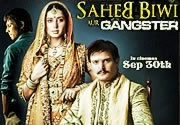
Saheb Biwi Aur Gangster
Synopsis:
Based in a small town in the Northern part of India, Sahib Biwi Aur Gangster is a story packed with intrigue betrayal and ambition between a beautiful Begum, her Nawab husband and an ambitious young boy.
The Nawab and his Begum, live in their ancestral royal house trying to maintain the status and structure their ancestors had left behind. But due to the changing time, some extreme financial conditions and the long gone habit of a royal having a mistress, the Nawab tries real hard to maintain his status and financial conditions.
His rival political party, belonging to Gainda Singh is on a constant mission to eliminate the Nawab and his allies, to get a hold of the administration, which has been with this royal family for decades. Eventually leaving him with just one Kanahiya who is Saheb''s most trusted and dangerous servant.
Due to the Nawab''s interest in his beautiful mistress, Begum suffers seriously from the lack of his attention and tries to put every bit of her effort into getting him to come back to her or even spend a moment of his time with her. The Nawab starts taking contract killing assignments to be able to cope up with his lifestyle and to be able to get a stronger hold over his political situation while campaigning for the elections, which becomes a difficult battle considering the loss of his allies and deteriorating financial situation.
The drama in the plot walks in when the same rival gang plant Babloo, to get information and plot the Nawab''s killing, as the temporary driver for Begum as her age-old driver meets with an accident, which was also conspired by the same group.
Begum suffering from the lack of her husband''s attention and slightly hysterical due to the same gets into a sort of sexual relationship with this young driver who seems to be giving more of his time to her.
In this process, Babblo falls deeply in love with the Begum and lands up confessing of his connections and intentions in front of the Nawab. This is exactly the point where the entire drama between the Sahib, his Biwi and Babloo the gangster begins.
The story is filled with twists and turns as Biwi uses Babblo to get the mistress killed to gain back the lost attention from her husband. Babloo manages to fulfill her demand but in turn gets ambitious and wants the begum for him and the power which Saheb now holds after he eliminates Gainda Singh.
That one tracking shot where Jimmy Sheirgill’s horse suddenly refuses to move on cue feels like it cost about forty rupees, and honestly, that’s where you should start when talking about Tigmanshu Dhulia’s 2011 feature. Most Hindi films in that era were trying so hard to look like glossy export-quality goods from a festival circuit that didn’t actually want them, whereas this thing smelled genuinely of dust and stale whiskey. Saheb Biwi Aur Gangster didn’t reinvent anything about the dying feudal politics of Uttar Pradesh, but it treated them with a rough, greasy familiarity that made you forget for two hours that you were watching people say lines written in a vanity van.
The screenplay, co-written by Dhulia and Sanjay Chouhan, has this wonderful habit of letting scenes run about twenty seconds past the point where a normal editor would have chopped them for pacing. Characters just sit there sweating through their kurtas while silence does the heavy lifting, which shouldn't work in a commercial thriller about territorial lust and sexual frustration. Saheb is confined to a wheelchair for the first half, but Sheirgill uses his neck muscles and these flat, dead stares to project absolute menace without ever raising his voice above a gravelly murmur. It's a small thing, but it bugged me how the sound design keeps dropping ambient crickets out of nowhere just to remind us we’re in the rural sticks, as if the dry heat radiating off the walls wasn't enough.
Mahie Gill as the Biwi is doing something entirely different from the usual wronged aristocrat routine you’ve seen in every period-adjacent drama since the seventies. She drinks out of quarter bottles in broad daylight with her hair unwashed, howling obscenities at empty hallways when the booze runs out, and she looks genuinely uncomfortable in her own skin most of the time. When she shares a frame with Randeep Hooda’s driver-turned-hitman, the power dynamics shift back and forth with every cigarette they share. Hooda brings that same coiled intensity he had in Once Upon a Time in Mumbaai, though here he’s looser, less theatrical, walking through frame like he’s trying to avoid waking up a sleeping dog. Their affair isn’t filmed like a passionate cinematic milestone; it looks sweaty, hurried, and vaguely pathetic, which makes it infinitely more believable than the usual slow-motion romance nonsense.
The cinematography by Sachin K. Krishn loves harsh daylight and washed-out pastel interiors that make every haveli look like a tomb that hasn't been swept since the emergency. There is no real soundtrack to speak of besides some diegetic wedding bands and a recurring harmonium motif that gets on your nerves by the third time it plays during a scene change. Dhulia directs actors like he’s catching them mid-argument at a family wedding, letting people talk over each other and stumble on dialogue instead of hitting every punchline with the precision of a stage play. Bollywood movies usually treat royalty with this exhausting, reverent gloss, but this film strips all the varnish off until you’re left with people who are essentially just broke landlords with guns and bad tempers.
Power in this universe isn't ideological, and nobody is sitting around discussing the agrarian crisis or the fall of the zamindari system. They just want the land back, or they want the girl, or they want enough cash to clear out to Delhi and open a petrol pump, and the smallness of those ambitions is what keeps the narrative from bloating into a three-hour epic about the soul of India. The supporting cast feels like they were pulled straight off the local bus stand in Meerut, especially the various corrupt uncles and nervous police inspectors who sweat through their uniforms while trying to figure out who to bribe this week. When the violence finally arrives, it’s clumsy and noisy and over in three seconds, leaving someone bleeding on a dirty concrete floor while a ceiling fan clicks uselessly overhead.
There’s an exhaustion to the whole enterprise that I actually kind of liked, if I'm honest, because it doesn't pretend these characters have any grand redemption waiting for them in the fourth reel. They are just bad people locked in a very old house together, tearing each other to pieces over scraps of territory that stopped mattering to the rest of the country about thirty years ago. Hindi films rarely spend this much time on people who are entirely unlikable without asking the audience to feel sorry for their childhood traumas or their bad marriages. Nobody learns a lesson here, and by the time the credits drop over a freeze-frame that looks like it was captured on a cheap digital camera, you’re left with the distinct impression that everyone in this story is going to wake up tomorrow and make the exact same stupid mistakes all over again.