

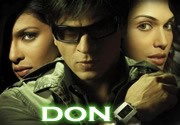
Don
Synopsis:
Shah Rukh Khan adjusts his blazer in the middle of a Bangkok alleyway and you can already tell the contacts are bothering him. It is a small thing, but it bugged me from the first frame, that slight watery blink he has whenever the camera catches his eyes at a forty-five degree angle. Reminds me of Tom Cruise in Collateral, minus the grey wig and the actual malice, though Khan tries his absolute level best to fill that gap with sheer velocity. Farhan Akhtar had a mountain to climb when he decided to remake the 1978 Amitabh Bachchan classic, mostly because the original sat in the cultural attic of every Indian household like some untouchable deity that nobody was actually allowed to touch. If I'm honest, the whole thing felt like an unnecessary exercise in glossy nostalgia when it was first announced, smelling faintly of corporate calculus and vanity. Yet the machinery of this production grinds forward with such greasy efficiency that you stop resisting around the twenty-minute mark and just let the synth-heavy bass rattle your teeth.
Akhtar directs with the kind of kinetic, hyper-stylized polish that defined urban Indian cinema in the middle of the decade, leaning heavily on drone shots of Kuala Lumpur that make the city look like a motherboard dipped in blue food coloring. The screenplay, co-written with his sister Zoya, takes the structural skeleton of the Salim-Javed original and twists the final reel into a pretzel that leaves half the audience blinking in the dark during the credits. It’s smarter than it needs to be, dodging the trap of a direct shot-for-shot remake by introducing a double-switch that relies entirely on audience memory of the source material. The pacing occasionally stumbles over its own slickness, dragging through the middle portions where Arjun Rampal has to look intensely troubled by a laptop screen, but the action choreography by Ousep Chan keeps the pulse rate artificially high. You get car chases through multi-level parking structures that were clearly filmed on a generous budget and edited by someone with a serious caffeine addiction.
Then there is Khan himself, pulling double duty as the ruthless syndicate boss and the gullible street dancer from Mumbai who gets pulled into Interpol's messy orbit. He plays the villain with a cigarette permanently glued to his lower lip and a smugness so thick you could scrape it off the screen with a butter knife, yet his version lacks the gravelly menace that made the original Don genuinely frightening to watch as a kid. He is too clean, too aware of his own reflection in the lens, posing even when he is supposed to be bleeding out on a concrete floor. Priyanka Chopra steps into the Helen role with a fierce, athletic energy that makes her action sequences genuinely thrilling, though her dialogue delivery occasionally dips into a strange, breathy register that feels like she is trying to audition for a perfume commercial in slow motion. Kareena Kapoor pops up for roughly fifteen minutes to look miserable in various shades of leather and does her best with a character written strictly as collateral damage for the plot.
The supporting cast does heavy lifting without ever getting a moment to breathe, particularly Om Puri, whose weary Interpol officer looks like he'd rather be anywhere else in Malaysia than listening to Khan deliver lines about global crime networks. Isha Koppikar wears a lot of sharp tailoring and kicks people with ruthless precision, while Chunkey Pandey drops in for a bizarre cameo that feels imported from an entirely different movie shot on a different continent. The cinematography by Mohanan uses a desaturated palette that turns every nightclub and warehouse into a monochromatic fever dream of steel and shadow, drowning the actors in pools of neon blue and sickly amber. Shankar-Ehsaan-Loy's soundtrack remains the beating heart of the enterprise, even if the remix of "Khaike Paan Banaras Wala" is hammered into your brain three separate times across two hours just to make sure you remember what decade this whole thing is referencing. It’s loud, aggressive, and engineered to sell ringtones to teenagers in suburban multiplexes.
Hindi movies have long struggled with the mid-budget crime thriller, usually falling back on cheesy melodrama or embarrassing local imitations of Hollywood cop flicks that look like they were shot on a camcorder behind a petrol station. This production avoids that particular trap by simply throwing enough money at the screen until it looks expensive enough to justify its own existence, even when the logic of the plot starts dissolving into utter nonsense involving microchips and secret floppy disks. The themes are entirely superficial, trading any actual engagement with criminality or state corruption for slick montages of passport stamps and private jets landing on rainy runways at midnight. Nobody in this universe has an internal life beyond the next plot twist or the next costume change, which makes it an exhausting watch if you are looking for anything resembling human behavior.
By the time the twins and the doubles and the dead bodies start sorting themselves out in the final ten minutes, the exhaustion has settled deep into your bones and you stop caring about who is actually running the syndicate. It is not a great film by any stretch of the imagination, but it moves fast enough that you don't have time to dwell on its structural idiocies while the popcorn is still warm in your lap. Akhtar proves he can wrangle a massive commercial star without completely losing his grip on visual geography, a rare feat in an industry that usually dissolves into chaotic close-ups the second a fight scene breaks out. The small continuity errors—like Chopra’s holster magically shifting hips between one wide shot and the next—keep pulling you out of the fantasy, reminding you that this is just a very expensive dress-up party for people with great teeth.