

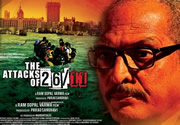
The Attacks Of 26-11
Synopsis:
The Attacks Of 26/11, narrates the Bombay joint commissioner of police’s (Nana Patekar) account of the terrorist attacks on the city on 26th November, 2008. The film begins with the joint commissioner recounting the events of the dreaded night in front of a committee. It ends with the hanging of the sole terrorist, Ajmal Kasab (Sanjeev Jaiswal), who was arrested. The film shows in graphic detail the killings by terrorists at several landmarks of Bombay including Leopold Café, Taj Mahal Hotel, CST Station, Cama Hospital and other places. It also shows how Ajmal Kasab was arrested and ultimately the end that awaited him.
Rommel Rodrigues has penned a story based on true-life incidents and his screenplay is fast-paced and engrossing. While some scenes are chilling and leave the audience staring in disbelief, there are others which evoke claps. Instances of the clapworthy scenes are the one in which constable Tukaram Ombale (Sunil Jadhav) lays down his life but does not let go of Ajmal Kasab; the one in which the joint police commissioner lectures Ajmal Kasab in the morgue where dead bodies of his (Kasab’s) terrorist-friends are lying; the one in which he forces Kasab to embrace a dead body; the one in which he hurls the choicest abuses at Kasab; the one in which he explains to Kasab what is written in the Quran; etc.
Ram Gopal Varma loves a wide-angle lens pointed upward from a rain-slicked pavement, and if I'm honest, it's a visual tick that stopped working around the time of Sarkar. Yet here it is again in The Attacks Of 26-11, framing the CST station carnage with the kind of low-angle theatricality that feels less like documentary realism and more like a graphic novel drawn by someone who read too much Frank Miller in the nineties. You sit there waiting for the camera to settle, for the frame to stop tilting for no discernible narrative reason, but Varma wants every single frame to scream importance even when the dialogue is just doing basic functional heavy-lifting. It makes the opening twenty minutes feel exhausting in a way that has nothing to do with the actual tragedy unfolding on screen, shoving style down your throat before you have even had a chance to process the geography of the attacks.
Nana Patekar plays Joint Commissioner Rakesh Maria—though the character is named Raosaheb Ingle here for reasons that probably had to do with legal clearances or avoiding too much direct journalism—and he spends most of the runtime sitting across a table, drinking endless cups of tea while explaining to a judicial commission exactly how a bunch of teenagers from Karachi hijacked a trawler and turned South Mumbai into a shooting gallery. Patekar has this wonderful, weary rasp that he deploys like an old bludgeon, leaning back in his chair with his eyes half-closed as if the sheer stupidity of human cruelty has finally given him a migraine he will never shake. He doesn't do much acting in the traditional sense; he just occupies the space with a cynical, bone-deep fatigue that feels entirely earned, carrying the talky framing device on his shoulders because the script gives him precious little else to do besides state historical facts we already memorized from news channels.
Then you have Sanjeev Jaiswal as the primary militant, a fictionalized stand-in for Ajmal Kasab who grins too broadly and barks his lines with a theatrical menace that belongs on a regional stage rather than in a tight, digital feature. Jaiswal isn't terrible, exactly, but the direction forces him to hit the exact same note of gleeful fanaticism over and over until the character ceases to be a human being and flattens into a cartoon villain straight out of a nineties action potboiler, which feels like a strange and unfortunate creative choice for a project attempting to grapple with a real-world trauma that still rawly haunts the national consciousness. Hindi movies have always struggled to humanize their antagonists without accidentally turning them into anti-heroes, but Varma swings so violently in the opposite direction that he strips every drop of psychological complexity out of the killer, leaving behind a snarling cipher who demands you hate him with every fiber of your being.
The pacing of the middle section is where the whole enterprise starts to wobble on its axis, bouncing haphazardly between the sterile committee room where Patekar is holding court and jittery, poorly lit reconstructions of the assaults at the Leopold Cafe and the Taj Mahal Palace hotel. There is a specific background extra playing a terrified waiter who appears in at least three separate carnage sequences running in the exact same direction while clutching a white napkin, and once you spot him, you can never unsee him, which completely shatters the illusion of chaotic, documentary-style immediacy that the frantic editing is trying so desperately to manufacture. It's a small thing, sure, but these little mechanical shortcuts accumulate until the horror of the event starts to feel staged, reduced to a series of jump cuts and squib hits that remind you constantly of the budget constraints and the studio lot.
Amar Mohile’s score deserves a special mention here for being perhaps the most relentlessly intrusive piece of musical accompaniment put on celluloid since the worst excesses of Ram Gopal Varma’s own nineties output, hammering every single emotional beat with an orchestral shriek that leaves no room for silence or genuine dread. When Patekar looks out over the burning harbor, the strings swell so loud you can barely hear his dialogue, as if the composer didn't trust the audience to understand that a burning city at night is a sad thing without a choir wailing in D-minor underneath it. It drains the tension right out of the room, replacing quiet horror with generic cinematic noise that wouldn't feel out of place in a supernatural thriller or a low-budget cop drama.
Comparisons to Paul Greengrass’s United 93 are inevitable, and frankly, they do no favors to this movie, exposing just how much more disciplined a filmmaker needs to be when staging modern terrorism without resorting to cheap melodrama or jingoistic speechifying. Greengrass understood that silence and procedural friction are far more terrifying than close-ups of weeping victims or villains shouting ideological slogans into the night air. Varma, by contrast, cannot resist the urge to editorialize through his characters, giving Patekar long, unbroken monologues about the nature of jihad and the failure of intelligence agencies that sound less like a weary cop talking and more like an editorial column published in the Sunday papers the week after the tragedy.
Yet there is a weird, stubborn honesty in how unvarnished the ugliness gets once the film abandons its half-hearted attempts at a police procedural and simply watches the carnage unfold with a blunt, unblinking stare that refuses to look away from the gore. When the bullets start flying inside the hospital, the chaos feels genuinely disorienting, capturing that strange, numb shock of ordinary people realizing their world has ended while they were just trying to buy tickets or visit a sick relative in a ward. It’s not a pleasant viewing experience, nor is it a particularly sophisticated one, but it captures the sheer, grinding numbness of that night better than any polite, sanitized prestige drama ever could have managed.
The supporting cast features Ganesh Yadav as a beleaguered local cop who gets caught in the initial crossfire at the train station, and his sweaty, trembling panic feels far more grounded than anything the main antagonist is given to chew on during his long, ranting stretches in custody. Yadav plays fear without vanity, his voice cracking and his eyes darting toward exits that are already blocked, grounding the hysteria in something recognizable and small. Bollywood movies have spent decades perfecting the heroic police officer who walks in slow motion through explosions, so seeing an actor play a copper who simply wants to hide behind a wooden bench and pray for his wife is refreshing, even if the surrounding direction insists on framing him against burning ticket counters.
By the time the credits begin to roll over a stark, black screen devoid of musical catharsis, you feel battered rather than enlightened, scraped raw by a piece of filmmaking that cares far more about provoking a visceral reaction than fostering any kind of mature reflection on the geopolitical forces that put those guns in those kids' hands in the first place. It remains an awkward, lurching, deeply flawed artifact of a national trauma, refusing to offer easy answers while simultaneously indulging in the cheapest possible cinematic tricks to keep your pulse elevated.